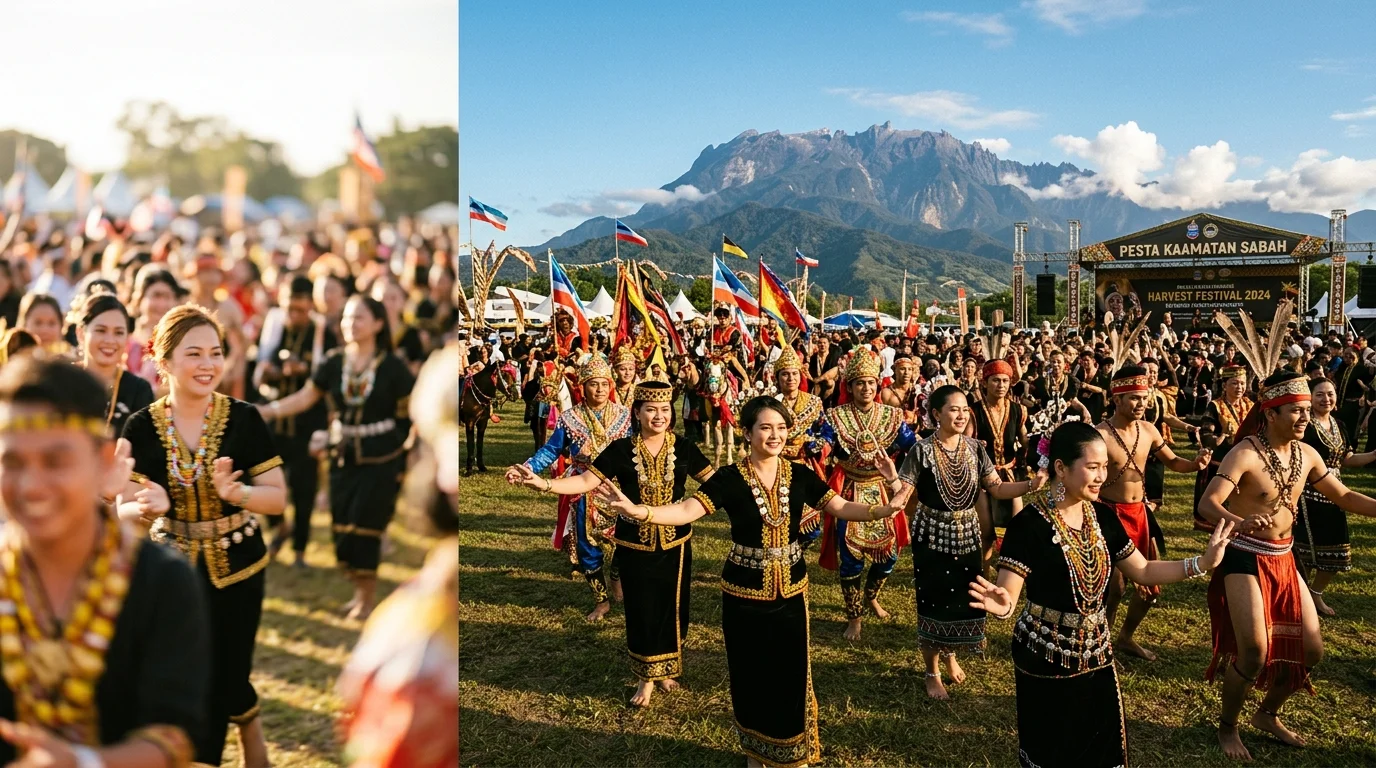
Ethnic Groups of Sabah: 40+ Peoples, 80+ Languages
How many ethnic groups are there in Sabah?
Sabah officially recognises over 40 ethnic groups, with linguists and anthropologists documenting more than 200 sub-ethnic groups and dialects. Together, Sabah's communities speak approximately 80 distinct languages — making this Malaysian state one of the most linguistically diverse regions on Earth relative to its population of 3.4 million.
This is not a modern phenomenon. Sabah's diversity is the product of tens of thousands of years of Austronesian migration, indigenous community divergence across isolated mountain valleys and river systems, and centuries of maritime trade routes connecting Borneo to the Philippines, Java, China, and the Arabian Peninsula. The result is a living mosaic unlike anywhere else in Southeast Asia.
The 2024 population data from Malaysia's Department of Statistics (DOSM) estimates Sabah's Bumiputera population at 89.1% of the state total — the highest proportion of any Malaysian state. Within this Bumiputera population, the breakdown is: Kadazan/Dusun (31.7%), Bajau (26.5%), Murut (5.1%), and other Sabah Bumiputera (36.7%). Non-Bumiputera groups including Chinese, Malay, Indian, and non-citizen communities make up the remaining 10.9%.
The non-citizen population — estimated at 810,000 or roughly 23.7% of Sabah's total — is the highest of any Malaysian state and includes significant stateless communities such as the Bajau Laut, Suluk, and Filipino migrant workers.
Who are the major ethnic groups in Sabah?
Sabah's major ethnic groups can be broadly grouped by their historical origins and geographic distribution: indigenous highland and coastal peoples (Kadazan-Dusun, Murut, Rungus, Lundayeh), maritime peoples (Bajau, Bajau Laut, Suluk/Tausug), immigrant communities (Chinese, Malay), and cross-border communities (Bajau Laut, Suluk, Filipino).
Indigenous Peoples of Sabah
The Kadazan-Dusun — Sabah's largest indigenous group — are primarily rice farmers of the west coast and interior highlands. The Bajau span two very different worlds: the horse-riding "Cowboys of the East" on the west coast, and the sea-nomadic Bajau Laut of Semporna's waters. The Murut are interior forest peoples of the Tenom, Keningau, and Nabawan districts, known for the spectacular Lansaran trampoline dance. The Rungus, concentrated around Kudat at the Tip of Borneo, maintain some of the most intact traditional longhouse cultures in Sabah, famed for intricate beadwork. The Lundayeh (called Lun Bawang in Sarawak and Brunei) are a small but deeply Christian community in Sipitang, divided by colonial borders across three countries.
Maritime and Migrant Communities
The Suluk (Tausug) carry the historical legacy of the Sulu Sultanate — one of Southeast Asia's most powerful maritime polities — and remain concentrated on Sabah's east coast. The Chinese community, predominantly Hakka in origin, arrived from Guangdong province from 1883 onwards under the British North Borneo Chartered Company and built much of Sabah's agricultural and commercial economy. Sabah Malay (Melayu Sabah) is distinct from Peninsular Malay — many Sabah Malays have Bajau, Brunei, or Kadazan ancestry who adopted Islam and Malay cultural identity over generations.
Ethnic group population breakdown (2024)
Based on 2020 Census data and 2024 DOSM estimates, Sabah's population of approximately 3.5 million breaks down as follows:
| Ethnic Group | Est. Population | % of Sabah | Main Districts |
|---|---|---|---|
| Kadazan-Dusun | ~700,000–800,000 | ~19–30% | Penampang, Tuaran, Ranau, Tambunan, Kota Belud |
| Bajau (West Coast) | ~500,000+ | ~14–17% | Kota Belud, Tuaran, Putatan, Papar |
| Chinese | ~310,000 | ~9% | Kota Kinabalu, Sandakan, Tawau |
| Suluk / Tausug | ~300,000+ (many undocumented) | ~9%+ | Semporna, Lahad Datu, Sandakan, Tawau |
| Other Bumiputera | ~600,000 | ~17% | Interior, East Coast |
| Malay (Sabah) | ~200,000 | ~5.8% | KK, Papar, Beaufort, Sipitang, Kudat |
| Murut | ~112,900 | ~3.2% | Tenom, Keningau, Nabawan, Pensiangan |
| Filipino (documented) | ~120,000 | ~3.5% | Semporna, Sandakan, Tawau |
| Indonesian (documented) | ~150,000 | ~4.4% | Tawau, East Coast |
| Bajau Laut (stateless) | ~28,000 (est.) | ~0.8% | Semporna, Mabul, Omadal |
| Rungus | ~80,000 | ~2.3% | Kudat, Kota Marudu, Banggi Island |
| Lundayeh / Lun Bawang | ~10,000–15,000 | ~0.4% | Sipitang, Tenom |
| Other (Indian, mixed, etc.) | ~50,000 | ~1.4% | Various |
Sources: Malaysia DOSM 2020 Census, DOSM Demographic Statistics Q3 2024, UNHCR Malaysia estimates. Note: Non-citizen populations (810,000+) are partially counted; actual figures may be higher for undocumented communities.
An estimated 23.7% of Sabah's population are non-citizens — the highest proportion of any Malaysian state. Many are documented workers from Indonesia and the Philippines. A significant portion, including Bajau Laut and Suluk communities, are stateless — lacking citizenship in any country — and have lived in Sabah for generations.
What languages are spoken in Sabah?
Sabah has approximately 80 distinct indigenous languages across four major language families. This makes it one of the most linguistically rich regions in Southeast Asia, comparable to parts of Papua New Guinea. The full language guide covers all major languages in detail.
| Language Family | Key Languages | Approx. Speakers | Status |
|---|---|---|---|
| Dusunic (Kadazan-Dusun cluster) | Kadazan, Dusun, Bundu-Liwan, Lotud, Kimaragang | 500,000+ | Vulnerable (UNESCO) |
| Sama-Bajau cluster | Bajau West, Sama Dilaut, Bajau Sandakan | 600,000+ | Vulnerable to Endangered |
| Murutic cluster | Tagal Murut, Timugon, Paluan, Beaufort Murut | 100,000+ | Vulnerable (pilot teaching programmes from 2024) |
| Paitanic | Rungus, Momogun | 80,000+ | Vulnerable |
| Tausug / Suluk | Bahasa Sug (Tausug) | 250,000+ | Relatively stable |
| Lundayeh / Lun Bawang | Lundayeh, Lun Bawang | 10,000–15,000 in Sabah | Vulnerable |
| Chinese (Sinitic) | Hakka (dominant), Cantonese, Hokkien, Mandarin | 300,000+ | Hakka declining; Mandarin stable via schools |
| Malay | Sabah Malay dialect, Standard Bahasa Malaysia | Widespread (lingua franca) | Official language |
What are the major cultural festivals by ethnic group?
Sabah's ethnic diversity means virtually every month has a significant cultural festival somewhere in the state. The calendar below covers the major recurring celebrations tied to specific ethnic communities.
| Festival | Ethnic Group | Typical Date | Location | What Happens |
|---|---|---|---|---|
| Pesta Kaamatan | Kadazan-Dusun | May 30–31 (public holiday) | Statewide; main event at KDCA Penampang | Harvest thanksgiving; Unduk Ngadau beauty pageant; Sumazau dance; Lihing rice wine |
| Regatta Lepa | Bajau Laut | Late April / June (annual) | Semporna waterfront | Decorated lepa boat competition; traditional dances; beauty queen contest. 2026: late April. |
| Tamu Besar Kota Belud | West Coast Bajau | Usually November | Kota Belud | Famous horse parade; ceremonially dressed horsemen; tamu (market) with local goods |
| Irau Rayeh Lundayeh | Lundayeh | May (biennial in Sabah) | Sipitang | Harvest thanksgiving; traditional music, dances, food; 16th edition held May 2024 |
| Pesta Tanglung | Chinese | 15th day, 8th lunar month (Sep/Oct) | Kota Kinabalu (Central Park) | Mid-Autumn lantern parade; mooncakes; lion dance performances |
| Chinese New Year | Chinese | January/February (lunar) | Kota Kinabalu, Sandakan, Tawau | Parades, lion dances, firecracker night; major public celebration involving all races |
| Kalimaran | Murut | May | Tenom, Keningau | Murut harvest festival; Lansaran trampoline dance; traditional games and food |
| GATA Festival | Lundayeh, Murut, Kedayan, Brunei Malay | May (biennial) | Sipitang | Gasing (top spinning) competition; Tamu Besar; traditional costumes from multiple groups |
What makes Sabah's diversity unique in Malaysia?
Sabah's ethnic diversity is qualitatively different from Peninsular Malaysia's. On the Peninsula, diversity largely means three major communities — Malay, Chinese, Tamil Indian — who arrived at different points in the colonial era. In Sabah, the diversity is pre-colonial, rooted in tens of thousands of years of indigenous divergence, and involves dozens of distinct peoples who have lived side by side since before recorded history.
Several factors make Sabah's case exceptional:
Linguistic richness: 80 languages in a state of 3.4 million is extraordinary by any global standard. Papua New Guinea has ~840 languages for 10 million people; Sabah's density approaches that level. The Sama-Bajau language family alone branches into dialects so distinct that West Coast Bajau and Bajau Laut speakers cannot fully understand each other.
Cross-border identities: Colonial borders cut through living ethnic territories. The Bajau Laut live across Malaysian, Filipino, and Indonesian waters. The Lundayeh are split between Sabah, Sarawak, Brunei, and Kalimantan. The Suluk/Tausug's historical homeland is the Sulu Archipelago in the Philippines — yet hundreds of thousands live in Sabah. These are not immigrant populations but people whose ancestral territories pre-date the nations that now claim them.
Rapid change: Sabah's ethnic landscape is shifting faster than at any point in its history. Young Kadazan-Dusun are urbanising and shifting to Malay and English. Bajau Laut sea nomads are being forced onto land. Murut languages are being introduced in primary schools to prevent extinction. The 2024 Mabul Island demolitions displaced hundreds of Bajau Laut families from their over-water homes. What visitors see today is both an ancient culture and a community in the middle of profound transformation.
A landmark 2018 study published in Cell by Ilardo et al. found that Bajau Laut people carry a genetic variant of the PDE10A gene that gives them naturally enlarged spleens — about 50% larger than neighbouring land-dwelling groups. The spleen releases oxygen-rich red blood cells during dives, extending breath-hold time. Bajau Laut free divers can reach depths of 60 metres and hold their breath for up to 13 minutes. This is one of the only documented cases of human genetic adaptation to an occupational lifestyle.
In-depth guides for each ethnic group
Each guide below covers the group's origins, population, language, traditional culture, food, festivals, and current situation — sourced from academic research, DOSM data, and Sabah government publications.
Kadazan-Dusun
Kaamatan harvest festival, Sumazau dance, Hinava, Lihing rice wine
Read guide → ~500,000+Bajau (West Coast)
Horse parade at Tamu Besar, "Cowboys of the East", Kota Belud culture
Read guide → ~28,000 (stateless)Bajau Laut
Sea nomads of Semporna, free diving genetics, Regatta Lepa, displacement crisis
Read guide → ~112,900Murut
Lansaran trampoline dance, Magunatip bamboo dance, Rundum Rebellion
Read guide → ~80,000Rungus
Bavanggazo longhouse, pinakol beadwork, Mongigol dance, Tip of Borneo
Read guide → ~300,000+Suluk / Tausug
Sulu Sultanate heritage, Pangalay dance, stateless crisis, east coast culture
Read guide → ~10,000–15,000Lundayeh / Lun Bawang
Cross-border identity, Christianity, Irau Rayeh festival, Long Pasia
Read guide → ~310,000Chinese in Sabah
Hakka heritage, Tuaran Mee, Sandakan history, kopi tiams, 1883 pioneers
Read guide → ~200,000Melayu Sabah
Brunei Malay heritage, Bisaya, Kedayan, coastal trading culture
Read guide → 80+ languagesLanguages of Sabah
Full language map, 4 language families, UNESCO endangered status, preservation efforts
Read guide →