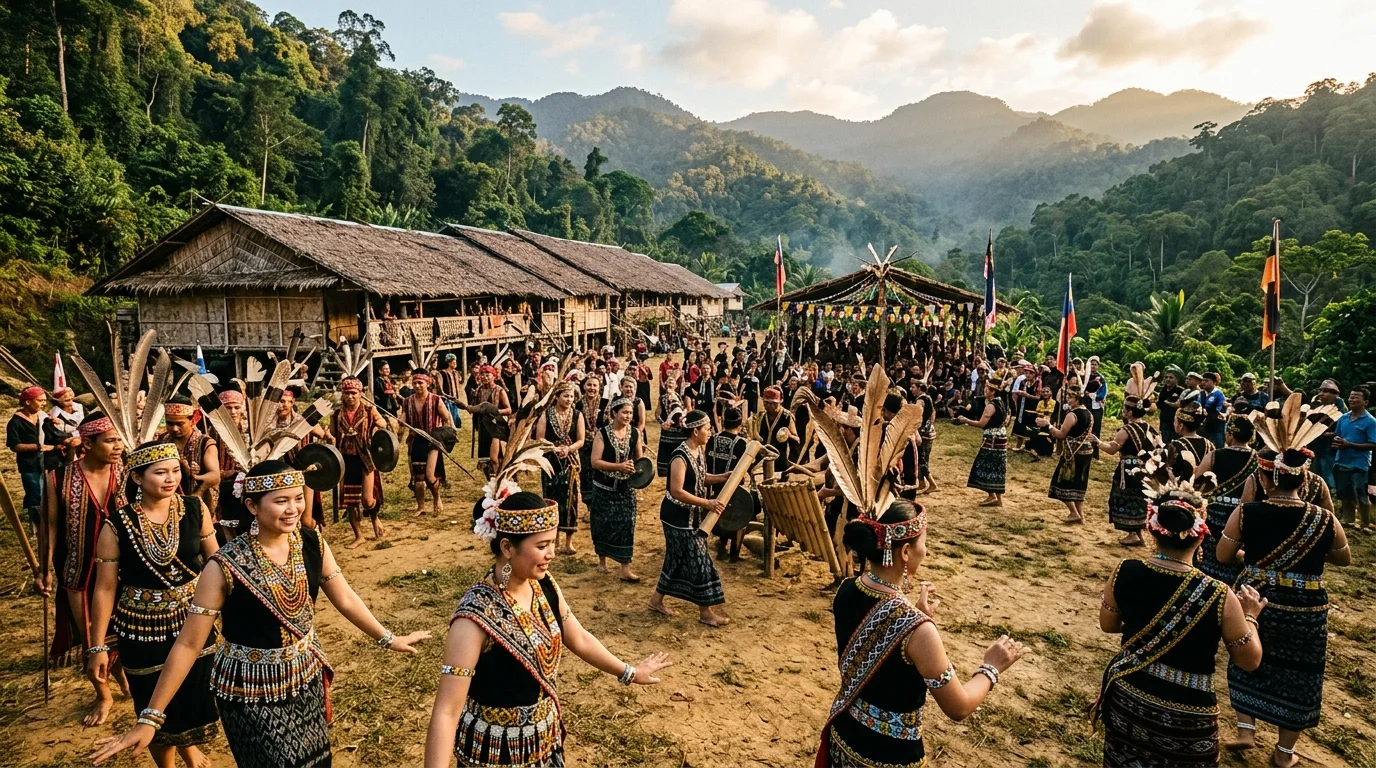
Lundayeh of Sabah: Borneo's Cross-Border Highland People
Who are the Lundayeh?
The Lundayeh are one of Borneo's earliest indigenous peoples — a highland agricultural community who have lived in the interior river valleys and forested hills of southwestern Sabah, Sarawak's Lawas district, Brunei's Temburong district, and the adjacent Kalimantan highlands for millennia. Their total population across all four territories is estimated at 60,000–80,000, with approximately 10,000–15,000 living in Sabah, primarily in Sipitang district and the Long Pasia valley.
The Lundayeh are among the smallest of Sabah's major indigenous groups but carry a distinctive cultural identity: among the earliest mass Christian converts in Borneo (from the 1930s), known for exceptional hospitality and community cohesion, and defined by a cross-border identity that colonial borders have divided but never fully severed. A Lundayeh family in Sipitang may have cousins in Lawas (Sarawak), relatives in Brunei, and extended family in Kalimantan — and they move between these territories for weddings, festivals, and trade with relative ease.
What is the difference between Lundayeh and Lun Bawang?
"Lundayeh" and "Lun Bawang" refer to the same ethnic group — the name used depends entirely on which side of the colonial border you are on. In Sabah and Kalimantan, they are called Lundayeh. In Sarawak and Brunei, the same people are called Lun Bawang.
The linguistic difference is minimal: both names derive from the same language and mean essentially "inland people" or "people of the hills." The two communities use mutually intelligible dialects of the same Lundayeh/Lun Bawang language. They share the same origin stories, the same agricultural and longhouse traditions, the same Christian faith (adopted at roughly the same time through the same Borneo Evangelical Mission), and the same harvest festival calendar.
The distinction matters politically and administratively — Lun Bawang in Sarawak are a recognised native (bumiputera) community under Sarawak's separate Native Customary Rights land law system, while Lundayeh in Sabah fall under Sabah's different legal framework. Culturally, however, the two communities see themselves as one people divided by a historical accident of colonial border-drawing.
The Lundayeh/Lun Bawang are a textbook case of colonial border disruption. When the British drew the boundary between Sabah and Sarawak, and when the Indonesian-Malaysian border was demarcated following Konfrontasi in the 1960s, the Lundayeh's ancestral territory was divided among four nations. The same family might hold Malaysian (Sabah), Malaysian (Sarawak), or Indonesian citizenship depending only on which side of a colonial-era line their grandparents happened to be on.
Where in Sabah do the Lundayeh live?
In Sabah, the Lundayeh are primarily concentrated in Sipitang district on the south-west coast — a quiet, relatively little-visited district bordering Brunei and the Sarawak border. Within Sipitang, communities are found both in the coastal areas near Sipitang town and deep in the interior, particularly the Long Pasia valley — one of Sabah's most remote and pristine communities, accessible only by 4WD on rough forest roads.
Smaller Lundayeh communities also exist in Tenom district (Interior division), where they overlap culturally and geographically with Murut communities. The Sipitang-Tenom corridor is the Lundayeh heartland in Sabah.
| Location | Population | Notes |
|---|---|---|
| Sipitang district (coastal and lowland) | Majority of Sabah Lundayeh | Mix of traditional and modern lifestyles; accessible by road from KK (~3 hrs) |
| Long Pasia valley (deep interior) | Several hundred families | Remote; traditional longhouse communities; stunning rainforest setting; 4WD only |
| Tenom district | Small communities | Overlap with Murut cultural zone |
| Lawas (across border in Sarawak) | Larger Lun Bawang population | Cross-border family connections frequent; same people, Sarawak name |
What cultural traditions do the Lundayeh have?
Lundayeh traditional culture is shaped by centuries of hill paddy (dry rice) farming, forest living, and longhouse community life in some of Borneo's most biodiverse highland rainforest.
Swidden agriculture (ladang): The Lundayeh are traditionally swidden (slash-and-burn) hill paddy farmers — cutting small areas of jungle, burning the cleared vegetation, and planting hill rice in the resulting ash-fertilised soil. After one or two seasons the plot is left fallow and a new area cleared, allowing the forest to regenerate. This practice, when done at traditional community scales, is ecologically sustainable and has maintained Borneo's interior forest communities for thousands of years.
Traditional longhouses: Some Lundayeh communities in Long Pasia maintain traditional longhouse communities — the same concept as the Rungus vinataang, with multiple family units sharing a single extended building and communal veranda. Long Pasia longhouses are built from local hardwood and are architecturally simpler than the elaborate Iban longhouses of Sarawak but function according to the same communal principles.
Ulung Buayeh (crocodile cutting ritual): One of the Lundayeh's distinctive traditional ceremonies, symbolising bravery and the conquering of feared forces. The ritual involves a ceremonial "cutting" of a symbolic crocodile and is tied to rites of passage and community protection ceremonies.
Music: Traditional Lundayeh music uses the sape (a long-neck lute more widely associated with Sarawak's Orang Ulu peoples but shared with the Lun Bawang/Lundayeh), the mouth harp, and traditional bamboo instruments. Christian choral singing has become another important musical tradition — many Lundayeh churches are known for their strong choir communities.
GATA Festival: A biennial festival in Sipitang featuring gasing (traditional top spinning) competitions and Tamu Besar market — co-hosted with Murut, Kedayan, and Brunei Malay communities of the district.
What is the Irau Rayeh Lundayeh festival?
The Irau Rayeh Lundayeh (IRLS) is the annual Lundayeh cultural festival in Sabah, organised by the Sabah Lundayeh Cultural Association (PLKS). "Irau" means festival or celebration in Lundayeh. The festival is held in Sipitang district, typically in May, and serves as the primary showcase of Lundayeh cultural identity — traditional music and dance, traditional costumes, handcraft exhibitions, traditional food, and sports competitions.
The 16th Irau Rayeh Lundayeh was held on 24–25 May 2024, themed "Preserving Culture, Creating Unity, Preserving Harmony". The event highlighted the tensions and opportunities of maintaining cultural identity in a rapidly modernising world — combining traditional performances with modern sports competitions and cultural exhibitions aimed at engaging younger generations.
On the Sarawak side, the equivalent event is the Irau Aco Lun Bawang — typically held in Lawas, Sarawak. The 38th edition in 2025 was held June 1–3 in Lawas, drawing 3,000 participants and 20,000 visitors from across Borneo. This is one of the largest ethnic festivals in Sarawak. Many Sabah Lundayeh cross the border to attend, reinforcing the sense of pan-Lundayeh/Lun Bawang cultural unity that transcends the political border.
What religion do the Lundayeh follow?
The Lundayeh are near-universally Christian — making them one of the most thoroughly Christianised indigenous communities in Borneo. Christian conversion came through the Borneo Evangelical Mission (BEM) starting in the 1930s, with mass conversion following in the 1940s–1950s. The BEM, working across the Lun Bawang/Lundayeh territory on both sides of the colonial border, achieved conversion rates that were remarkable by any missionary standard.
Several theories have been proposed for the rapid and thorough conversion: pre-existing Lundayeh social cohesion meant community decisions spread quickly; BEM missionaries learned the Lundayeh language deeply and worked with rather than against community leaders; and the communities were undergoing significant social disruption (from colonial rule, Japanese occupation, and post-war instability) that made a new spiritual framework attractive.
Today, the Sidang Injil Borneo (SIB) — the church that emerged from the BEM — is the primary Lundayeh church across Sabah and Sarawak. SIB churches in Sipitang are among the most active community institutions in Lundayeh society. Easter and Christmas are major community events involving inter-village gatherings, feasting, and traditional music alongside Christian worship.
Traditional Lundayeh animist beliefs — a spirit world involving forest, river, and agricultural spirits — have been largely displaced by Christianity, though some cultural practices (particularly agricultural ceremonies tied to the rice cycle) retain traces of pre-Christian cosmology in syncretic form.
What language do the Lundayeh speak?
The Lundayeh language (also written as Lundayeh, Lun Daye, or Lun Dayeh) is an Austronesian language in the Malayo-Polynesian branch. It is mutually intelligible with Lun Bawang (the Sarawak/Brunei name for the same language), with only minor dialectal differences. The combined speaker population across all four territories is approximately 25,000–40,000, with 10,000–15,000 in Sabah.
UNESCO classifies Lundayeh as Vulnerable. The language is maintained strongly in community settings, particularly in Sipitang and Long Pasia. SIB church services in Lundayeh communities often use the Lundayeh language, which has significantly helped language maintenance — unlike some communities where church shifted entirely to Malay or English.
The Lundayeh Bible was translated and published through collaborative effort between SIB, BEM successor organisations, and the Lundayeh/Lun Bawang community — a major project that standardised the written language and created a substantial body of Lundayeh-language text. This written tradition (modest by global standards) provides an anchor for language preservation that purely oral languages lack.