Murut People of Sabah: Lansaran Dance & Interior Culture
Who are the Murut people of Sabah?
The Murut are Sabah's third-largest indigenous group, numbering approximately 112,900 (2020 census) and representing around 5.1% of Sabah's Bumiputera population as of 2024-2025. They are the indigenous forest peoples of Sabah's interior — inhabiting the rugged hill country, river valleys, and deep jungle of the Interior and West Coast divisions. Before British colonial rule ended the practice in the late 19th century, the Murut were widely feared as headhunters; today they are celebrated for the Lansaran (a jaw-dropping trampoline dance), their deep knowledge of medicinal forest plants, and their role in one of Sabah's most significant anti-colonial uprisings.
The name "Murut" is itself contested — it is a Malay term meaning "hill people," applied from outside rather than chosen by the communities themselves. Many individuals prefer their specific sub-group identity: "I am Tagal" or "I am Timugon," rather than the umbrella Murut label. The Murut Cultural Association (MACA) works to build unified Murut political and cultural identity while respecting this sub-group diversity.
Where do the Murut live in Sabah?
The Murut are concentrated in Sabah's Interior Division — primarily the districts of Tenom, Keningau, Nabawan, Pensiangan, and Sipitang, with smaller communities in Beaufort and pockets of Sandakan and Tawau divisions. Their territory follows the major river systems of the Interior: the Padas, Sapulut, and upper Kinabatangan rivers. Some Murut communities extend into Sarawak and Kalimantan, as their ancestral territory predates national borders.
The Murut district of Nabawan has the highest concentration in Sabah — approximately 88.8% Murut ethnicity, the most ethnically concentrated district in Sabah. Tambunan district to the north (predominantly Kadazan-Dusun) marks the approximate cultural boundary between these two great interior peoples.
| District | Murut Presence | Main Sub-groups |
|---|---|---|
| Nabawan | ~88.8% of district population | Tagal, Okolod, Nabai |
| Tenom | Major presence; pilot Murut language teaching (2024) | Tagal, Timugon |
| Keningau | Significant presence alongside Kadazan-Dusun | Tagal, Beaufort Murut |
| Sipitang | Coastal Murut; Muslim sub-groups here | Beaufort Murut, Paluan |
| Pensiangan | Remote interior; traditional longhouse communities | Tagal, Sulungai, Peluan |
What is the Lansaran trampoline dance?
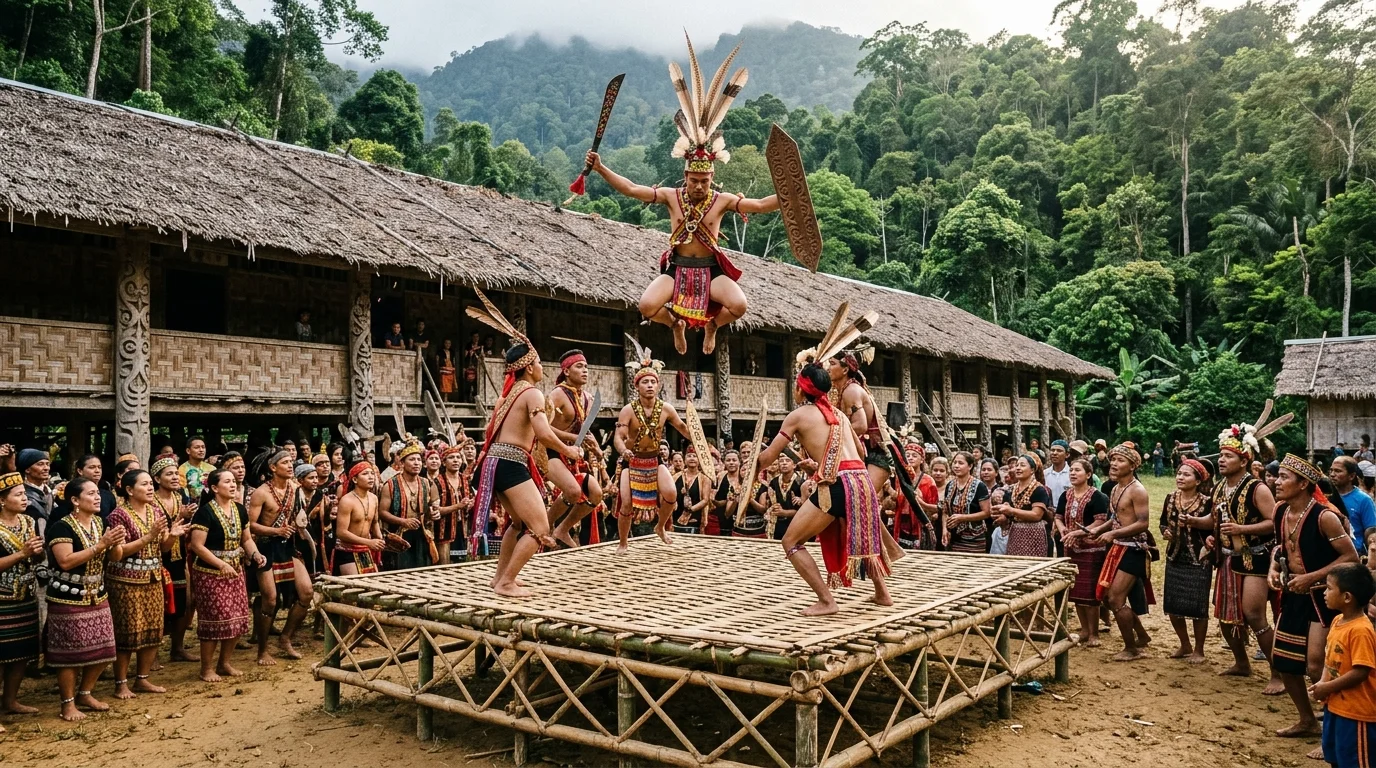
The Lansaran is one of the most spectacular traditional performances in all of Sabah — and possibly in all of Borneo. It involves a large platform suspended by ropes from a wooden frame, functioning as a giant trampoline. Performers jump on the platform in coordinated sequences, bouncing up to 3–4 metres in the air, performing acrobatic manoeuvres, and landing in synchronised patterns to the rhythm of a gong ensemble.
Constructing a Lansaran requires significant community effort. The platform is built from long bamboo poles and hardwood planks, lashed together with rattan. Ropes suspend it above the ground with calibrated tension to maximise bounce. The finished platform may be 4–5 metres long and 2 metres wide, capable of launching multiple performers simultaneously.
Historically, the Lansaran was performed to celebrate successful headhunting raids and abundant harvests — the height of the jump was said to demonstrate the community's vitality and prowess. Today it is performed at the Kalimaran harvest festival, KDCA events, Sabah Fest, and cultural performances for visitors. It remains uniquely Murut — no other ethnic group in Malaysia has anything comparable.
The Lansaran is performed at the annual Kalimaran harvest festival in Tenom and Keningau (typically May), at Sabah Fest (usually April/May), and at the Sabah State Museum cultural performances. The Murut Cultural Association in Tenom can assist with arrangements for groups wishing to visit a traditional performance. It is not commonly performed outside of Murut-area events.
What is the Magunatip bamboo dance?
The Magunatip — also known as the Bamboo Clap Dance — is the Murut's other famous performance tradition and one of Sabah's most widely performed dances. Two (or more) pairs of long bamboo poles are held horizontally and clapped together rhythmically, while one or more dancers weave and step between the poles, timing their footwork to avoid getting trapped when the poles clap shut.
The dance requires agility, precise timing, and nerves of steel — a moments hesitation and the poles will clap down on the dancer's feet. The poles clap progressively faster as the music builds, increasing the difficulty. Skilled dancers perform at high speed with elaborate footwork, crossing their feet, spinning, and jumping while the poles thunder together around them.
The Magunatip is widely believed to be related to the Philippine Tinikling — the national folk dance of the Philippines, which uses an identical bamboo-pole format. This connection reflects the deep historical and cultural links between the Murut and Philippine indigenous communities across the Sulu Sea. The Magunatip is now performed across Sabah at festivals, schools, and cultural events and is frequently the dance visitors first learn when attending Sabah cultural shows.
Did the Murut really practice headhunting?
Yes — headhunting was a documented, culturally significant practice among the Murut before British colonial suppression. But the practice was not random violence; it was embedded in a complex ritual, spiritual, and social system.
In Murut traditional belief, a human head carried spiritual power. Heads were required for certain rites of passage — in some sub-groups, a young man could not marry or be considered a full adult warrior until he had taken a head. The skull of an enemy was believed to protect the longhouse, ensure good harvests, and transfer the victim's strength to the community. Heads were kept in specially constructed net baskets hung in the longhouse rafters, where they were regularly "fed" offerings of food and tobacco.
The British North Borneo Chartered Company (NBCC) systematically suppressed headhunting from the 1880s, deploying armed police and imposing severe penalties. The pacification process took decades in the deep interior. By the 1920s, the active practice had largely ended. However, ceremonial and cultural references to headhunting — in dance, oral poetry, and decoration — survived and remain part of Murut heritage expression today.
The Murut are not unique in this history — the Dayak of Sarawak, the Kenyah, Kayan, and many other Borneo peoples practiced headhunting. In context, it was a feature of intertribal warfare and spiritual life across much of Borneo's interior for centuries.
What was the Rundum Rebellion?
The Rundum Rebellion of 1915–1916 was the final major armed Murut uprising against British North Borneo Chartered Company rule — and one of the most significant anti-colonial events in Sabah's history. It was led by the Murut headman Ontoros Antanom (also known as Antanom bin Duris), who rallied communities across the Interior against the NBCC's escalating demands: tax collection, land confiscation, and prohibition of traditional practices including headhunting.
The rebellion centred on the Rundum area in present-day Nabawan district. Ontoros Antanom organised hundreds of Murut warriors who launched coordinated attacks on NBCC outposts, trade stations, and personnel. The NBCC responded with a large military expedition that ultimately overwhelmed the Murut resistance. Over 200 Murut were killed in the NBCC's military response; Ontoros Antanom himself died during the suppression.
Today, Ontoros Antanom is recognised as a Sabah state hero — his image appears on commemorative materials and he is taught in Malaysian schools as a symbol of indigenous resistance to colonial injustice. The Rundum Rebellion is considered alongside the Mat Salleh Rebellion (1894–1900) as one of the two defining acts of indigenous resistance in Sabah's colonial history. See the full Rundum Rebellion history page for complete details.
What do the Murut eat and drink?
Murut cuisine is rooted in the forest and river — wild game, river fish, jungle vegetables, sago, and fermented foods. Traditional Murut communities in the interior still hunt wild boar, deer, and birds using blowpipes and traditional traps.
Tapai Murut: The Murut's most iconic drink — a thick, strongly fermented glutinous rice or tapioca wine. More intensely fermented than the Kadazan-Dusun's Lihing, it has a deeper, more complex flavour and higher alcohol content. Tapai is served in a large communal jar from which guests drink through long bamboo straws — topping up the jar with water between servings. It is central to Murut hospitality; refusing Tapai when offered is considered impolite.
Ambuyat: A thick, glutinous sago starch dish — colourless, tasteless, and gelatinous on its own, but eaten by twirling onto a bamboo fork and dipping into sharply flavoured sauces (sour, spicy, or fish-based). Ambuyat is also eaten by Brunei Malay and coastal Lundayeh communities, suggesting a shared sago-forest cultural zone across Sabah's interior and western coast.
Wild boar: Despite many Murut converting to Christianity, wild boar remains an important food for non-Muslim Murut communities — hunted, smoked, and preserved. Forest ferns (midin), bamboo shoots, tapioca leaves, and river fish complete the traditional diet.
Botanical medicine: The Murut have an exceptionally deep knowledge of medicinal forest plants. Each community traditionally had its own herbalist who could treat conditions from diarrhoea and diabetes to wounds and fever. This botanical knowledge — accumulated over centuries of forest living — is increasingly at risk as younger generations urbanise.
What are the Murut sub-groups?
The Murut comprise 29 recognised sub-ethnic groups, each with their own dialect, slightly distinct customs, and geographic homeland. The major sub-groups are:
| Sub-group | Location | Notes |
|---|---|---|
| Tagal | Tenom, Keningau, Nabawan, Pensiangan | Largest and most widely spoken; Tagal Murut is the most documented dialect |
| Timugon | Tenom district | Distinct dialect; Tenom primary schools piloting Timugon language teaching from 2024 |
| Paluan | Interior districts | Smaller sub-group; some overlap with Tagal territory |
| Beaufort Murut | Beaufort, Sipitang (coast-adjacent) | Muslim majority; more integrated with Malay coastal culture than interior Murut |
| Nabai | Nabawan area | Interior group; closely related to Tagal |
| Okolod | Nabawan/Pensiangan border | Small group; highland forest lifestyle |
| Sulungai | Pensiangan | Remote interior community; among the most traditional Murut sub-groups |
What language do the Murut speak?
The Murut speak a cluster of related Murutic languages — a branch of the Austronesian family. The various Murut dialects form a continuum: some adjacent sub-groups can understand each other partially, while others are not mutually intelligible at all. Tagal Murut is the most widely spoken and best documented, functioning as a partial lingua franca across Interior Murut communities.
UNESCO classifies all Murut languages as Vulnerable. The total speaker count across all Murut dialects is estimated at 100,000+, but urban migration and language shift toward Sabah Malay is reducing usage among younger generations.
A significant development in 2024: 10 primary schools in Tenom district became pilot projects for teaching the Timugon Murut language as part of Malaysia's ethnic language preservation initiative. This is the first formal inclusion of a Murut language in Sabah's public school curriculum and represents a meaningful step toward reversing language loss. Advocates hope the programme will be expanded to other Murut-majority districts.
What religion do the Murut follow?
The majority of Murut today are Christian — primarily Protestant (Sidang Injil Borneo / SIB) or Roman Catholic. Christian conversion began in the 1950s through SIB and Catholic missions and accelerated rapidly through the 1960s–1980s. Today, Christianity is deeply integrated into Murut community life.
Before Christianity, Murut traditional religion was animist — a complex spirit world involving rovod (spirits of the dead), nabalu (the spirit of Mount Kinabalu), and a cosmology of forest, river, and agricultural spirits. The bobolizan (shaman) mediated between the human and spirit worlds. Elements of this traditional cosmology persist in syncretic form alongside Christianity in many communities.
A minority of Murut — particularly those in Sipitang and Beaufort districts near the coast — are Muslim. These are often communities that had more sustained contact with Malay and Brunei coastal culture. The Muslim Murut are sometimes culturally and linguistically distinct from their inland Christian counterparts.
The Murut also celebrate Kalimaran — their own harvest festival (equivalent to the Kadazan-Dusun Kaamatan) held in May in Tenom and Keningau. Kalimaran features the Lansaran performance, Tapai consumption, traditional games, and cultural displays.