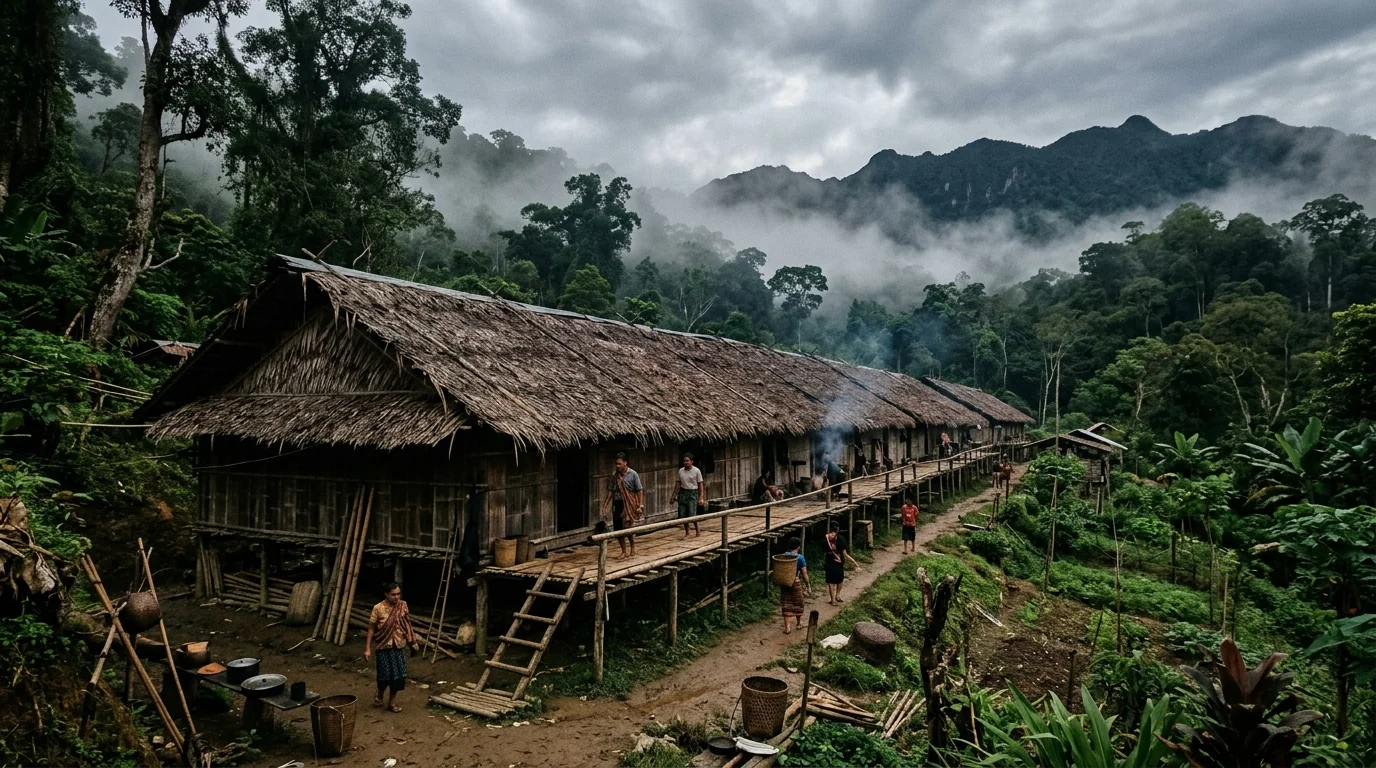
Rundum Rebellion (1915-1916) — The Murut Uprising Against British Rule
What was the Rundum Rebellion?
The Rundum Rebellion was an armed uprising by the Murut people of the interior of North Borneo (now Sabah) against British colonial rule, occurring from 1915 to 1916. It was led by Ontoros Antanom, a respected Murut warrior, and involved approximately 1,000 fighters. The rebellion was centred in the Rundum area, a settlement in the mountainous interior of what is now the Tenom and Keningau districts, but it represented a broader Murut response to decades of British colonial policies that the community found increasingly oppressive.
The Rundum Rebellion stands as the last major organised indigenous armed resistance against British colonial authority in North Borneo before the region's independence in 1963. Unlike earlier uprisings that were scattered or led by individual chiefs, the Rundum Rebellion represented a coordinated, multi-community response to colonial exploitation. After its suppression, British colonial control over the interior became consolidated, and no subsequent large-scale armed challenges to colonial authority emerged until the push for independence decades later.
The rebellion's significance lies not only in its military dimensions but in what it represented politically: the refusal of the indigenous interior populations to accept the terms imposed by foreign colonial administration without resistance. The uprising demonstrated that the Murut people, despite their geographic isolation in the interior, were aware of and opposed to the broader system of colonial exploitation that affected all Sabahans.
Who was Ontoros Antanom?
Ontoros Antanom was a Murut warrior of the Rundum area whose name has become synonymous with indigenous Sabahan resistance to colonialism. Unlike many resistance leaders who rose to prominence through political connections or literacy, Ontoros was primarily known as a skilled warrior within the Murut tradition. He came from a family of standing within the Murut community and was respected for his martial prowess and his understanding of the interior terrain.
Little is definitively recorded about Ontoros Antanom's early life, reflecting the limited documentation the British kept on interior indigenous leaders. What is clear is that by the early 1910s, he had emerged as a voice of opposition to British policies and had begun building networks of support across multiple Murut settlements. He combined traditional Murut leadership authority — based on skill, lineage, and demonstrated courage — with a clear-eyed understanding of why British policies were harmful to his people.
Ontoros Antanom was not a conventional military strategist or a trained officer. His leadership style reflected Murut cultural traditions of warrior consensus-building rather than top-down hierarchy. He operated through consultation with other respected fighters and leaders rather than issuing unilateral orders. This approach, while perhaps less efficient than centralised military command, was more aligned with Murut social structures and helped him build broad support for the uprising across ethnically and geographically diverse Murut communities.
By contemporary accounts, Ontoros Antanom was described by British observers as intelligent, eloquent in his own language, and capable of articulating sophisticated critiques of British colonialism despite his lack of formal education. He was killed during the British suppression of the rebellion, though the exact circumstances remain somewhat obscure in historical records. His legacy transformed him from a living warrior into a martyr and symbol of indigenous resistance.
What caused the Murut people to rebel?
The Rundum Rebellion did not emerge spontaneously but was the product of decades of accumulating grievances against British North Borneo Chartered Company (BNBCC) rule. The primary causes centred on taxation, forced labour, and cultural suppression — policies that the Murut people found increasingly intolerable.
The most immediate trigger was the imposition and enforcement of a poll tax on the interior population. The British colonial authorities had decided to extend direct taxation to the interior Murut settlements in order to increase revenue and create a more "orderly" administrative system. To the Murut, this tax represented an unprecedented extraction of resources and an assertion of colonial power into spheres previously left relatively autonomous. The tax was not merely financial — it symbolised the loss of independence and subjection to foreign rule.
Conscription for forced labour projects was equally resented. The British began demanding labour contributions from interior communities for infrastructure projects, public works, and company-related activities. The Murut people were effectively conscripted — required to perform labour service for the colonial administration — without compensation or choice. This practice disrupted traditional subsistence activities, removed men from their communities for extended periods, and was perceived as slavery under a different name.
Underlying these economic grievances was a cultural dimension. The British were actively attempting to suppress traditional Murut practices, including the tradition of "kesemaran" — warrior revenge raids and inter-community conflicts that were part of Murut culture. While outsiders viewed these practices as "headhunting" and barbaric, they were integral to Murut social and warrior culture. British suppression of these traditions was seen as an attack on Murut identity itself, not merely a security concern.
Additionally, there was growing awareness that British rule was consolidating control over Murut lands. The colonial administration was surveying and claiming territory that the Murut had inhabited and used for generations. Indigenous land rights were being displaced in favour of company interests and colonial property concepts. The cumulative effect — loss of land, loss of autonomy, loss of cultural practices, and extraction of wealth — created the conditions for organised resistance.
What happened during the Rundum Rebellion?
The Rundum Rebellion began in 1915 with coordinated action among multiple Murut settlements. Fighters attacked colonial administration posts, military installations, and symbols of British authority in the interior. The uprising was not a single battle but a series of engagements across the mountainous interior. Ontoros Antanom worked to coordinate attacks across multiple districts and settlements, attempting to create a unified movement rather than scattered incidents.
The fighters used traditional weapons supplemented by firearms that had been obtained through various means. Spears and parangs (traditional machetes) remained the primary weapons, but the rebels had also acquired rifles and ammunition through trade, theft, or capture. The knowledge of interior terrain was a crucial advantage — the Murut fighters knew the mountains and forests intimately, while British military forces were operating in unfamiliar landscape where supply lines were difficult to maintain.
Initial rebel successes led to widespread participation and raised hopes for victory. Communities across the interior saw the uprising as a genuine opportunity to expel British colonial rule or at least force a renegotiation of the terms of colonial domination. Support spread rapidly through Murut networks, and the rebellion attracted fighters not only from Rundum itself but from surrounding settlements and districts.
However, the rebels faced a critical challenge: the British had superior firepower, more disciplined military forces, and better logistical capacity. By early 1916, the tide had shifted decisively against the Murut forces. British military expeditions, supported by local police forces and collaborating indigenous units, began systematic operations to suppress the uprising. The coordination that Ontoros Antanom had achieved through consensus-building proved difficult to maintain in the face of military setbacks.
As the rebellion fragmented, fighters fell back into the mountains. Some continued resistance in scattered, guerrilla-like actions, but the unified rebellion as a coherent military force was broken. By mid-1916, the British had achieved decisive military control, though pockets of resistance continued sporadically.
How did the British suppress the rebellion?
The British response to the Rundum Rebellion was harsh and methodical. After initial surprise at the scale and coordination of the uprising, British colonial authorities deployed military forces into the interior with explicit instructions to crush the rebellion comprehensively. The suppression involved both direct military engagement and what would now be recognised as collective punishment.
British forces, including military units and local police, conducted multiple punitive expeditions into the rebel strongholds. These expeditions targeted Murut settlements that had participated in or supported the uprising. The British pursued a strategy of destroying the material base of the rebellion — they burned villages, destroyed crops and food stores, and targeted the infrastructure that supported the rebels. The destruction of crops and granaries was particularly devastating because it meant that the rebel forces would face starvation and the civilian population would suffer severe food shortages.
This policy of economic destruction served dual purposes: it was a direct military strategy to undermine the rebels' ability to sustain resistance, and it was a form of collective punishment designed to break the will of communities to continue supporting the uprising. Civilians, including women and children, suffered immensely from the destruction of their agricultural resources. The British justified this harsh approach as necessary to restore order and crush the rebellion decisively.
Ontoros Antanom was killed during the suppression operations, though historical records differ on the exact circumstances. Some accounts suggest he died in direct combat with British forces; others indicate he was captured and executed. Regardless of the precise manner of his death, his killing effectively decapitated the leadership of the uprising. Without Ontoros' coordinating role and symbolic authority, the rebellion rapidly lost coherence.
By 1916, the British had regained full military control over the interior. The physical destruction of rebel capability, combined with the death or capture of key leaders, ended the organised uprising. However, the memory of the rebellion and British suppression methods remained deeply embedded in Murut cultural memory, influencing indigenous political consciousness for decades to come.
How does the Rundum Rebellion compare to the Mat Salleh Rebellion?
Both the Mat Salleh Rebellion and the Rundum Rebellion represent indigenous Sabahan resistance to colonialism, yet they occurred in different eras and had distinct characteristics. The table below compares these two foundational moments of Sabah's resistance history:
| Characteristic | Mat Salleh Rebellion | Rundum Rebellion |
|---|---|---|
| Dates | 1897-1900 | 1915-1916 |
| Leader | Mat Salleh (Paduka Mathalimau) | Ontoros Antanom |
| Ethnic Group | Bajau (coastally-based Islamic people) | Murut (interior highland indigenous people) |
| Primary Grievance | Territorial conquest, loss of traditional authority | Taxation, conscription, cultural suppression |
| Number of Fighters | 1,000-2,000 (estimates vary) | Approximately 1,000 |
| Geographic Area | Coastal regions, particularly around Lahad Datu | Interior mountains (Rundum, Tenom, Keningau areas) |
| Colonial Authority Response | Military campaigns; Mat Salleh killed in 1900 | Punitive expeditions; Ontoros Antanom killed in 1916 |
| Outcome | Rebellion crushed; British consolidated coastal control | Rebellion crushed; British consolidated interior control |
| Legacy Status | National hero; widely commemorated; statues, monuments | Regional hero; commemorated in Murut communities; less mainstream recognition |
The Mat Salleh Rebellion occurred during an earlier phase of British colonisation (1897-1900), when the BNBCC was still establishing control. Mat Salleh's uprising was fundamentally about resistance to the loss of traditional Bajau sultanate authority and territorial conquest. The rebellion was motivated by the loss of power and autonomy for a traditionally ruling group.
The Rundum Rebellion, occurring 15-18 years later (1915-1916), arose in a different context. By then, British colonial control was already established, and the rebellion was directed at the particular policies and extraction methods of consolidated colonialism. The Murut, as an interior highland people without pre-existing sultanate structures, were rebelling against direct exploitation rather than loss of historical authority.
Both rebellions were suppressed militarily, both leaders were killed, and both have been preserved as important memories in Sabah's struggle for independence. However, Mat Salleh has achieved greater national recognition and commemoration, while Ontoros Antanom remains more prominent in regional and academic memory. Both deserve equal recognition as symbols of Sabahan indigenous resistance.
How is Ontoros Antanom remembered today?
Ontoros Antanom is remembered as one of Sabah's important historical figures and a symbol of indigenous resistance against colonial exploitation. While he does not have the same level of mainstream national commemoration as Mat Salleh, his legacy remains powerful within Murut communities and among historians of Sabah. The Rundum Rebellion stands as testimony to the fact that even well-established colonial rule was not accepted without resistance.
Within the Murut community, Ontoros Antanom is remembered as a warrior hero who chose to resist oppression rather than accept colonial terms. Stories of the rebellion are transmitted through Murut cultural memory and represent a point of pride and connection to pre-colonial autonomy. His willingness to risk his life against overwhelming odds demonstrates the values of courage and resistance that remain culturally significant in Murut identity.
The Sabah Museum in Kota Kinabalu maintains historical records and exhibits related to the Rundum Rebellion and Murut resistance. Historians and researchers have studied the rebellion as an important example of indigenous resistance. Academic works on Sabah's history consistently include discussion of Ontoros Antanom and the Rundum Rebellion as key moments in the territory's path toward independence.
The rebellion also influenced how subsequent independence movements understood Sabah's history. The fact that indigenous Sabahans had consistently resisted foreign rule — whether through Mat Salleh in the 1890s, Ontoros Antanom in the 1910s, or Albert Kwok in the 1940s — created a historical narrative of resistance that became foundational to Sabah nationalism. Ontoros Antanom is part of this longer continuum of Sabahan resistance to external domination.
More broadly, the Rundum Rebellion represents an important lesson about colonial rule: even when colonial authority appears consolidated and militarily superior, subject peoples retain the capacity and will to resist. Ontoros Antanom and the Murut fighters of 1915-1916 demonstrated that resistance to exploitation is not limited to the initial moment of colonisation but can emerge decades into colonial rule when the accumulated weight of exploitation becomes too great to bear passively.
Frequently asked questions
Q Who were the Murut people and where do they live today?
Q Was Ontoros Antanom recognised as a national hero like Mat Salleh?
Q Were there any positive outcomes from the Rundum Rebellion?
Q How long did it take British forces to suppress the rebellion?
Q Are there any places I can visit to learn about the Rundum Rebellion?
Resources
- Wikipedia: Rundum Rebellion — Overview of the 1915-1916 Murut uprising
- Sabah Museum — Exhibits on indigenous Sabah history and colonial-era resistance
- Wikipedia: Mat Salleh Rebellion — Comparative context for indigenous Sabah resistance
- Sabah Tourism Board — Information on historical sites and cultural heritage in Sabah's interior