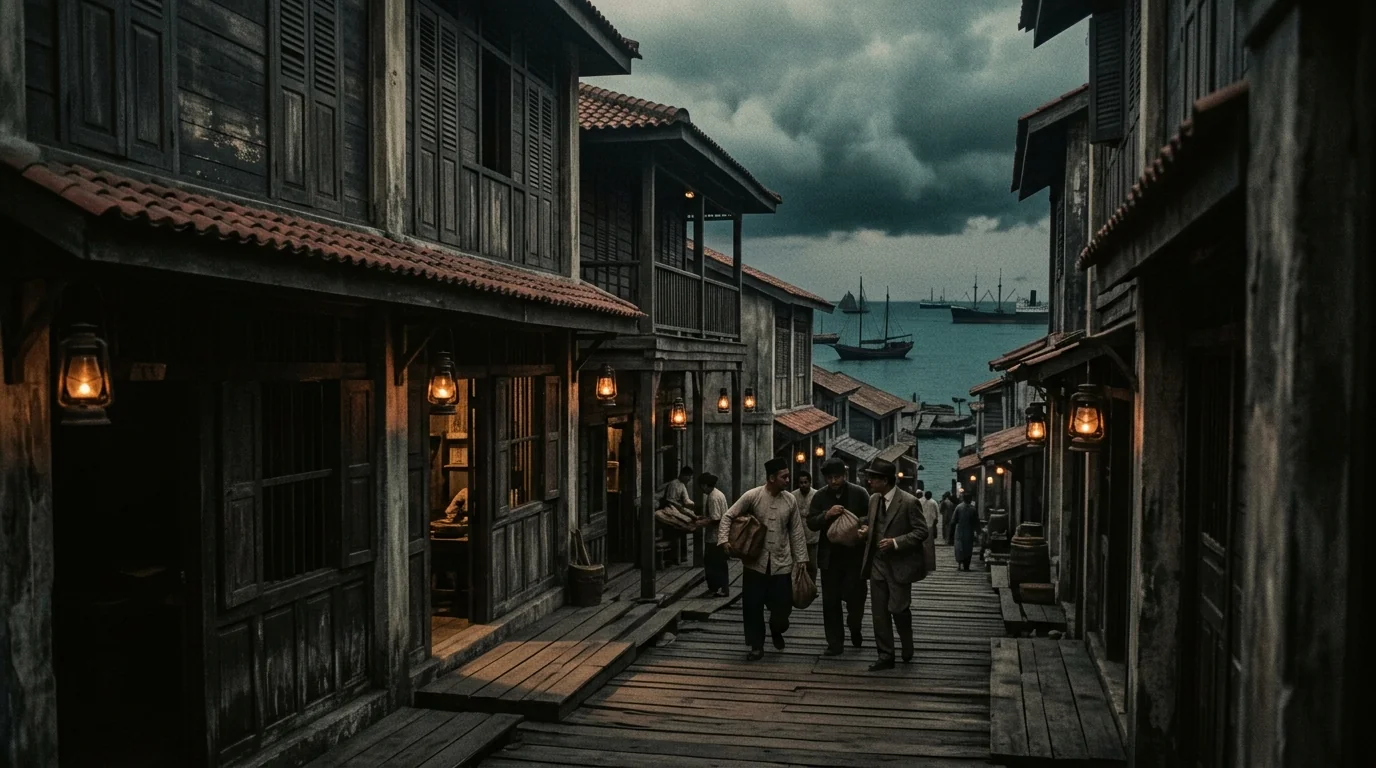
The Jesselton Revolt 1943: Sabah's Multi-Ethnic WWII Uprising
What was the Jesselton Revolt?
The Jesselton Revolt, also known as the "Double Tenth" for its date of October 9-10, 1943, was a spontaneous armed uprising against Japanese occupation in Jesselton (now Kota Kinabalu), the capital of North Borneo. Approximately 300 fighters from six different ethnic groups coordinated simultaneous attacks across the district in what would become Sabah's most significant resistance movement during World War II.
The revolt was remarkable because it was entirely civilian-led with no connection to British military command or communist organizations — a rarity in the Pacific War theater. The uprising was motivated purely by a desire to resist Japanese occupation and reclaim their homeland. The fighters, who called themselves the "Kinabalu Guerrillas," achieved temporary control of Jesselton and several surrounding districts before Japanese forces overwhelmed them within days. The subsequent reprisals killed an estimated 2,000 to 4,000 civilians and left nearly every village in affected areas destroyed.
Though the revolt itself lasted only days, its significance endures. It stands as a unique example of multi-ethnic cooperation forged in the crucible of war and remains central to how Sabahans understand their identity and their capacity for collective resistance. The Kinabalu Guerrillas are remembered as symbols of independence and self-determination in the face of foreign domination.
Who led the Kinabalu Guerrillas?
The Kinabalu Guerrillas were led by Albert Kwok Fen Nam, a local Chinese merchant with no military background who emerged as an unlikely resistance leader. Kwok operated a business network across Jesselton and the surrounding districts, which gave him connections and credibility across different ethnic communities. Unlike typical WWII military commanders, Kwok was not a trained soldier but rather a civilian entrepreneur driven by conviction and courage.
Kwok's leadership was collaborative and inclusive. He worked with representatives from multiple ethnic groups — Dusun, Suluk, Bajau, Chinese merchants like himself, Eurasian community members, and Sikh Indian traders. This was entirely his innovation; there was no external military structure dictating strategy or organization. Kwok understood that resistance to the Japanese would only succeed if it transcended ethnic lines and united people around a shared cause.
As a Chinese merchant, Kwok had also faced particular hardship under Japanese occupation. Chinese communities were subject to special taxes, forced labor, and restrictions on movement and trade. Kwok's personal experience of oppression, combined with his standing in the community and his merchant network, made him a natural organizer for resistance. His plan was bold and dangerous: coordinate simultaneous attacks across multiple districts, seize government and military installations, and establish a foothold from which to expand the uprising.
Albert Kwok Fen Nam would not live to see the end of the war. He was captured by the Japanese during the crackdown following the initial revolt and was executed. His name and legacy are inscribed at the Jesselton Revolt Memorial in Petagas, Kota Kinabalu, where he is honored as Sabah's symbol of civilian resistance and cross-ethnic leadership.
What made this uprising unique in WWII history?
The Kinabalu Guerrillas represented an entirely novel form of resistance in the Pacific War theater. Most WWII uprisings in Southeast Asia fell into two categories: organized military movements (like the Chinese Nationalist Army's resistance in occupied China) or communist-led insurgencies (like Ho Chi Minh's Viet Minh in Indochina). The Jesselton Revolt fit neither model.
The Kinabalu Guerrillas were entirely civilian-led. Albert Kwok Fen Nam had no military rank, no training, and no connection to the British military hierarchy that still nominally controlled Malaya and Singapore. The fighters themselves — merchants, farmers, fishermen, laborers, and craftspeople — were ordinary civilians. They had no formal officer corps, no supply lines from an external power, and no strategic coordination with other Allied forces. Everything about this uprising was homegrown and improvised.
The movement was also determinedly multi-ethnic at a time when colonial rule had emphasized ethnic divisions. Chinese, Dusun, Bajau, Suluk, Eurasian, and Indian communities came together under a single leadership. This was not merely tactical; it reflected a vision that resistance to occupation could unite people across ethnic and cultural lines. In a region where the British colonial system had institutionalized ethnic differences, this spontaneous cooperation was revolutionary.
Furthermore, the uprising had no ideological superstructure. Unlike communist-led resistance movements that sought to overthrow capitalism or establish a particular political system, the Kinabalu Guerrillas simply wanted the Japanese out. Their goal was restoration of sovereignty and self-determination — a purely nationalist impulse without broader ideological aims. This clarity of purpose and simplicity of mission gave the uprising its moral clarity.
Finally, the Kinabalu Guerrillas were unique in their complete independence from external military command. They did not receive orders from London, Chungking, or any other Allied power. They did not coordinate with other resistance movements. They acted solely on local knowledge, local leadership, and local determination. This independence meant they could move quickly and decisively, but it also meant they lacked the resources, training, and intelligence support that organized military forces possessed.
What happened on the night of 9-10 October 1943?
October 9-10, 1943 was the night everything changed. The Kinabalu Guerrillas had spent weeks coordinating through merchant networks, community leaders, and trusted contacts. Word had been carefully passed through ethnic networks: Chinese merchants, Dusun village leaders, Suluk fishermen, Bajau boatmen, Eurasian families, and Sikh traders. The time had come to act.
Coordinated attacks were launched simultaneously across multiple locations. In Jesselton itself, fighters moved against government and military installations. The Jesselton police station became a focal point of the uprising — fighters temporarily seized control and held it against initial Japanese response. Attacks also erupted in nearby districts: Api-Api, Tuaran, Menggatal, Sulaman, and Menambur all saw coordinated action by fighters determined to drive out the occupiers.
The fighters were armed with a mixture of weapons, mostly primitive by military standards. Many carried spears and parangs (traditional machetes) — tools of farming and fishing that could serve as weapons. A small number of firearms were available, probably acquired through underground networks or captured in early skirmishes. Compared to the Japanese military forces with machine guns, artillery, and organized command structures, the Kinabalu Guerrillas were radically outmatched in firepower.
Yet the uprising succeeded in seizing territory and holding positions for at least several hours. The element of surprise, the coordination of attacks across multiple locations, and the sheer determination of the fighters allowed them to achieve initial tactical success. Japanese forces in Jesselton and surrounding areas were taken aback. For a brief moment, it seemed possible that a local resistance could challenge occupation.
The initial phase of the revolt — the night of October 9-10 and the immediate aftermath — was the high point of the Kinabalu Guerrillas' military success. They held positions, maintained territorial control, and kept Japanese forces on the defensive. However, this window of advantage would close quickly once the Japanese military could concentrate forces and mount a coordinated counterattack.
How did the Japanese respond?
The Japanese military response to the Jesselton Revolt was overwhelming and brutal. Once initial shock wore off, Japanese commanders mobilized military forces far exceeding what the Kinabalu Guerrillas could withstand. Within days, the uprising was militarily crushed. Organized guerrilla forces were hunted down, captured, or killed.
But the Japanese response extended far beyond suppressing the military uprising. The occupation authorities viewed the revolt as a direct challenge to their rule and an intolerable act of defiance. To prevent future uprisings, they implemented a strategy of collective punishment and terror targeting entire communities suspected of supporting the rebellion.
| Ethnic Group | Role in Revolt | Communities Affected by Reprisals |
|---|---|---|
| Chinese | Leadership and merchant networks (Albert Kwok Fen Nam) | Jesselton Chinese quarter, interior trading communities |
| Dusun | Fighters and forest knowledge | Inland villages, agricultural communities |
| Bajau | Fighters, logistics, boatmen | Coastal settlements and fishing villages |
| Suluk | Fighters, coastal coordination | Island and coastal communities throughout district |
| Eurasian | Fighters and liaisons | Jesselton urban areas |
| Sikh Indian | Fighters and merchants | Trading communities in Jesselton and interior |
The Bajau and Suluk coastal communities bore the heaviest price. Because these maritime communities had participated actively in the initial attacks and maintained networks with other fighters, they became targets of systematic Japanese reprisal. Entire villages suspected of harboring rebels were destroyed. Adult males were executed. Homes were burned. Crops were destroyed. The coastal regions that had supplied logistics and fighters to the uprising were ravaged in retaliation.
The Japanese killed an estimated 2,000 to 4,000 civilians in the weeks and months following the initial revolt. This was not proportional retaliation but rather collective punishment designed to terrorize the population into absolute submission and to make any future resistance unthinkable. Families were killed for suspicion of sympathizing with the rebels. Entire communities were eliminated to send a message.
Albert Kwok Fen Nam, the leadership figure of the uprising, was captured and executed. Other leaders and significant participants were also hunted down and killed. The Japanese used captured members of the Kinabalu Guerrillas to identify other participants and to locate hideouts where fighters were sheltering.
Nearly every village in the regions that had participated in or sympathized with the uprising was left in ruins. The destruction was so complete that villages had to be rebuilt from scratch after the war. The human toll — killed, wounded, orphaned, displaced — was catastrophic. A civilization that had taken generations to develop was damaged in weeks of Japanese retribution.
How is the revolt commemorated today?
The Jesselton Revolt is commemorated at several significant sites and through annual observances. The most important is the Petagas War Memorial, located in Petagas, Kota Kinabalu. This memorial site is where many victims of the Japanese reprisals were executed. It has been gazetted as an official heritage site and serves as the primary place of remembrance for the Jesselton Revolt and its victims. The memorial bears inscriptions honoring the names of known fighters and the estimated thousands who perished in the reprisals.
The Jesselton Revolt Memorial itself, dedicated to the 300 fighters of the Kinabalu Guerrillas, preserves the names of leaders like Albert Kwok Fen Nam and other identifiable participants. The memorial has become a focal point for education about this unique moment in Sabah's history.
Annual commemorations are held, particularly around the anniversary date of October 9-10. These observances bring together descendants of participants, government officials, historians, and community members to remember the uprising and honor those who died. The commemorations emphasize the multi-ethnic nature of the resistance and celebrate the unity that transcended colonial-era divisions.
The Jesselton Revolt has become increasingly important in Sabah's understanding of its own identity and history. Unlike the Sandakan Death Marches, which are primarily an Australian-focused tragic memory, the Jesselton Revolt is a Sabahan story — a moment when local people of diverse backgrounds stood together against occupation. This has made it central to Sabahan national identity and historical consciousness.
Educational institutions throughout Sabah teach about the Jesselton Revolt and its significance. The uprising is presented not merely as a military episode but as a profound statement about the possibility of multi-ethnic cooperation and the power of collective resistance. For many Sabahans, Albert Kwok Fen Nam and the Kinabalu Guerrillas represent a historical moment when ordinary people achieved extraordinary courage and unity.
In recent decades, efforts have been made to more fully document the Jesselton Revolt through oral histories, academic research, and community preservation projects. Descendants of participants have shared family stories and memories. These grassroots efforts have enriched the historical record and ensured that the personal dimensions of the uprising — the individual stories of those who fought and those who died — are not lost to broader historical narratives.