Best Time to Visit Sabah — Month-by-Month Weather Guide
Quick Answer
Go in February or March for the best overall experience. February is the driest month of the year in Kota Kinabalu (78mm across about seven rainy days) and March is second driest (93mm). Both sit in the shoulder band for crowds, so you get the driest weather of the year without peak-season prices. If you're on a budget and flexible, April or May are the two quietest months of the year by visitor arrivals. September is not a quiet month — it is the second busiest of the year, ahead of both July and August. December is the busiest month by a wide margin.
February to May hits the sweet spot. February and March are the two driest months on the west coast; April and May are the two quietest of the year by visitor arrivals. Together they give the best combination of dry weather, space and price.
Month-by-Month Guide
| Month | Avg Temp | Rain | Crowds (2025 arrivals) | Top Activities | Rating |
|---|---|---|---|---|---|
| January | 24-33°C | Low (141mm) | Shoulder — 303,614 visitors | Islands, city and culture — dry and uncrowded | 7/10 |
| February | 24-33°C | Lowest (78mm) ★ | Shoulder — 305,032 visitors | Kinabalu climbing, whale sharks (dive visibility is poor) | 9/10 ★ |
| March | 24-33°C | Low (93mm) | Shoulder — 315,063 visitors | Climbing, wildlife, whale sharks peak (dive visibility is poor) | 9/10 ★ |
| April | 24-33°C | Low (123mm) | Quietest month — 253,992 visitors | Regatta Lepa festival, diving, whale sharks | 8.5/10 |
| May | 24-33°C | Moderate (212mm) | Quiet — 259,869 visitors | Kaamatan Festival, orangutans, all activities | 8/10 |
| June | 24-33°C | High (284mm) | Shoulder — 319,956 visitors | All activities available, orangutans, hiking | 8.5/10 |
| July | 24-33°C | High (288mm) | Peak — 362,287 visitors | Diving (30m+ visibility), rafting, hiking | 7.5/10 |
| August | 24-33°C | High (279mm) | Peak — 336,599 visitors | Excellent for all outdoor activities | 8/10 |
| September | 24-33°C | High (287mm) | Peak — 369,978 visitors, second busiest | All activities, good weather, but busy | 8.5/10 |
| October | 24-33°C | Highest (387mm) ⚠️ | Quiet — 267,279 visitors | Limited — wet season, but budget-friendly | 5.5/10 |
| November | 24-33°C | High (283mm) | Quiet — 271,480 visitors | Sipadan CLOSED (Nov 15-30), limited options | 4/10 |
| December | 24-33°C | Moderate (262mm) | Busiest month — 428,560 visitors | Christmas markets, diving improves late month | 6/10 |
Weather Patterns
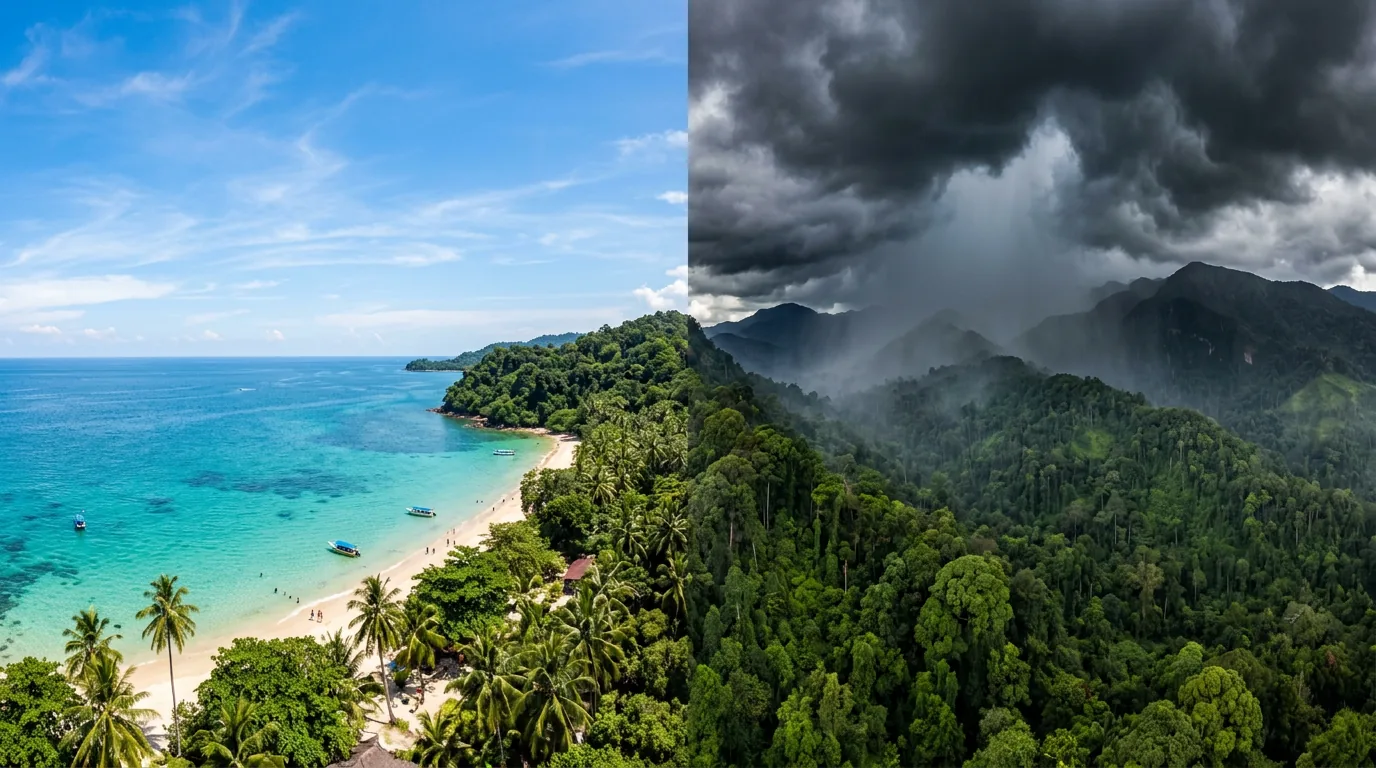
Sabah does not have one wet season and one dry season — the two coasts run on different calendars, and a guide that gives you a single answer is describing only one of them.
West coast — Kota Kinabalu, Papar, Kudat
The driest stretch is February to April, and February is the driest month of the year at 78mm across about seven rainy days. The wettest month is October at 387mm over 18 rainy days — about a third more than any other month. June to September are wetter than most visitors expect, at roughly 279 to 288mm each, but the rain usually arrives as an afternoon downpour rather than an all-day storm. Kota Kinabalu averages 2,718mm across about 147 rainy days a year.
East coast — Sandakan, Semporna, Lahad Datu
The east coast is the wetter of the two and peaks at the opposite end of the year. Its driest months are April and May, with May the driest at 138mm, and its wettest are December and January (449mm and 444mm). These are Sandakan figures — it is the only northeast coast station with published normals. Sandakan averages 3,220mm across the year, about 500mm more than Kota Kinabalu.
Which coast the monsoon hits
The Northeast Monsoon runs from November to March and hits the northeast coast hardest. Sandakan averages 449mm in December against Kota Kinabalu's 262mm: the northeasterly flow off the South China and Sulu Seas strikes Sabah's northeast-facing coast head on, and the Crocker Range is generally credited with sheltering the west. Tawau, in the southeast, barely follows the pattern at all. Kota Kinabalu's own wettest month, October, falls in the inter-monsoon rather than the Northeast Monsoon — which is why its driest stretch, February to April, sits inside the monsoon window. The Southwest Monsoon, late May to September, is drier across most of Malaysia but not in Sabah, which stays wet on typhoon-fed squall lines tracking past the Philippines.
Temperature & Humidity
- Coastal areas: 24-33°C year-round — nights around 24°C, days around 31-33°C. The change across the year is under 2°C; the swing between dawn and mid-afternoon is 7-8°C, several times larger
- Highlands (Kundasang): noticeably cooler, roughly 18-25°C by day and dropping towards 13°C at night. Research stations on Mount Kinabalu measure 15.4 to 23.8°C at Park headquarters (1,560m) and 6.7 to 13.8°C at Laban Rata (3,270m), falling about 0.55°C per 100m climbed. No official weather station publishes normals for Kundasang itself
- Humidity: high all year. Expect to feel sticky from dawn, washed clothes to take more than a day to dry, and glasses to fog the moment you leave air-conditioning. No official humidity normals are published for Sabah, so any precise percentage you see is modelled rather than measured
- Typhoons: Sabah lies outside the main typhoon track and direct hits are rare, but not unknown — Tropical Storm Greg made landfall at Kudat in December 1996.
West Coast (wettest October)
Heaviest rainfall: Oct-Nov peak — Kota Kinabalu averages 387mm in October, 283mm in November
Best workaround: Rain comes late afternoon; mornings usually clear
Activities: Kinabalu climbing affected, some tour cancellations possible
Diving visibility: Moderate, but Sipadan is still operational (until Nov 15)
East Coast (wettest Dec-Jan)
Extreme conditions: Sandakan averages 449mm in December and 444mm in January — its two wettest months
Critical closure: Sipadan diving CLOSED Nov 15-30 due to rough seas
Travel impact: Some river tours and boat activities may be cancelled
Best strategy: Avoid Nov if Sipadan diving is a must-do
Best Times for Activities
Mountain Climbing (Mount Kinabalu)
- Best: February-April — Sunniest, clearest views, highest success rate
- Good: May-September — Still excellent conditions, fewer crowds (April onwards)
- Avoid: October-November — Heavy rain, low visibility, difficult conditions
- Permit booking: 3-6 months in advance for peak season, 1-2 months for off-peak. Only 163 climbers per day allowed.
Diving (Sipadan, Tun Sakaran)
- Peak visibility: July-August — 30m+ underwater visibility, best conditions
- Good: April-December (except Nov 15-30)
- Worst: January-March — Poor visibility, not recommended
- Sipadan closure: November 15-30 — Park entirely closed due to rough seas
- Permit booking: Maximum 6 months in advance, 176 permits issued daily. Most dive operators can help arrange.
Whale Shark Watching
- Peak season: February-April — Highest encounter probability (70%+)
- Extended season: November-April — Still good chance outside peak
- Tours operate from: Semporna (daily tours available during season)
Orangutan Encounters
- Best: April-September — Peak fruit season, more sightings
- Peak: May-June — Fruiting season, easier encounters at Sepilok and Kinabatangan
- Available year-round: Mari Mari Cultural Village (semi-wild orangutans)
Pygmy Elephant Spotting
- Best: March-October — Dry season, better river visibility
- Peak: April-August — Highest sighting rates
- Tour option: Kinabatangan River 2-day trips; elephants more active in evening
Sea Turtle Nesting (Selingan Island)
- Green turtles: July-October — Peak nesting season
- Hawksbill turtles: February-April — Nesting season
- Year-round activity available — Hatchery visits possible any time
Birdwatching
- Best: May-October — Local fruiting season, resident birds active
- Also good: November-March — Migratory birds arrive (winter visitors)
- Hotspot: Kinabatangan River (most biodiverse birdwatching area)
Rafting (Kiulu River, Padas River)
- Best: February-September — Good water levels, stable conditions
- Avoid: October-November — Too much water, dangerous conditions
Firefly Watching
- Best visibility: Moonless nights between 7-10 PM
- Year-round available from Klias, Kinabatangan, and Weston
- Tip: Check lunar calendar before booking for optimal darkness
Events & Festivals
Kaamatan (Harvest Festival)
Dates: May 30-31, 2026 (celebrations throughout May). This is Sabah's biggest cultural festival, celebrating the Kadazan-Dusun rice harvest. Expect parades, traditional food, competitions, and cultural performances across the state. Hotels book up 2-3 months in advance — reserve early if interested.
Regatta Lepa
End of April (3-day event in Semporna). Traditional wooden boat racing festival with cultural performances and seafood markets. Smaller and less crowded than Kaamatan.
Chinese New Year
February 17-18, 2026. Celebrated especially in Kota Kinabalu and Sandakan. Night markets, lion dances, and special food offerings.
Hari Raya (Islamic Festival)
March 21-22, 2026 (Hari Raya Aidilfitri, end of Ramadan — Feb 17 to Mar 18, 2026). Holiday season with increased traffic and celebrations. Some restaurants may have modified hours.
Christmas
December 25 (Friday in 2026). Holiday crowds and festive atmosphere in Christian-majority areas and tourist spots. Good time for year-end travel if you enjoy holiday energy.
Sabah Jazz & Other Events
Check the Sabah Tourism Board website closer to your travel dates for cultural performances, food festivals, and sporting events. New events are added regularly.
Seasons Explained
Two different calendars both get called "seasons" in Sabah, and mixing them is what makes most advice contradictory. The crowd and price seasons below rank the twelve months of 2025 by recorded visitor arrivals. Weather seasons are a separate thing and differ by coast — see Weather Patterns above. A month can be quiet and wet, or busy and dry.
Peak — December, September, July, August
The four busiest months by visitor arrivals. December is the busiest of the year by a wide margin, and September is second — ahead of both July and August, which is the opposite of what most guides say. Expect the highest room rates, the tightest availability and the most competition for permits. Book flights and Kinabalu or Sipadan permits months ahead.
Shoulder — June, March, February, January
This is the smart traveller's window. Arrivals sit close to the annual average, so rates and availability are reasonable, and February and March are the two driest months of the year on the west coast. Near-peak weather without peak-season pressure.
Quiet — November, October, May, April
The four quietest months by arrivals. April and May are the quietest of all and still sit in the west coast's drier stretch, which makes them the best value of the year. October and November are quiet for a reason — October is the wettest month in Kota Kinabalu at 387mm, and Sipadan diving is closed 15-30 November.
If visiting during monsoon season (Oct-Nov), consider travel insurance that covers weather-related cancellations. Many tour operators offer free rebooking if activities are cancelled due to rain.
Long Weekends in Sabah 2026
Sabah observes all Malaysian national public holidays plus several state-specific holidays — including Good Friday, Kaamatan (Harvest Festival), and the Governor's Birthday. When a public holiday falls on a Friday or Monday, you get an automatic long weekend. Here are all the confirmed long weekends for 2026.
| Date | Day | Holiday | Scope | Long Weekend? |
|---|---|---|---|---|
| 1 Jan | Thursday | New Year's Day | National | — |
| 29–30 Jan | Thu–Fri | Chinese New Year (Day 1 & 2) | National | ⭐ 4-Day Weekend |
| 20–21 Mar | Fri–Sat | Hari Raya Aidilfitri (approx.) | National | 🌙 3+ Days |
| 3 Apr | Friday | Good Friday | Sabah only | ✝️ 3-Day Weekend |
| 1 May | Friday | Labour Day | National | ✅ 3-Day Weekend |
| ~26 May | TBD | Hari Raya Haji (approx.) | National | — |
| 30–31 May + 1 Jun | Sat–Sun–Mon | Kaamatan + King's Birthday | Sabah only + National | 🌾 3-Day Weekend |
| 16 Sep | Wednesday | Malaysia Day | National | — |
| 31 Aug | Monday | National Day (Merdeka) | National | 🇲🇾 3-Day Weekend |
| Oct TBD | Saturday | Sabah Governor's Birthday | Sabah only | — |
| 25 Dec | Thursday | Christmas Day | National | — |
* Islamic holiday dates are approximate — confirmed by JAKIM typically 1–2 days in advance. Highlighted rows are confirmed long weekends (3+ consecutive days off). Sabah-specific holidays do not apply to other Malaysian states.
Q What is the absolute best month to visit Sabah?
Q When is the cheapest time to visit?
Q Is it ever "too wet" to visit?
Q What months should I avoid?
Q Can I climb Kinabalu in the off-season?
Q When is the best time for diving at Sipadan?
Q Can I see whale sharks year-round?
Q What is Kaamatan and when is it?
Sources & References 5 sources
Last verified: 21 August 2026
Climate & Weather Data
- Malaysian Meteorological Department Official weather records and climate data for Sabah regions
- WMO World Weather Information Service — Kota Kinabalu and Sandakan Monthly rainfall, rain days and temperature normals supplied by the Malaysian Meteorological Department on the current 1991-2020 baseline, archived by NOAA NCEI