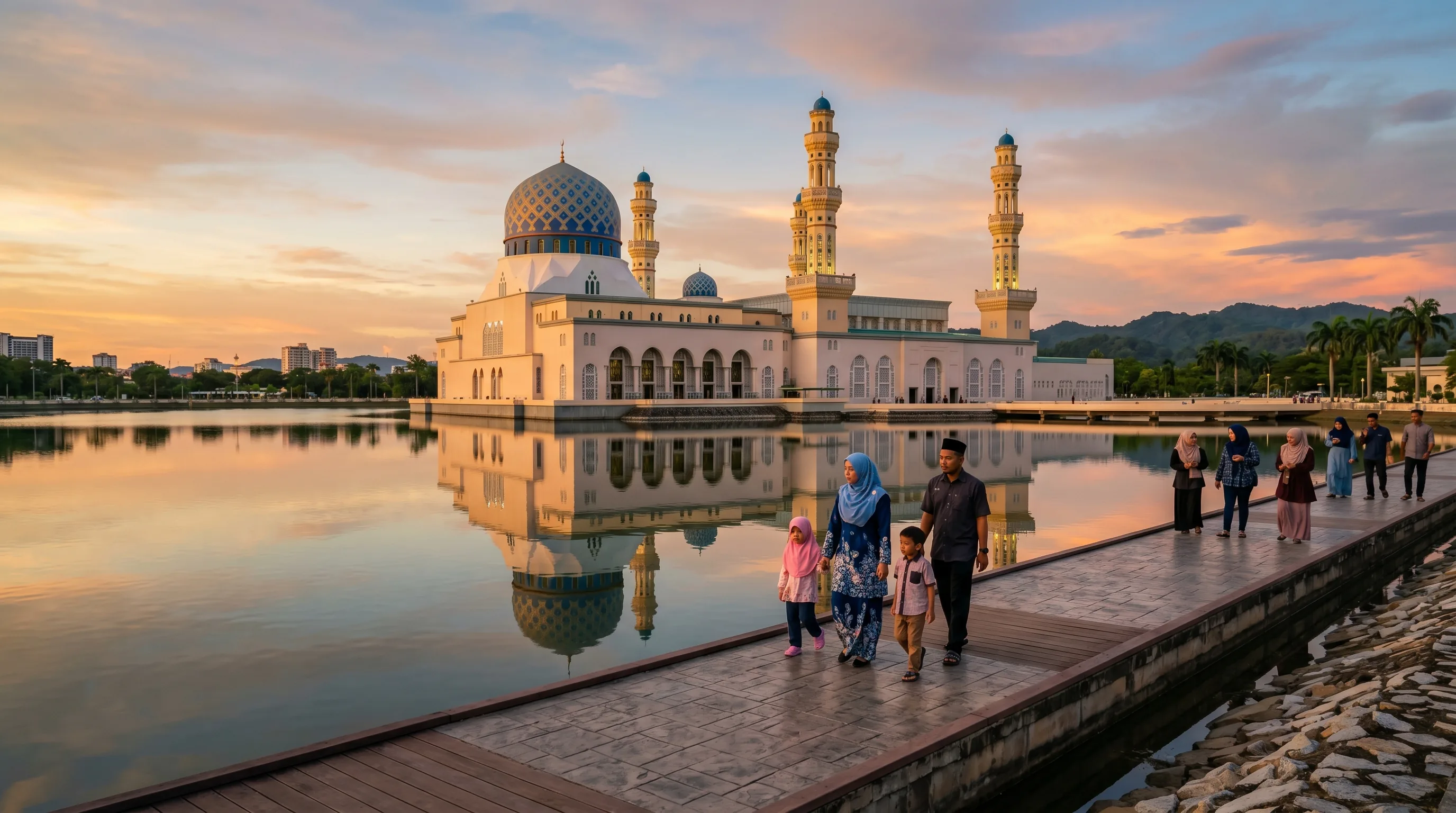
Places of Worship in Sabah: Mosques, Churches, Temples
What places of worship can you visit in Sabah?
Sabah's places of worship span grand mosques, historic churches, Chinese Buddhist and Taoist temples, Hindu temples, a century-old Sikh gurdwara, and indigenous sacred sites such as Mount Kinabalu — reflecting one of Malaysia's most religiously diverse populations.
Places of worship in Sabah at a glance
Few places in Malaysia wear their religious diversity as openly as Sabah. Within a short drive of Kota Kinabalu you can stand before a mosque that appears to float on the sea, a cathedral shaped like a spaceship, a hillside Buddhist temple with a tall pagoda, and a Hindu temple that fills with milk-pot processions each Thaipusam. Out in the interior, the mountains and rivers themselves are sacred to the indigenous Kadazan-Dusun and Murut peoples.
This diversity reflects Sabah's population: at the 2020 census 69.6% of residents were Muslim, 24.7% Christian and 5.1% Buddhist (DOSM, Census 2020 Sabah, checked 7 October 2026), with smaller Hindu, Sikh and other communities. This guide walks through the most significant places of worship faith by faith — with the history, architecture and practical visitor information for each — and links to a detailed page on every landmark.
These are living places of prayer, not just tourist sites. Dress modestly, keep your voice low, remove shoes where indicated, ask before photographing people or ceremonies, and avoid visiting during main prayer times. A little courtesy is always welcome.
Mosques in Sabah
Sabah's mosques range from the photogenic Kota Kinabalu City Mosque on Likas Bay to the State Mosque, completed in 1975, with its minaret of about 65.5 metres (Borneo Post, checked 7 October 2026), the Al-Kauthar Mosque in Tawau, which can hold up to 17,000 worshippers (Bernama, checked 7 October 2026), and the Masjid Jamik in Sandakan, described as 100 years old and the first stop on the Sandakan Heritage Trail (Sabah Tourism Board, checked 7 October 2026). The City Mosque is closed to visitors on Fridays, charges a RM5 entrance fee and asks visitors to wear a coverall, which can be rented (Sabah Tourism Board, checked 7 October 2026). Each tells part of the story of Islam in North Borneo.
Churches in Sabah
Christianity arrived with missionaries in the colonial era and spread rapidly among indigenous communities in the twentieth century. Landmark churches include the modern Sacred Heart Cathedral in Kota Kinabalu, mother church of the Archdiocese of Kota Kinabalu, whose history goes back to the Prefecture Apostolic of Labuan and Borneo erected in 1855 (Archdiocese of Kota Kinabalu timeline, checked 7 October 2026), and St. Michael's and All Angels in Sandakan. Its foundation stone was laid in 1893 and it was consecrated in 1906 as the first stone building in North Borneo (Anglican Diocese of Sabah, checked 7 October 2026).
Chinese temples
Sabah's Chinese community maintains Buddhist, Taoist and Confucian temples across the state. Near Kota Kinabalu, Puh Toh Tze is a Mahayana Buddhist temple off Tuaran Road. In Sandakan, the Sam Sing Kung (Three Saints) Temple was completed in 1887 and is described as the town's oldest Chinese temple, while the small Goddess of Mercy Temple dates from the late 1880s. Both are on the Sandakan Heritage Trail (Sabah Tourism Board, checked 7 October 2026).
Hindu temples and the Sikh gurdwara
Sabah's Tamil and broader Hindu communities worship at temples such as Sri Subramaniya Swamy Temple at Lok Kawi, whose Thaipusam celebrations drew more than 1,200 people in 2026, including non-Hindu visitors (Malay Mail, checked 7 October 2026). The state's small but long-established Sikh community gathers at the Gurdwara Sahib in Kota Kinabalu, which marked its centenary in September 2024 (Asia Samachar, checked 7 October 2026).
Indigenous spiritual sites
Long before mosques, churches and temples, Sabah's indigenous peoples revered the land itself. Mount Kinabalu is the resting place of ancestral spirits in Kadazan-Dusun belief, Nunuk Ragang is honoured as their ancestral homeland, and the bobohizan priestesses once led the rituals that bound communities to the spirit world. These traditions survive today mainly as living cultural memory.
Explore every place of worship
KK City Mosque (Floating Mosque)
Blue-and-gold mosque on Likas Bay, inspired by Medina's Nabawi Mosque
Read guide → MosqueSabah State Mosque
Sembulan landmark, completed in 1975, with a minaret of about 65.5 metres
Read guide → MosqueAl-Kauthar Mosque, Tawau
Holds up to 17,000 worshippers, on the Tawau beachfront
Read guide → ChurchSacred Heart Cathedral, KK
Mother church of the Archdiocese of Kota Kinabalu
Read guide → Church · HeritageSt. Michael's, Sandakan
First stone building in North Borneo, consecrated in 1906
Read guide → Buddhist templePuh Toh Tze Temple
Mahayana Buddhist temple off Tuaran Road, with a tall pagoda and Guanyin statue
Read guide → Chinese templesSandakan's Chinese Temples
Sam Sing Kung, completed in 1887 and the town's oldest, and the Goddess of Mercy Temple
Read guide → Hindu templesHindu Temples of Sabah
Lok Kawi, Sandakan and Tawau temples — and Thaipusam in Sabah
Read guide → Sikh gurdwaraGurdwara Sahib, KK
A century of Sikh community life in Kota Kinabalu
Read guide → IndigenousIndigenous Spiritual Sites
Mount Kinabalu, Nunuk Ragang and the bobohizan tradition
Read guide →