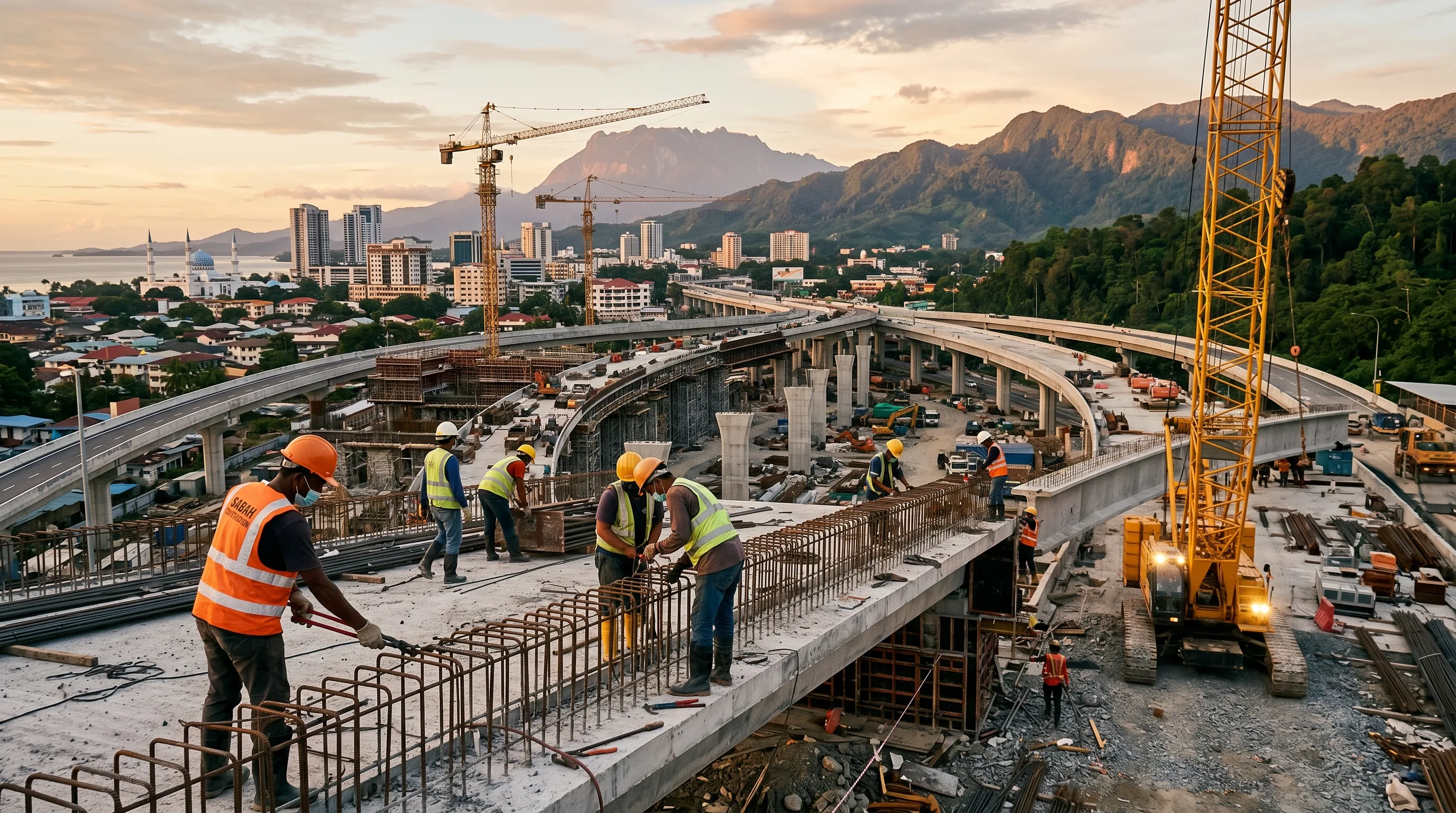
Sabah Mega Projects & Future Development Guide
What is happening with development in Sabah?
Sabah is in its biggest infrastructure transformation in decades, with over RM50 billion across the Pan Borneo Highway, KKIA expansion, the KK2035 city plan, the KKIP and Sepanggar port, the SOGIP industrial area, UMS Hospital and renewable energy running at once.
Sabah's development at a glance
Sabah is in the middle of its most ambitious infrastructure and economic transformation in decades. Multiple mega projects are running at the same time across transport, energy, industry and urban development, with a combined investment pipeline that exceeds RM50 billion. For residents, investors and visitors alike, the state that exists in 2030 will look noticeably different from the one today.
This hub brings every major project together in one place — what each one is, what it costs, where it stands and why it matters. Each topic links to a detailed page. The aim is a factual, neutral overview: numbers come straight from project announcements and official figures, with no speculation added.
Transport and connectivity projects
The headline transport project is the Pan Borneo Highway, a 706 km trunk road upgrade across Sabah costing RM24.889 billion. No official Kota Kinabalu to Tawau travel-time saving has been published, so treat the precise figures quoted elsewhere with caution. In the air, the KKIA Terminal 1 expansion (RM442.3 million) would lift the airport's capacity from about 10 million to 12 million passengers a year, though work had not started as at July 2026. Looking further ahead, a proposed Trans-Borneo Railway is under feasibility study as a cross-border line spanning the whole island.
Industrial and port development
Sabah's industrial base is anchored by the 8,320-acre Kota Kinabalu Industrial Park (KKIP) at Sepanggar, which has drawn 341 companies and RM11.2 billion in investment. The adjacent Sepanggar Bay container port — Sabah's only international container port — is raising capacity from 500,000 to 1.25 million TEU under a federally funded expansion now due in October 2027, with DP World operating the terminal. To the southwest, the SOGIP oil-and-gas area in Sipitang is anchored by the RM8.88 billion SAMUR ammonia-urea plant launched in February 2025.
Urban renewal and city planning
The KK2035 master plan, launched by DBKK in November 2023, sets the direction for Kota Kinabalu as a smart, sustainable and competitive city by 2035. It carries a RM300 million Smart City initiative and the RM4.2 billion Jesselton Docklands, a 35-acre reclaimed waterfront precinct designed by Norwegian firm Snøhetta — the largest urban waterfront redevelopment in Sabah's history.
Energy, health and big-picture projects
Sabah has set a target of 40% renewable energy generation by 2030, with Malaysia's first reservoir floating-solar plant at Babagon Dam as an early proof of concept. In healthcare, the new UMS Hospital (HUMS) — East Malaysia's first university teaching hospital, with 400 beds — reached 96% completion in early 2026 with full operations targeted for Q2 2026.
Progress percentages, completion dates and capacities on these pages reflect the latest available project announcements. Mega projects evolve, so treat dates and figures as a snapshot rather than a fixed guarantee, and check official sources for the newest status.
Explore every Sabah mega project
Pan Borneo Highway
706 km, RM24.889 billion — route, phases and progress
Read guide → TransportKKIA Terminal 1 Expansion
RM442.3 million upgrade to 12 million passengers a year
Read guide → Urban planningKK2035 Master Plan
Smart city, six pillars and the Jesselton Docklands waterfront
Read guide → IndustryKota Kinabalu Industrial Park
8,320 acres, 341 companies, RM11.2 billion invested
Read guide → IndustrySepanggar Bay Container Port
Capacity rising to 1.25 million TEU, now due October 2027
Read guide → Energy & industrySOGIP & SAMUR Plant
Sipitang oil-and-gas area and the RM8.88 billion urea plant
Read guide → HealthcareUMS Hospital (HUMS)
East Malaysia's first university teaching hospital, 400 beds
Read guide → EnergyRenewable Energy in Sabah
40% by 2030 target and the Babagon Dam floating solar
Read guide → Future conceptTrans-Borneo Railway
Proposed cross-border line under feasibility study
Read guide →