Sabah Renewable Energy: Targets, Solar & Hydropower
What is Sabah's renewable energy plan?
The 13th Malaysia Plan targets 40% of Sabah's installed power capacity from renewables by 2030, up from 15% in 2024. The state's SE-RAMP 2040 targets more than 50% of capacity and more than 30% of electricity generated by 2035. In 2021 only 7.3% of electricity generated came from renewables.
Sabah's renewable energy target
You will often read that Sabah is aiming for "40% renewable energy by 2030". That is close, but it is a target for installed capacity, not for the electricity that actually reaches your home. The two official targets are:
| Plan | Target | Measured as |
|---|---|---|
| 13th Malaysia Plan (2026 to 2030) | 15% in 2024 to 40% by 2030 | Share of installed capacity |
| SE-RAMP 2040 (Energy Commission of Sabah, 2023) | More than 50% by 2035 | Share of capacity |
| SE-RAMP 2040 | More than 30% by 2035 | Share of energy generated (MWh) |
Why the difference matters: a solar farm has a large capacity but only produces during daylight, so a grid can be 40% renewable by capacity while far less of the power actually used is renewable. The state plan also expects renewables to reach about 35% of generation by 2035, mainly from new hydro.
SE-RAMP 2040 is a 2023 plan and is meant to be reviewed every three years, so these targets may move. For all seven targets, your bill and blackouts, see Sabah's power plan explained.
The national National Energy Transition Roadmap (2023) also names a Sabah-specific flagship, the Sabah Energy Security Initiative, led by the Energy Commission of Sabah. It covers large-scale solar and small hydro plants, a policy and regulatory framework on biowaste to secure a steady supply of feedstock, and a study of geothermal power.
The current energy mix
Electricity in Sabah is supplied mainly by Sabah Electricity Sdn Bhd (SESB), and the grid runs mostly on natural gas. In 2021, from a total dependable capacity of 1,179 MW, the electricity generated came from:
| Source | Share of generation, 2021 |
|---|---|
| Natural gas | 86% |
| Diesel and fuel oil | 6.7% |
| Hydro | 4.6% |
| Biomass and biogas | 1.5% |
| Solar | 1.2% |
Renewables together were 7.3% of generation in 2021, down from 9.7% in 2019 and 8.8% in 2020. For 2035 the state plan targets a mix of about 55.4% gas, 28.6% hydro, 6.6% battery storage, 6.6% other renewables and 2.8% imported power, from a larger system of 1,805 MW.
These are the latest figures in the state energy plan, which uses 2021 data. We have not found a later official breakdown of Sabah's generation mix. We will update this table when one is published.
Solar: farms, rooftops and Babagon
Sabah gets the strongest sunshine of any Malaysian state, with solar irradiance of 1,861 kWh/m² according to the state energy plan. The plan puts Sabah's total solar potential at 99.4 GW, far more than it could ever use.
Solar farms: as of 2022, 113.9 MW of large-scale solar (LSS) had been awarded in Sabah, of which 50 MW was operating and 63.9 MW was still in progress. The plan deliberately limits solar to about 20 to 22% of peak demand to keep the grid stable, because solar output drops when clouds pass or the sun sets.
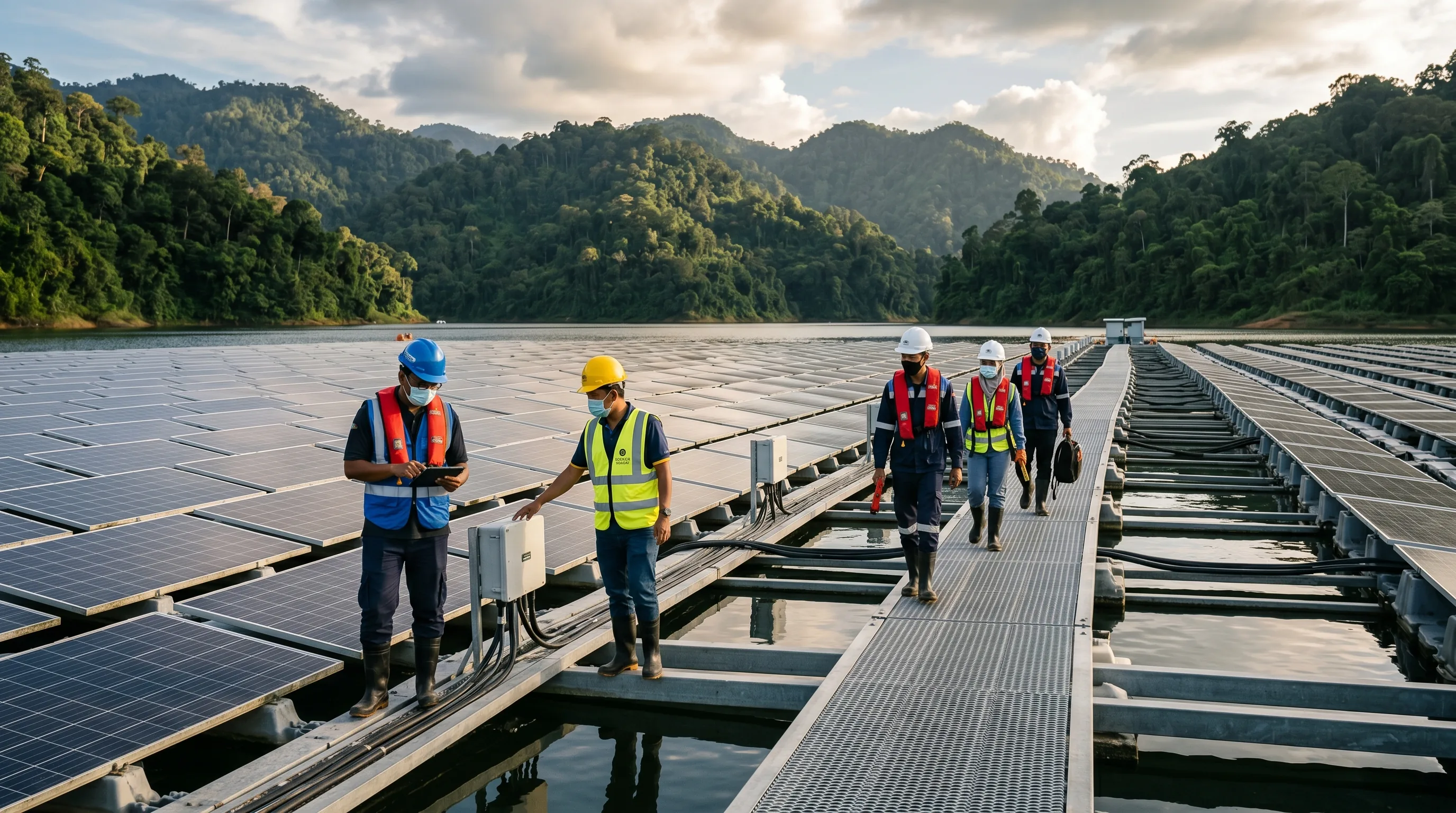
Babagon Dam floating solar: a 13.2 MW floating solar farm on the Babagon Dam reservoir in Penampang, developed by the state water producer Jetama Sdn Bhd, with a 25-year power purchase agreement with Sabah Electricity. It was launched in February 2026 alongside a 15 MW solar farm at Batu Sapi, Sandakan. In March 2026 Jetama said Babagon was 5% complete and both projects were due within 12 months.
Rooftop solar: the state plan's self-consumption (SelCo) scheme lets you put panels on your roof and use the power yourself, but not export it to the grid; the plan says it is open to individuals and small commercial users. Homes can also apply for Solar Rakyat Sabah, announced on 30 June 2026, which pays bill credits for power exported to the grid, within a 20 MW quota for about 4,000 homes. See how Solar Rakyat Sabah works.
Hydropower potential
Sabah's rivers could support about 1,100 MW of hydropower, 14% of Malaysia's large-hydro potential, but only 102 MW was available as of 2022. The state plan lists three committed projects:
| Project | Capacity | Scheduled completion |
|---|---|---|
| Telekosang 1 and 2 | 40 MW | Completed February 2023 |
| One River Power | 5.6 MW | 2024 |
| Upper Padas hydroelectric plant | 180 MW | 2029 |
With these, hydro is planned to supply up to 30% of Sabah's generation mix by 2029. Status as of September 2026: Telekosang is operating. Upper Padas was re-approved in May 2026 as a hybrid of 187.5 MW hydro, due by 31 December 2030, plus 150 MWac of floating solar, due by 31 December 2031 (The Star, 5 May 2026). The full project list and progress are on our Sabah power plan page.
For the next dams, the state plan proposes a Hydropower Development Master Plan: up to six regional models across Sabah, a shortlist of sites ranked by their social and environmental impact, and a framework for competitive bidding and public-private partnerships.
Palm oil waste (biomass and biogas)
Sabah has about 1.55 million hectares of oil palm and 124 palm oil mills, mostly on the east coast. The leftovers, such as empty fruit bunches, fibre, shells and fronds, can be burned or digested for power. The state plan estimates Sabah's total bioenergy potential at 749 MW, of which 561 MW is biomass and 158 MW is biogas from mill effluent and landfill.
Very little of it is used. In 2021 only about 5% of the 24.7 million tonnes of palm biomass produced went into power, giving 17.7 MW. Using all of it could give an estimated 364 MW. The plan also proposes a state policy that would require a minimum amount of empty fruit bunches to be made available for power generation.
Why so little is used: the state plan says biomass's share of power fell because two feed-in tariff biomass plants could not secure feedstock. It lists three barriers:
- Distance: plantations and mills are typically 30 to 90 km from the grid, but a 33 kV line only reaches about 30 km. A 132 kV line would be needed beyond that, and it costs about six times more.
- Cost: developers pay to connect to the nearest substation, and with tariffs fixed for 18 years they often only break even after about nine years.
- Competition: plantation companies often export biomass by-products, for example as feedstock to Europe, because it pays better than selling it for power.
The plan's answer is a Sabah Green Grid: collector substations placed near clusters of palm oil mills on the east coast, linked to the grid at 275 kV or 132 kV. It also proposes public-private partnerships to develop the biomass industry, estimating up to RM13.5 billion of investment and about 25,000 jobs.
Status as of September 2026: we have not found a published state policy on empty fruit bunches or a start date for the Sabah Green Grid. These are plan proposals and estimates, not committed projects.
Geothermal, wind, hydrogen and other new options
The state energy plan lists newer technologies Sabah should explore to diversify its power supply. None is committed yet.
| Technology | Plan timeline | What the plan says |
|---|---|---|
| Geothermal (Tawau) | Medium term | A 2009 study found 67 MW of potential near Tawau; a later study put it at up to 100 MW. A 30 MW feed-in tariff plant due in June 2018 was reported abandoned in December 2018, its approval was revoked and the land concession terminated. A review has started to revive it. |
| Wind | Medium term | Northern Sabah has wind speeds above 5 m/s at 100 metres. Profitable wind power generally needs 7 to 8 m/s. |
| Synthesis gas | Medium term | Explore producing synthesis gas, for example from biomass, for power. |
| Green hydrogen and green ammonia | Long term | Explore making green hydrogen from seawater, given Sabah's large coastal areas, and green ammonia, using its renewable energy supply. |
| Tidal | Long term | Malaysia has no tidal power yet; the plan suggests exploring it. |
| Small modular nuclear reactors (SMR) | Long term | The plan says it is practical for Sabah to explore SMRs, including as a stopgap for industrial demand. |
Status as of September 2026: we have not found an announced restart of the Tawau geothermal project, or approved wind, hydrogen, tidal or nuclear projects in Sabah.
Power links with Sarawak and beyond
SE-RAMP 2040 wants cross-border transmission links that improve security of supply and position Sabah as an energy exporter and "power wheeler" to its regional neighbours, naming North Kalimantan in Indonesia and Palawan in the Philippines. The first of these is the link with Sarawak: an initial 30 MW, rising to 50 MW, over a 31 km, 275 kV line for a 15-year term. Status as of September 2026: the Lawas–Mengalong link has supplied Sabah since 13 December 2025, carrying up to 50 MW; see power from Sarawak.
Earlier versions of this page described a "Sabah SCORE" framework, a "POTENSI" rooftop programme and an undersea cable exporting hydropower to Peninsular Malaysia. We could not find any of these in the state or federal plans, so they have been removed.
Frequently asked questions
Q What is Sabah's renewable energy target?
Q How much of Sabah's electricity is renewable today?
Q What is the Babagon Dam floating solar project?
Q Which hydro dams are coming?
Q Can I put solar panels on my roof in Sabah?
Q Does Sabah have geothermal power?
Q Will Sabah export power to Peninsular Malaysia?
Sources & References 6 sources
Last verified: 27 September 2026
Official plans
- Energy Commission of Sabah: Sabah Energy Roadmap and Master Plan 2040 (SE-RAMP 2040), 2023 Targets (p.11), 2021 generation mix (pp.29, 72, 75), geothermal, wind, hydrogen, green ammonia, tidal and SMR (pp.91-94), 2035 mix (p.75), hydro (p.77), Sarawak, North Kalimantan and Palawan links (pp.87-88), solar (pp.117, 119), rooftop SelCo (p.120), bioenergy (pp.122-127), Hydropower Development Master Plan (p.115). Page numbers as printed.
- National Energy Transition Roadmap (Ministry of Economy, 2023) p.53: flagship "Sabah Energy Security Initiative", championed by the Energy Commission of Sabah.
- Thirteenth Malaysia Plan 2026-2030 Renewable energy in installed capacity mix: Sabah 15% (2024) to 40% (2030), chapter 2 p.2-6.