Sabah Economy 2026 — RM88.8B GDP & Key Industries
We are working through the statistics in this section against their original sources. The headline figures above were re-checked on 17 August 2026. Detailed figures further down the page have not yet been individually verified, and some may be out of date or wrong.
If you spot something that looks wrong, please tell us — it genuinely helps.
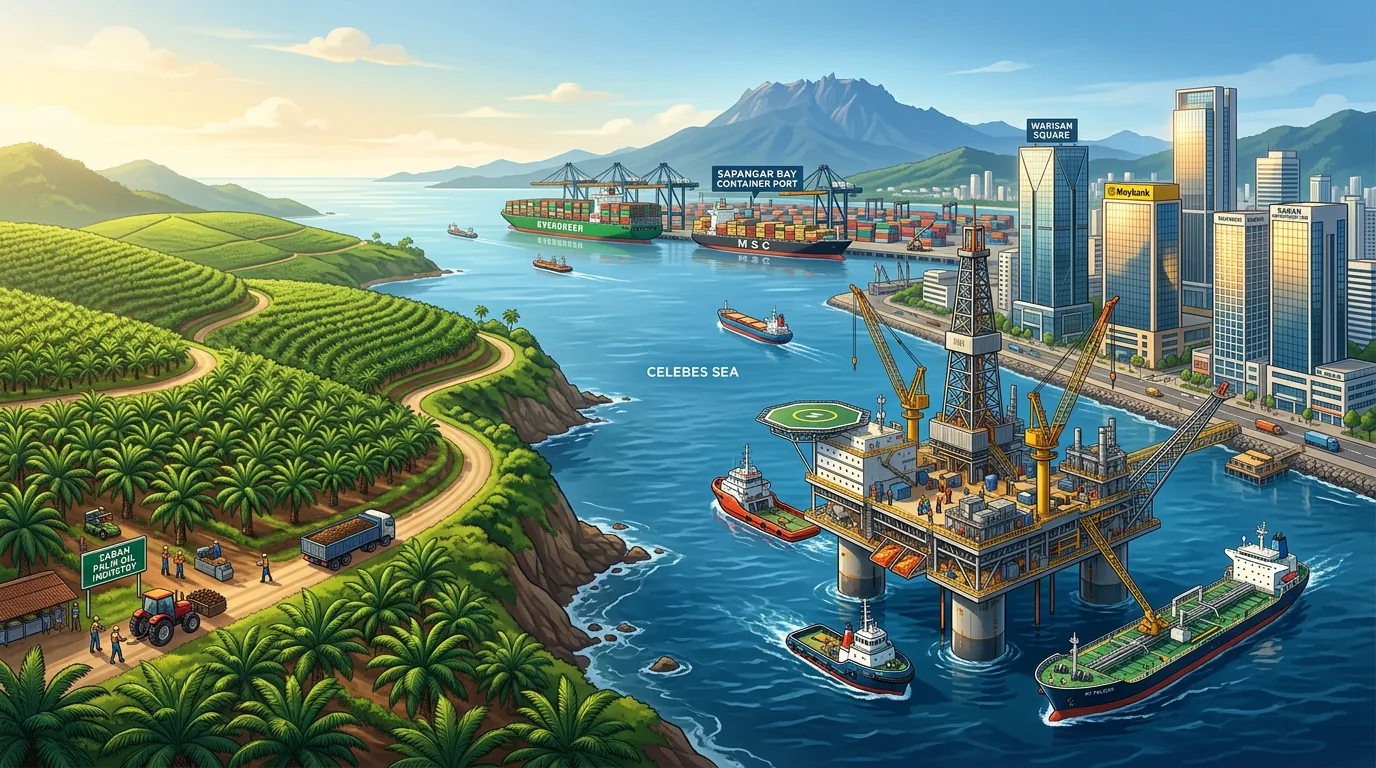
Sabah’s economy produced RM88.8 billion in GDP in 2025 (constant 2015 prices), making it Malaysia’s 7th-largest state economy, about 5% of national GDP. Growth was 5.1%, close to the national rate of 5.2% and a sharp improvement on 2024’s 1.2%. Per capita GDP is RM31,125 (current prices), about 53% of the national average. The economy is driven by services (52.1% of GDP), with mining & quarrying (22.0%) and agriculture (~14%) next.
Sabah’s GDP fell 9.1% in 2020 and recovered slowly — output only rose back above its 2019 level in 2025, when growth reached 5.1%.
Source: DOSM GDP by State releases (constant 2015 prices), via OpenDOSM
Economic overview
Sabah’s economy is the 7th largest in Malaysia by absolute GDP, but when measured per capita, it lags significantly behind wealthier states like Selangor, Penang, and even Sarawak. This disparity reflects Sabah’s economic structure: it is rich in natural resources but faces structural challenges that limit wealth per person — commodity export-dependence, infrastructure gaps, an underdeveloped manufacturing base, and the loss of skilled workers to Peninsular Malaysia.
The economy contracted sharply during COVID-19 (down 9.1% in 2020) and, unlike Malaysia as a whole, recovered slowly — growth was just 1.5% in 2021 and 1.2% in 2024. Output only rose back above its pre-pandemic level in 2025, when GDP reached RM88.8 billion on growth of 5.1%. The services sector, driven partly by tourism recovery, is now the primary growth engine.
Economic sectors
Sabah’s economy is composed of five main sectors, each with distinct characteristics and growth trajectories:
Services (52.1% of GDP, 2025)
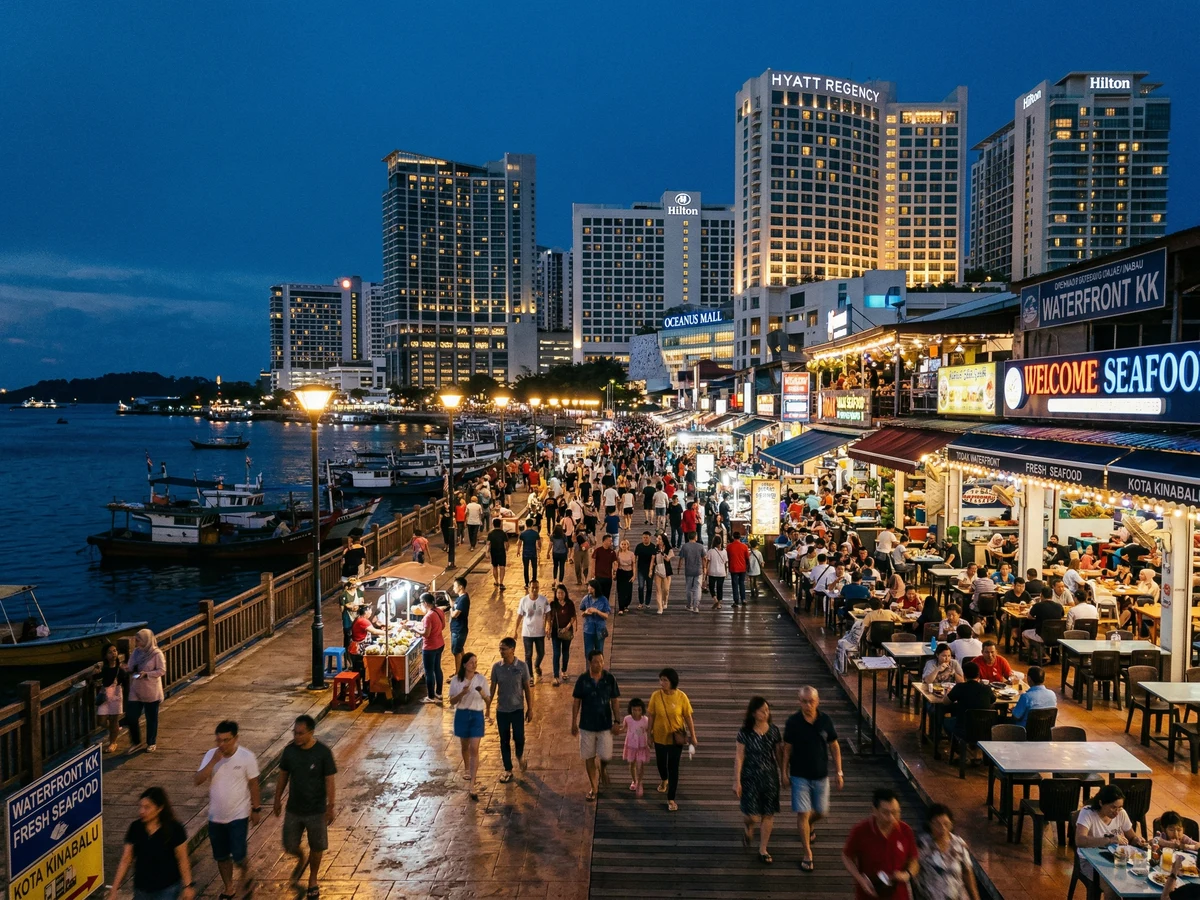
The largest sector, encompassing government, retail and wholesale trade, hospitality and tourism, finance, transport, and telecommunications. Within this, tourism is the growth star — tourism industries added RM13.7 billion in value in 2024, up 4.2% year-on-year, and 12% of state GDP. Government services remain large but stable. Retail trade has grown with urbanisation and rising incomes.
Agriculture (~14% of GDP)
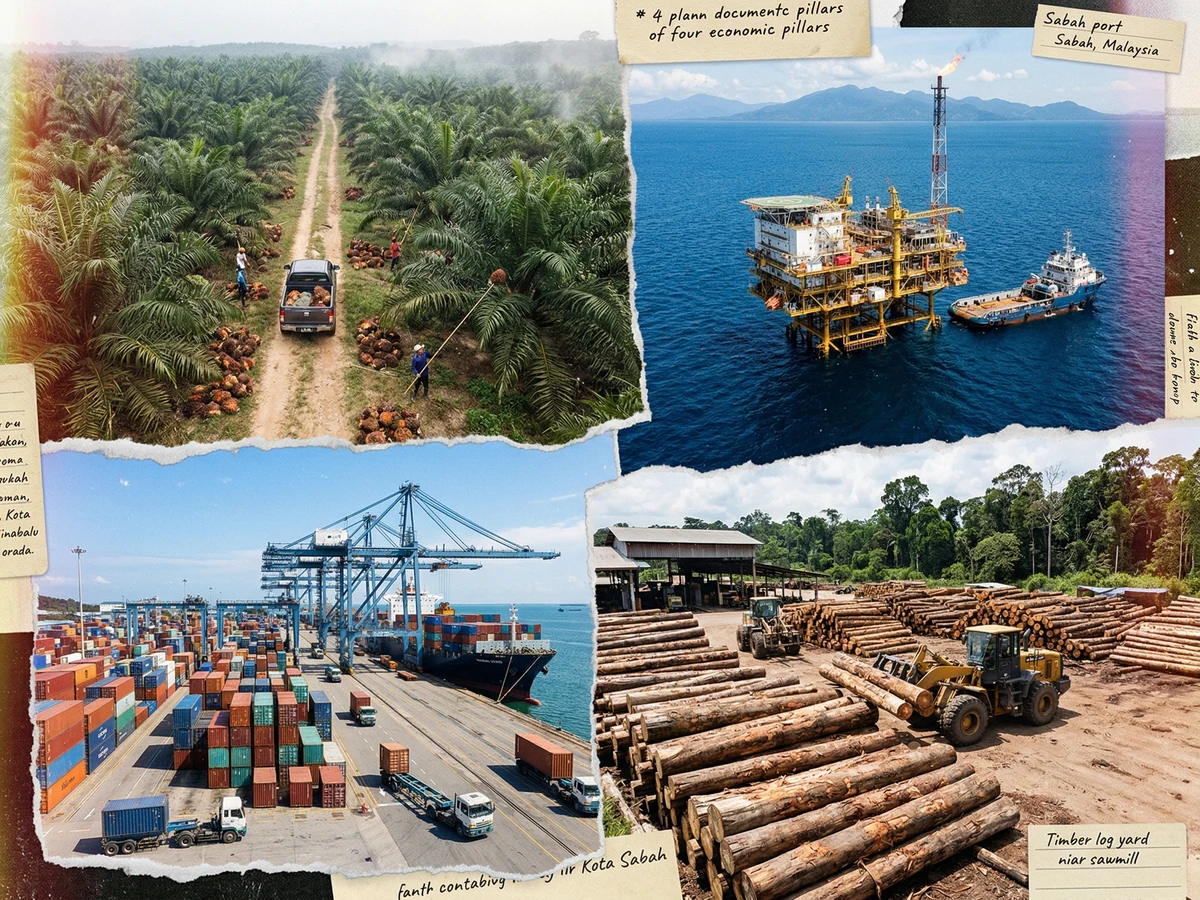
Dominated by palm oil, which alone accounts for roughly two-thirds of the agricultural share. Other subsectors include cocoa (declining due to age of trees and conversion to palm oil), rubber (stable but low-value), paddy/rice (only 30% self-sufficient), timber (declining due to logging restrictions), and increasingly, aquaculture. Agricultural output recovered 0.9% in 2025 after a 3.2% contraction in 2024 on lower palm oil and cocoa volumes.
Manufacturing
Modest but growing. Includes palm oil processing mills, wood-based products (plywood, furniture), food and beverage processing, and non-metallic minerals. Manufacturing grew 5.0% in 2025 (2024: 1.2%). The sector is constrained by logistics costs, limited skilled labour, and the cabotage policy.
Mining & Quarrying (22.0% of GDP, 2025)
Dominated by offshore oil and natural gas extraction. Sabah accounts for more than 40% of Malaysia’s crude oil production and about 13% of its natural gas (the last official state-level figure, 2017). The sector contracted 4.9% in 2024 before rebounding 4.9% in 2025 as project cycles turned, and major projects like PFLNG 3 (targeting 2H 2027) and Shell’s deepwater developments will support future growth.
Construction
A volatile sector that surged 28.3% in 2025 (2024: 21.5%), driven by infrastructure projects (Pan Borneo Highway, port expansions) and property development. Growth is cyclical and often project-dependent rather than structural.
Sabah versus other Malaysian states
Sabah ranks 7th by absolute GDP and lower still by per capita measures. The comparison below shows the gap between Malaysia’s largest economies and Sabah:
Selangor’s economy is roughly five times Sabah’s. Sarawak, with similar natural resources, has a much larger economy despite a smaller population.
Source: DOSM GDP by State 2025
Key economic challenges
Despite natural wealth, Sabah faces structural headwinds that suppress per capita income and growth:
- Commodity dependence: Over 70% of exports are palm oil and petroleum. Price volatility creates boom-bust cycles: growth slowed to 1.7% in 2023 as commodity prices fell.
- Limited value-added processing: Most palm oil is exported crude; oil and gas extraction is capital-intensive with limited local employment. Manufacturing is underdeveloped.
- Infrastructure gaps: Roads, ports, and utilities lag Peninsular Malaysia, raising business costs. The Pan Borneo Highway is addressing this but completion is still years away.
- Brain drain: Educated Sabahans migrate to Kuala Lumpur or Singapore for better-paying jobs, starving the state of local talent and entrepreneurship.
- Cabotage policy: Federal law requires goods shipped between Malaysian ports to use Malaysian-flagged vessels, raising shipping costs for Sabah (and Sarawak) by 15–20% relative to Peninsular ports.
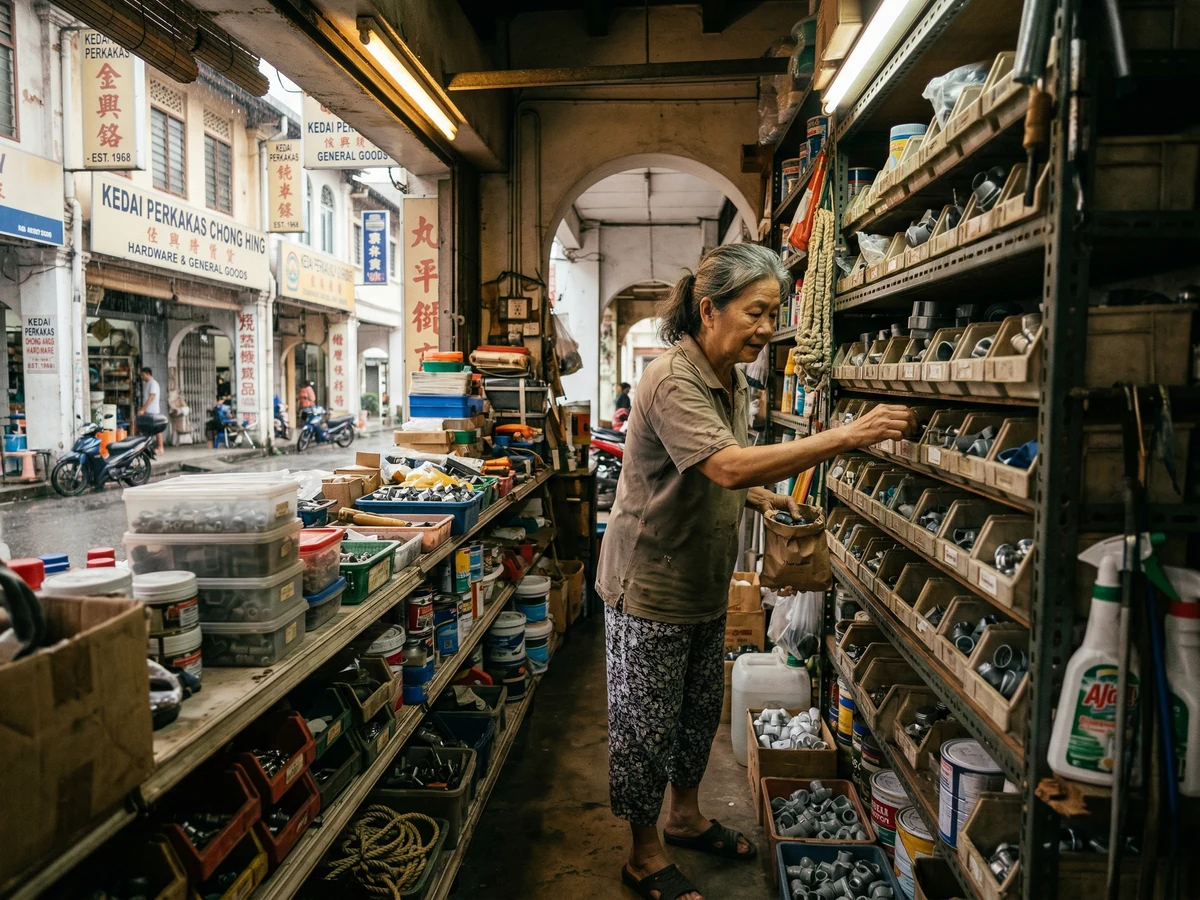
- Large informal economy: Subsistence farming, informal trade, and cross-border commerce don’t register in official GDP, understating true economic activity but also indicating low productivity.
Current growth drivers
Tourism is the bright spot. Total arrivals reached 3,793,709 in 2025 — 1,498,709 of them international — against 4.2 million in 2019. Tourism value added reached RM13.7 billion in 2024, up from RM13.1 billion in 2023. This has created jobs in hotels, restaurants, transport, and guides, and is attracting infrastructure investment.
Oil & gas projects provide another medium-term boost. PFLNG 3 (floating LNG, capacity 2.0 million tonnes/year) targets 2027 commissioning at an estimated investment of RM4.6 billion. Shell’s deepwater projects added 21,000 barrels of oil equivalent per day in 2024.
Infrastructure development — Pan Borneo Highway, port expansions, and utility upgrades — is creating construction jobs and lowering logistics costs, benefiting all sectors.
However, these gains remain modest relative to overall economic size, and are heavily dependent on commodity prices and external investment.
Frequently asked questions
Q What is Sabah's GDP ranking among Malaysian states?
Q Why is Sabah's GDP per capita so low despite natural resources?
Q What is the biggest employer in Sabah?
Q Is Sabah attracting foreign direct investment (FDI)?
Q How is Sabah's economy transforming?
Q How badly did COVID-19 hit Sabah's economy?
Q What is Sabah's economic outlook for 2025–2030?
Sources & References 7 sources
Last verified: 17 August 2026
Government — DOSM
- DOSM GDP by State 2025 (released July 2026) Official state GDP breakdown by sector and growth rates
- OpenDOSM GDP Dashboard Interactive dashboard with historical and projected GDP data
- DOSM Poverty Survey 2024 State-level poverty rates and household income data
- DOSM Labour Force Survey 2024 Employment by sector and unemployment rates