Sabah Palm Oil 2026 — Production, Hectares & Mill Data

We are working through the statistics in this section against their original sources. The headline figures above were re-checked on 16 August 2026. Detailed figures further down the page have not yet been individually verified, and some may be out of date or wrong.
If you spot something that looks wrong, please tell us — it genuinely helps.
Sabah is Malaysia’s #1 palm oil producer, with 1.59 million hectares planted, producing approximately 4.8 million tonnes of CPO annually. The sector employs around 150,000 people (direct + indirect), generates RM22 billion+ in annual export revenue, and sustains approximately 87,000 smallholders. However, the industry faces replanting challenges, price volatility, and environmental scrutiny.
Production has stabilised around 4.8 million tonnes annually. Growth has plateaued due to limited available land for expansion; future gains must come from yield improvements on existing plantations.
Source: MPOB Industry Overview & DOSM Trade Data
Sabah’s palm oil dominance
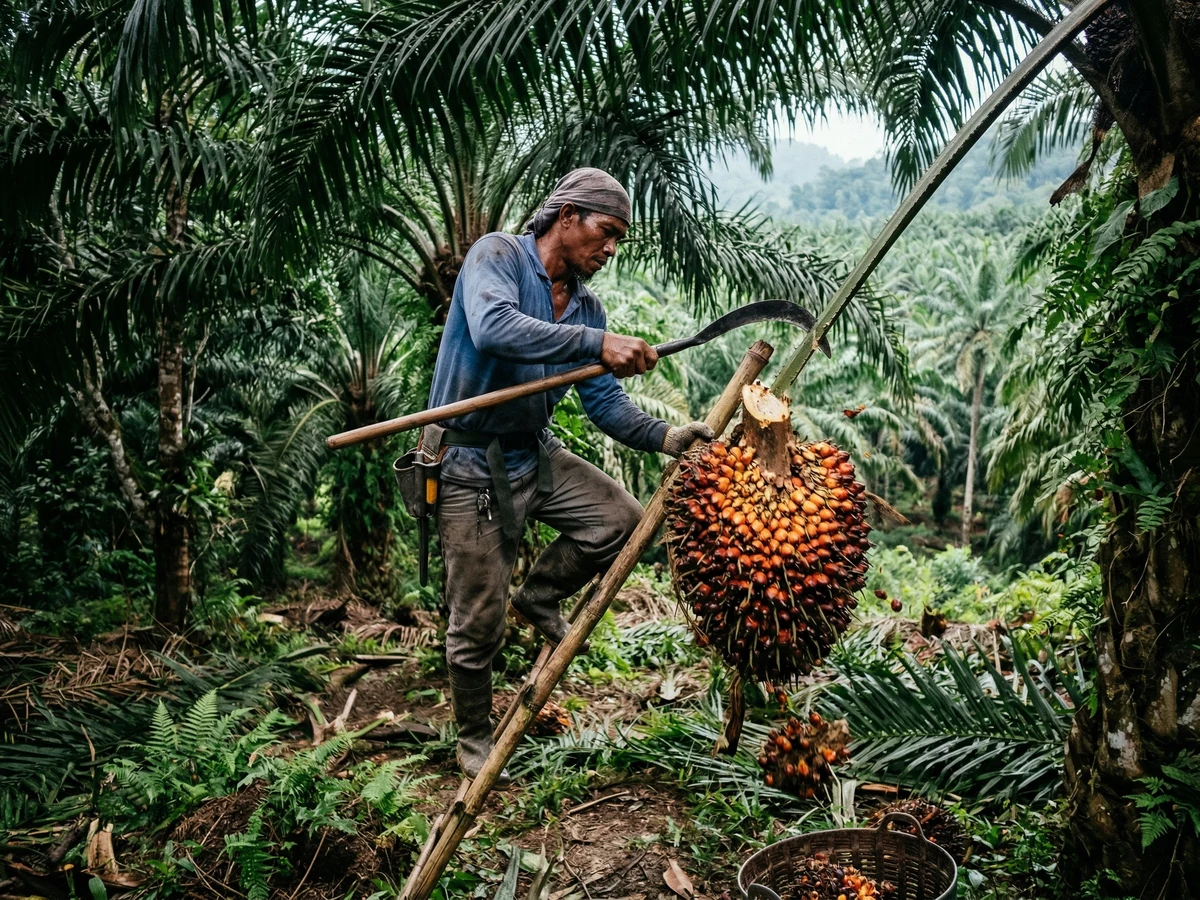
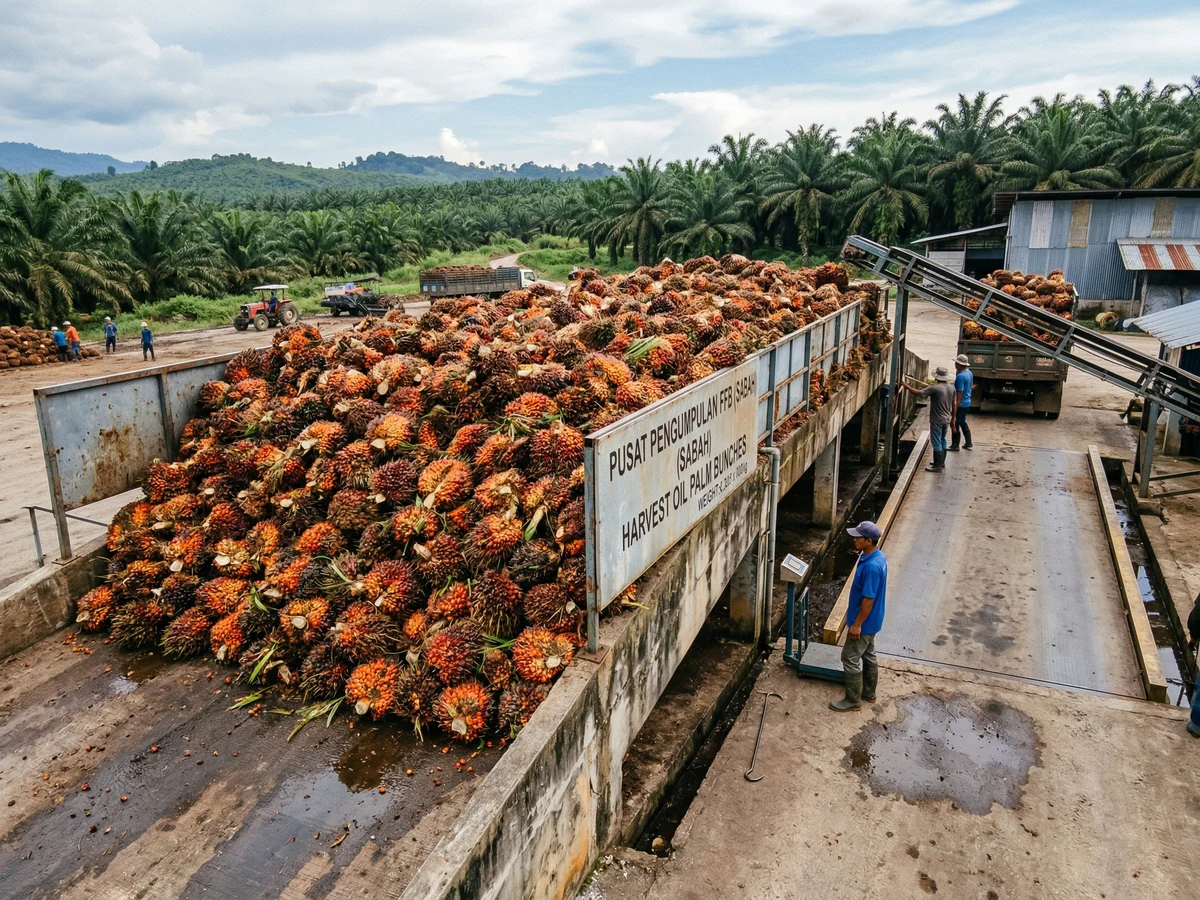
Palm oil is embedded in Sabah’s identity and economy. It is the state’s largest agricultural export, second only to petroleum in total export value, and the primary livelihood for over 150,000 people across the supply chain. The sector’s footprint is visible in almost every district — vast plantations blanket the landscape from Tawau to Sandakan to Beaufort.
Sabah’s dominance is the result of geography, climate, and deliberate policy. The state has abundant land suitable for palm cultivation, tropical rainfall, and warm year-round temperatures. From the 1970s onward, successive state governments promoted oil palm as an economic anchor, offering land concessions, tax breaks, and infrastructure investment. This strategy worked: by the early 2000s, Sabah had surpassed all other Malaysian states in total production.
However, dominance comes with challenges. Sabah is now vulnerable to global palm oil price fluctuations. Environmental concerns about deforestation and biodiversity loss persist. And the industry is ageing — about 25% of plantations are beyond optimal productivity, requiring expensive replanting.
Production and area
Sabah’s 1.59 million hectares of planted palm represents approximately 28% of Malaysia’s total palm area (5.61 million hectares nationally). The state consistently produces 4.8–4.9 million tonnes of Crude Palm Oil (CPO) annually — roughly 25% of Malaysia’s total output. Productivity averages 3.0–3.1 tonnes per hectare, comparable to Malaysia’s national average but below best-in-class mills achieving 3.5+ tonnes per hectare.
Industry structure: estates, smallholders, and government schemes
Sabah’s palm oil is grown and processed by three operator categories:
Large estates (corporate and foreign-owned) control the majority of land. Smallholders and government schemes (FELDA, SLDB) are important for rural livelihoods but occupy less land.
Source: MPOB & SEDIA
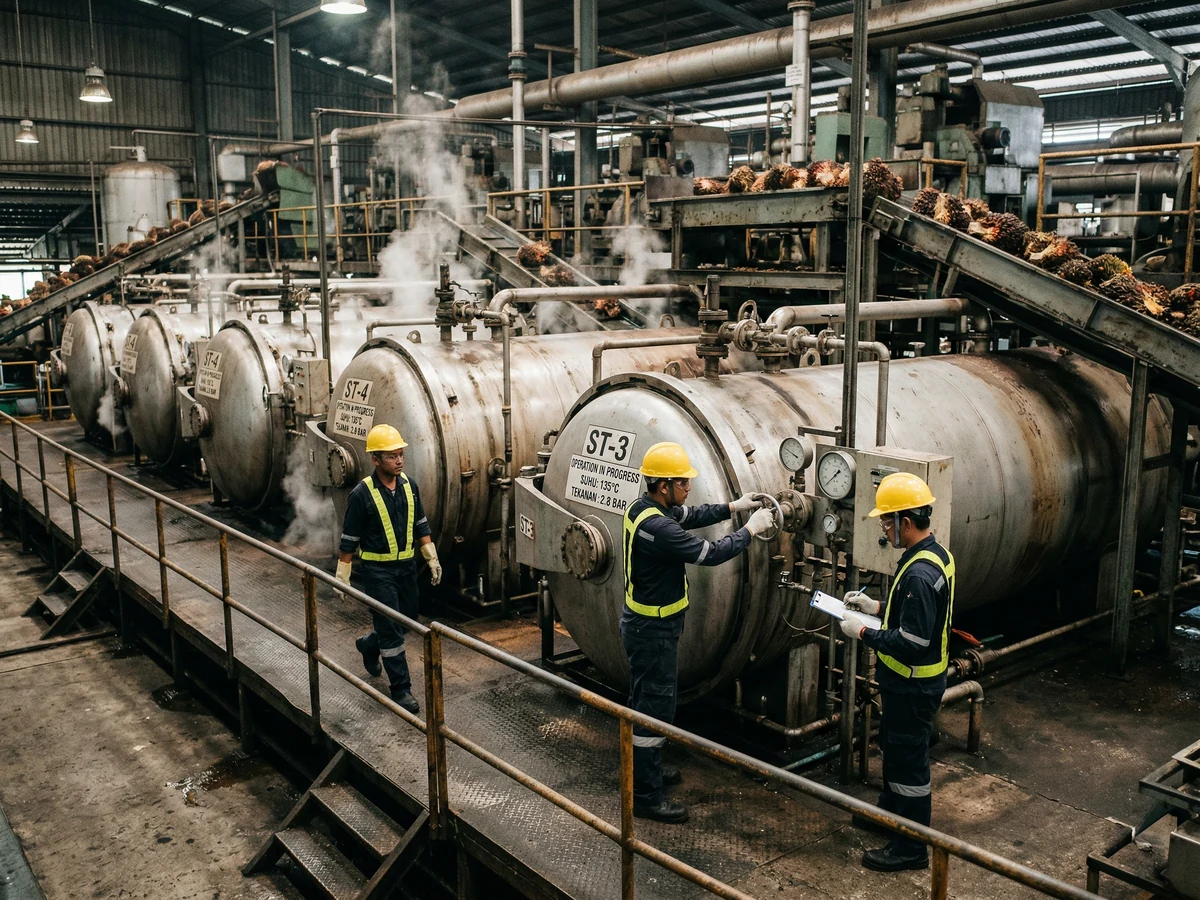
Large estates (~55% of area) are operated by major companies: FGV Holdings (largest in Sabah, >26% of state area), Sime Darby Plantation, Wilmar International, IOI Corporation, and Kuala Lumpur Kepong (KLK). These companies own mills, employ thousands, and are responsible for most capital investment and technology adoption. Many have achieved MSPO and RSPO certification.
Smallholders (~35% of area, ~87,000 farmers) include independent family farmers and members of government-sponsored schemes like FELDA and SLDB. Average holding size is 2–4 hectares. Smallholders often sell fresh fruit bunches (FFB) to nearby mills at negotiated prices. Income is more volatile than estate employment but offers autonomy. Many smallholders are older and lack succession plans for the next generation.
Government schemes (~10% of area) are land development projects (SLDB — Sabah Land Development Board) and federal programmes. These offer subsidised land, extension services, and processing support to small farmers, though efficiency has been mixed.
Geographic concentration
Palm oil plantations are concentrated in specific districts with suitable soil and rainfall:
Tawau is the epicentre of Sabah’s palm oil industry, with major mills and estates. Lahad Datu and Sandakan are secondary hubs. Interior districts (Keningau, Kinabatangan) have some plantations but are less intensively developed.
Source: MPOB & District Land Office Data
Export value and global trade
Palm oil exports are a pillar of Sabah’s trade profile. In 2024, Sabah exported approximately RM17.3 billion worth of palm oil and palm oil products, representing 28% of all Sabah exports (after crude petroleum at 35%). The main products are:
- Crude Palm Oil (CPO) — refined in Malaysia or shipped directly to refineries in Indonesia, India, or other markets
- Palm Kernel Oil & Meal — by-products of CPO extraction, used in animal feed and cosmetics
- Processed/refined palm oil — downstream products from mills with integrated refineries
- Oleochemicals — derivatives (fatty acids, methyl esters) for soap, detergent, lubricants
Top export destinations are India, China, the European Union (declining due to sustainability concerns), and Japan. Prices fluctuate based on global supply/demand and competing vegetable oils (soybean, rapeseed, sunflower). In 2024, average CPO prices were RM4,180 per tonne, up 9.7% year-on-year.
For data on forests and deforestation in Sabah, including the environmental impact of historical palm oil expansion, see our Forests & Land-Use Change page.
Industry challenges and future outlook
Ageing trees: Approximately 25% of Sabah’s plantations are over 30 years old and past peak productivity. Replanting is expensive (~RM20,000–30,000 per hectare) and land is scarce. Replanting rates are 1–2% annually, far below the 3–5% typically recommended. This will pressure yields in coming years.
Price volatility: Global palm oil prices swing 20–30% annually due to weather, geopolitical tensions, currency fluctuations, and competing vegetable oil supply. Smallholders are particularly vulnerable; prices below RM3,000 per tonne leave many unable to cover production costs.
Labour scarcity: Much plantation work is done by migrant workers from Indonesia and the Philippines. Recent immigration enforcement and COVID-related restrictions have created labour shortages, raising wages and eroding profitability. Automation (harvesting robots, drones) is emerging but remains expensive and not yet competitive with cheap labour.
Environmental scrutiny: Western buyers and NGOs increasingly demand certified sustainable palm oil (MSPO, RSPO). Compliance is costly and requires traceability systems. Some buyers are shifting to alternative oils or reducing palm use, constraining demand growth.
Downstream opportunities: The state government is promoting downstream processing — building more refineries, oleochemical plants, and biodiesel facilities — to capture more value locally. However, capital requirements and competition with larger facilities in Indonesia are barriers.
Frequently asked questions
Q Why does Sabah lead Malaysia in palm oil production?
Q What is OER and why does it matter?
Q Is deforestation a problem in Sabah's palm oil sector?
Q What is the difference between MSPO and RSPO certification?
Q How much income do palm oil smallholders earn?
Q What are the main challenges for Sabah's palm oil industry?
Q Is palm oil production sustainable in the long term?
Sources & References 6 sources
Last verified: 11 April 2026