Sacred Heart Cathedral Kota Kinabalu: Visitor Guide
What is Sacred Heart Cathedral in Kota Kinabalu?
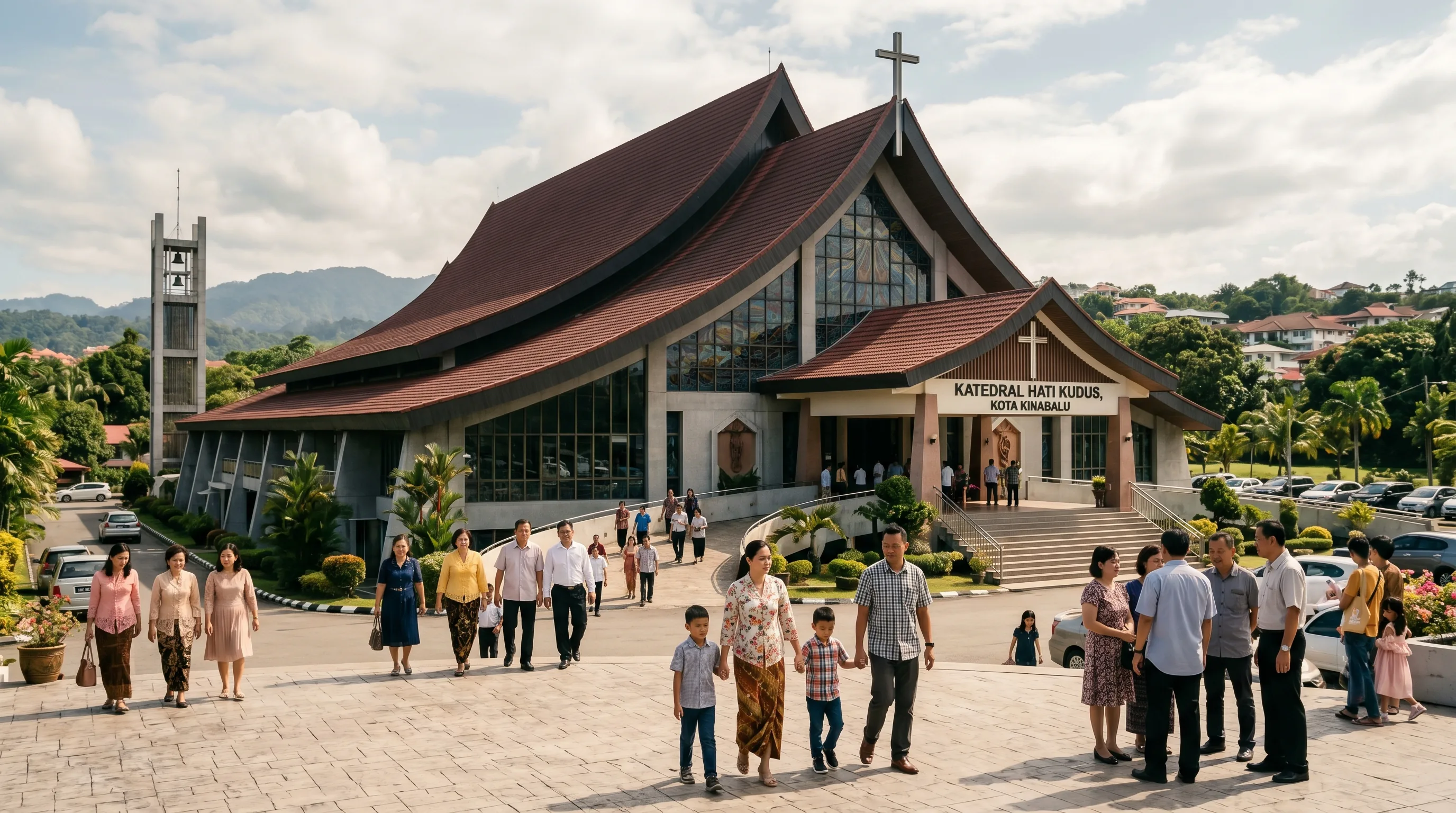
Sacred Heart Cathedral is the mother church of the Roman Catholic Archdiocese of Kota Kinabalu, built between 1979 and 1981. Its contemporary design, with a distinctive massive roof, is often said to resemble a spaceship.
Sacred Heart Cathedral at a glance
Sacred Heart Cathedral is the principal Roman Catholic church of Kota Kinabalu and one of the city's most distinctive modern buildings. As the cathedral of the Archdiocese of Kota Kinabalu, it serves as the mother church for the whole archdiocese — the seat from which the local Catholic community is led.
What strikes most first-time visitors is the building itself. Rather than the spires and stained glass of a traditional European cathedral, Sacred Heart is resolutely contemporary: a low, broad form crowned by a sweeping, oversized roof that has earned it an affectionate local nickname — the church that looks like a spaceship. Behind that striking silhouette lies a story that reaches back to the very beginnings of organised Catholicism in Malaysia.
Sacred Heart is a living place of worship, not just a landmark. Dress modestly, keep noise to a minimum, and avoid disturbing services. Photography is usually fine outside the building; ask permission before photographing the interior or anyone at prayer.
The Archdiocese of Kota Kinabalu
To understand the cathedral, it helps to understand the territory it serves. The roots of the Roman Catholic Archdiocese of Kota Kinabalu go back to 4 September 1855, when the Prefecture Apostolic of Labuan and Borneo was erected, with Don Carlos Cuarteron as its first Prefect Apostolic (Archdiocese of Kota Kinabalu timeline, checked 7 October 2026).
Over the following century and a half, that prefecture grew and was reorganised as the Catholic community expanded across North Borneo. On 25 July 1976 the Apostolic Vicariate of Jesselton became the Diocese of Kota Kinabalu (Archdiocese of Kota Kinabalu timeline, checked 7 October 2026), and Sacred Heart Church became a cathedral that year (Archdiocese of Kota Kinabalu, checked 7 October 2026). The diocese was raised to an archdiocese in 2008 (Archdiocese of Kota Kinabalu, checked 7 October 2026). Today the archdiocese centres on Kota Kinabalu, and Sacred Heart Cathedral stands at its heart as the mother church: the place where the archdiocese gathers for its most significant liturgies and where its identity is most visibly expressed.
Building the cathedral, 1979 to 1981
The present cathedral was built between 1979 and 1981. The old pro-cathedral was demolished in September 1979, foundation work started that December, and the building contract was awarded to Pemborong Pembenaan Tam Kam for about RM2.1 million. The principal architect was Shen Dah Cheong of Wisma Arkitek, working closely with the rector, Fr Tobias Chi (Archdiocese of Kota Kinabalu, checked 7 October 2026). It was formally dedicated on 21 November 1981 by Bishop Simon Fung.
Among those present at the dedication were Cardinal Jaime Sin of Manila, the Apostolic Delegate Archbishop Renato Martino, and the Mill Hill Missionaries, the religious society long associated with the Catholic mission in Borneo. The dedication marked the centenary of the Mill Hill Missionaries' arrival in 1881 (Archdiocese of Kota Kinabalu, checked 7 October 2026).
A contemporary, spaceship-like design
Sacred Heart Cathedral breaks deliberately with traditional church architecture. Fr Tobias Chi took his inspiration from pictures of neo-catechumenate churches in Spain and Italy rather than from older Gothic or colonial models (Archdiocese of Kota Kinabalu, checked 7 October 2026). The result is a building that feels modern and unusual even decades after it was built.
The plan is shaped by worship. The cathedral is narrow at the back, where the Blessed Sacrament Chapel is located, and widens toward the front, opening out to accommodate the congregation. Fr Chi himself likened this base design to a spaceship. Crowning the whole structure is a massive roof, which he likened to a tent, the meeting place of the people of God in the Old Testament. The chapel at the back faces the main road and acts as a sound barrier for the main hall.
The wider Catholic story in Sabah
The cathedral stands on the site of the Jesselton Mission, founded by Fr Henry van der Heyden in 1903. A church built there was blessed in 1938 but bombed in 1945, leaving only its foundation and some pillars. A post-war church opened in 1949, and its structural problems led to the present building (Archdiocese of Kota Kinabalu, checked 7 October 2026).
That sequence traces the arc of Catholic life in the capital: from a small mission serving mostly Hakka farmers and a mixed community, through wartime destruction, to the contemporary cathedral that anchors the archdiocese today.
Visiting Sacred Heart Cathedral
Sacred Heart Cathedral sits in Kota Kinabalu and is easy to reach for visitors exploring the city. As an active cathedral, it welcomes respectful visitors, and its striking exterior makes it a worthwhile stop even for those interested only in the architecture. The archdiocese lists Masses at 6:00 am Monday to Saturday (English), 6:00 pm Saturday (English), and on Sunday at 7:00 am (Chinese), 9:00 am (English) and 10:45 am (Bahasa Malaysia) (Archdiocese of Kota Kinabalu, checked 7 October 2026). Check the parish before travelling, as times can change.
A few simple courtesies go a long way. Dress modestly, as you would at any place of worship. Photography is usually permitted outside the building, where the dramatic roofline is best appreciated; if you would like to photograph inside, ask first. Be mindful of services in progress, and remember that for many in Kota Kinabalu this is not a tourist attraction but the spiritual centre of their community.
If Sabah's faith landmarks interest you, pair Sacred Heart with the historic St. Michael's Church in Sandakan and the photogenic KK City Mosque for a rounded picture of the state's religious heritage.