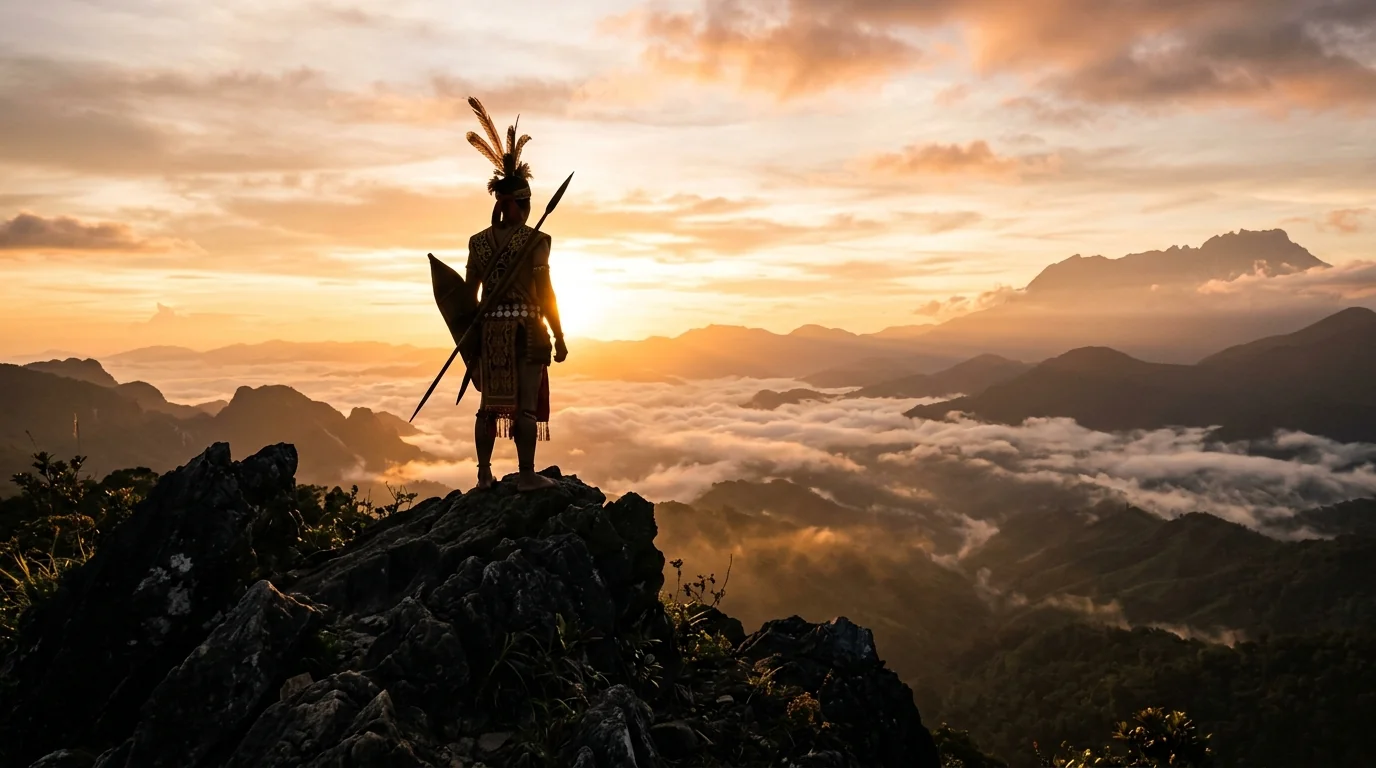
Mat Salleh Rebellion (1894–1900): Sabah's Greatest Indigenous Resistance
Who was Mat Salleh?
Datu Muhammad Salleh, widely known as Mat Salleh, was a Bajau chief from the Lingkabo district along the Sugut River in northern Sabah. Born into a respected indigenous family, Mat Salleh emerged as a powerful local leader with significant influence over the communities under his jurisdiction. Before the rebellion, he was a wealthy and prominent figure, commanding respect among his people and maintaining considerable economic and political power in the region.
Mat Salleh's full name and title—Datu Muhammad Salleh—reflects both his traditional status and his Islamic faith. As a datu (chief), he held authority over land, resources, and the administration of justice according to indigenous law and custom. His position was not merely ceremonial; he actively governed his territory, made decisions affecting thousands of people, and maintained diplomatic relationships with neighboring chiefs and colonial authorities.
What made Mat Salleh exceptional was his combination of traditional authority, organizational ability, and willingness to resist colonial imposition at a time when most indigenous leaders either accommodated or were overwhelmed by foreign powers. Unlike many contemporaries who capitulated to the British North Borneo Chartered Company (BNCC), Mat Salleh recognized the existential threat colonial rule posed to indigenous autonomy and acted decisively to protect his people's interests.
What caused the Mat Salleh Rebellion?
The rebellion did not emerge from ideological opposition to colonialism alone, but from concrete, devastating actions by the British North Borneo Chartered Company. The BNCC arrived in North Borneo with a mandate to exploit resources and establish colonial control, but their methods systematically undermined indigenous authority and stripped communities of wealth and autonomy.
Three grievances drove Mat Salleh to rebellion: unfair taxation, land confiscation, and imposition of foreign laws. The BNCC imposed taxes on indigenous populations far exceeding traditional tribute obligations, extracting wealth from communities with minimal return of services or infrastructure. Simultaneously, the company claimed vast tracts of land for its own economic interests—rubber plantations, timber concessions, and trading monopolies—effectively dispossessing indigenous communities of ancestral territories they had occupied and managed for generations.
Most inflammatory was the BNCC's attempt to impose British colonial law and administrative structures, directly challenging Mat Salleh's judicial authority and traditional governance systems. Indigenous customary law was displaced by colonial legal codes that indigenous people had no role in creating and that treated them as subjects rather than citizens. This assault on sovereignty—the right to govern one's own people according to one's own values and systems—proved unbearable for a leader of Mat Salleh's stature and conviction.
The immediate trigger came on August 29, 1895, when BNCC forces arrived at Mat Salleh's home in Jambongan with orders to arrest him. Rather than submit to this humiliation, Mat Salleh resisted. BNCC soldiers responded by burning and looting his village, destroying his property, and demonstrating that colonial might would crush any resistance. This act of violence transformed local grievances into open warfare.
What were the key events of the rebellion?
The Mat Salleh Rebellion unfolded over six years (1894–1900) with distinct phases, each revealing Mat Salleh's strategic thinking and the British military's struggle to contain him.
Early resistance (1894–1896): Before the dramatic 1895 arrest attempt, Mat Salleh had already begun organizing opposition to BNCC policies. Following the burning of Jambongan, he retreated inland with supporters and began fortifying positions, establishing supply networks, and recruiting allies among neighboring communities who shared his grievances against colonial exploitation.
The Gaya Island Raid (July 9, 1897): Mat Salleh's most audacious operation was a midnight naval attack on Gaya Island, the BNCC's colonial settlement off the coast of Sandakan. Leading a surprise force by sea, his warriors attacked and destroyed colonial buildings, administrative infrastructure, and supplies. This raid demonstrated that Mat Salleh's resistance was not merely local insurgency—it was capable of striking at the heart of colonial power and inflicting significant damage. The raid shocked British officials and showed indigenous populations that the BNCC could be hurt.
British intensified pursuit (1897–1899): After Gaya Island, the BNCC deployed massive military resources across northern Sabah to hunt Mat Salleh. British forces pursued him across difficult terrain, from Sandakan through the interior toward Tambunan. Despite superior weaponry and numbers, the British struggled against Mat Salleh's intimate knowledge of the landscape, his community support, and his tactical brilliance. The pursuit dragged on for years, tying up significant British military resources.
Retreat to Tambunan (1899–1900): As British pressure increased, Mat Salleh withdrew to Tambunan, a mountainous district in the interior where he could fortify his position and maintain supply lines through sympathetic communities. Here, he constructed a fort and prepared for a prolonged siege.
What happened at the Battle of Tambunan?
The final confrontation of the Mat Salleh Rebellion occurred at Tambunan in early 1900. By this point, Mat Salleh had been pursued for five years across vast distances, yet he maintained an organized, equipped force and the support of multiple communities. His fort at Tambunan was a formidable defensive position, and British forces knew that taking it would require substantial military commitment.
The battle itself was a siege rather than a single engagement. British forces surrounded Mat Salleh's fortifications and attacked repeatedly. Mat Salleh and his followers, numbering in the hundreds, mounted a determined defense. The siege lasted weeks, with ongoing skirmishes and attacks. British cannons and superior firepower gradually wore down the defenders' position, though not without significant British casualties.
According to British historical records, Mat Salleh was killed during the final assault on his fort in January 1900. British accounts claim he died fighting alongside his men, refusing to surrender. However, the circumstances of his death and the verification of his body became matters of intense historical dispute. Mat Salleh's death marked the collapse of organized resistance at Tambunan, though pockets of indigenous resistance continued in some areas until approximately 1905.
The Battle of Tambunan was militarily significant as a demonstration of the costs of colonial conquest. It took six years, thousands of troops, and sustained military operations for the British to suppress one indigenous leader and his followers. The battle stands as testimony to Mat Salleh's extraordinary leadership and the depth of community commitment to his cause.
Did Mat Salleh really die at Tambunan?
This question remains one of the most intriguing historical mysteries in Sabah. British colonial records state definitively that Mat Salleh was killed at Tambunan in early 1900, and this account has been incorporated into official Malaysian history texts. However, indigenous oral histories—the memories preserved and transmitted by Mat Salleh's communities for over 120 years—tell a different story.
According to oral traditions maintained among Bajau and Dusun communities, Mat Salleh may not have died at Tambunan at all. Some accounts suggest he escaped the siege, slipped away to remote areas, and survived for years afterward. Others claim that the British, unable to locate Mat Salleh after the fort fell, executed a man they believed was him or misidentified a fallen warrior. The fact that British forces never displayed Mat Salleh's body publicly—a common colonial practice to prove victory and deter future resistance—fuels skepticism about their account.
Indigenous communities maintained shrines and memorial sites to Mat Salleh that suggest they believed him to have survived longer than 1900. These oral histories were not written down in official records, making them difficult to verify by conventional historical methodology. However, they represent a legitimate counter-narrative to British accounts.
Modern historians acknowledge this ambiguity. While the British official record claims his death in 1900, the absence of definitive physical evidence and the persistence of alternative accounts in oral tradition suggest the truth remains uncertain. What is beyond dispute is that Mat Salleh's resistance ended by 1905, that he ceased to be a significant military threat, and that British control was firmly established thereafter. Whether he died at Tambunan or elsewhere, his rebellion fundamentally challenged colonial power and demonstrated indigenous capacity for organized, sustained resistance.
Why is Mat Salleh a national hero today?
Mat Salleh is officially recognized as a Malaysian national hero—one of the few indigenous resistance leaders to receive this honor. This recognition reflects appreciation for his principled stand against colonial exploitation and his unwillingness to accept foreign domination of his people.
In modern Malaysia, Mat Salleh symbolizes indigenous dignity and the right to self-determination. His rebellion occurred at a time when colonialism seemed inevitable and overwhelming, yet he mounted sustained, organized resistance that required six years and massive military force to suppress. For indigenous communities in Sabah and Malaysian society generally, Mat Salleh represents the refusal to be passively colonized—the assertion that indigenous peoples have rights that cannot be legitimately stripped away by external powers.
His portrait appears in government buildings throughout Sabah and in school history textbooks used to teach Malaysian students about their nation's past. Students learn about Mat Salleh alongside other national heroes who fought against colonialism or foreign occupation. This educational presence ensures that each generation understands his significance and remembers that Malaysian independence was not a gift granted by colonial powers but something for which indigenous leaders fought.
Mat Salleh is officially commemorated as a Malaysian national hero. His portrait hangs in government buildings across Sabah. School textbooks throughout Malaysia teach his story as an essential part of the nation's resistance to colonialism. Tambunan district hosts annual cultural events honoring his legacy. The Mat Salleh Memorial Monument in Tibabar village, managed by the Sabah Museum, stands as a permanent tribute to his struggle.
The Tambunan district has embraced Mat Salleh as a symbol of local pride and identity. Cultural events and commemorations throughout the district keep his memory alive and connect contemporary residents to their history of resistance and leadership. For many Sabahans, Mat Salleh represents a golden age of indigenous independence before colonial rule, and honoring him means reasserting indigenous identity in post-colonial Malaysia.
Internationally, Mat Salleh's rebellion has attracted scholarly attention as one of the most significant anti-colonial uprisings in Southeast Asian history. His story challenges narratives that portray colonialism as a smooth, unopposed process and demonstrates that indigenous peoples mounted sophisticated, sustained resistance to colonial domination.
Key events timeline
| Date | Event | Location | Significance |
|---|---|---|---|
| 1894–1895 | Mat Salleh organizes resistance to BNCC taxation and land policies | Northern Sabah (Lingkabo, Sugut region) | Early coordination phase; grievances crystallize into organized opposition |
| August 29, 1895 | BNCC forces burn and loot Jambongan village; Mat Salleh resists arrest and flees | Jambongan | Trigger event; transforms local grievances into open rebellion |
| 1895–1897 | Mat Salleh retreats inland, fortifies positions, recruits supporters from multiple communities | Interior northern Sabah | Establishes network of supporters and supply lines; British pursue without success |
| July 9, 1897 | Midnight naval raid on Gaya Island colonial settlement; destruction of buildings and infrastructure | Gaya Island (off Sandakan) | Demonstrates indigenous capacity to strike at colonial power; shows rebellion extends beyond local resistance |
| 1897–1899 | British intensify pursuit across northern Sabah; forces pursue Mat Salleh across vast distances | Sandakan to Tambunan interior | Multi-year chase demonstrates Mat Salleh's evasion skills and community support |
| 1899–1900 | Mat Salleh retreats to Tambunan, constructs fort, prepares siege defense | Tambunan | Final stronghold; demonstrates continued capacity to organize and fortify |
| January 1900 | British forces assault Tambunan fort; Mat Salleh killed (official account) or disappeared (oral history) | Tambunan | End of organized rebellion; disputed death remains historical mystery |
| 1900–1905 | Scattered indigenous resistance continues in pockets; gradually suppressed | Various locations | Gradual consolidation of British control; major organized resistance ends |
Frequently asked questions
Q Was Mat Salleh the only indigenous leader to resist the British?
Q How many people supported Mat Salleh's rebellion?
Q What happened to Mat Salleh's family after the rebellion?
Q Why did it take the British six years to defeat Mat Salleh?
Q Is there physical evidence of Mat Salleh's resistance today?
Resources and further reading
- Mat Salleh Rebellion — Wikipedia article covering the full timeline and context
- Sabah Museum — Houses artifacts, documents, and displays about Mat Salleh and the rebellion
- Sabah Tourism Board — Information about the Mat Salleh Memorial Monument and Tambunan historical sites
- North Borneo History Enthusiasts — Community-maintained resource for colonial era history
- Rundum Rebellion (1915–1916) — The next significant indigenous uprising in Sabah