West Coast Bajau: Cowboys, Horses & Kota Belud Culture
Who are the Bajau of Sabah?
The Bajau are Sabah's second-largest ethnic group, numbering approximately 500,000+ and making up around 14–17% of the state's population. They are Austronesian peoples speaking languages of the Sama-Bajau family — one of the most widely dispersed maritime language clusters in Southeast Asia, with related communities scattered across the Philippines, Indonesia, and Brunei.
In Sabah, the Bajau divide into two very different communities that share a name but little else: the West Coast Bajau (Bajau Darat, or Sama Taud) — the subject of this page — and the Bajau Laut (Sama Dilaut), the sea nomads of Semporna. The West Coast Bajau are settled, land-based, devoutly Muslim rice farmers and horsemen. Their traditional homeland is the Kota Belud district on Sabah's north-west coast, and their reputation for spectacular horsemanship has earned them the nickname "Cowboys of the East."
What is the difference between West Coast Bajau and Bajau Laut?
Despite sharing a name, the West Coast Bajau and Bajau Laut are culturally and geographically distinct, having diverged over centuries of very different lifestyles.
| Feature | West Coast Bajau (Bajau Darat) | Bajau Laut (Sama Dilaut) |
|---|---|---|
| Location | Kota Belud, Tuaran, Putatan, Papar | Semporna, Mabul, Omadal, Lahad Datu |
| Traditional lifestyle | Land-based farming, rice cultivation, horsemanship | Sea nomadic; boats and over-water stilt houses |
| Religion | Sunni Islam (devout) | Islam (some traditional animist practices remain) |
| Famous for | Horse parade, Tamu Besar Kota Belud, equestrian culture | Free diving 60m depth, Regatta Lepa, stateless crisis |
| Citizenship status | Malaysian citizens | ~78% stateless or undocumented (2024 estimates) |
| Language | Bajau West (Sama dialect); Malay widely spoken | Sama Dilaut; considered a separate language |
| Traditional architecture | Elevated stilt houses (rumah wakaf) in villages | Over-water stilt villages and lepa-lepa boats |
For the complete profile of the Bajau Laut and their current human rights situation, see the dedicated Bajau Laut guide.
Why are the Bajau called Cowboys of the East?
The "Cowboys of the East" nickname comes from the West Coast Bajau's extraordinary tradition of horseback riding. In Kota Belud district, Bajau men have bred, trained, and ridden horses for centuries — a remarkable distinction in a region where most indigenous peoples farmed on foot or navigated by boat.
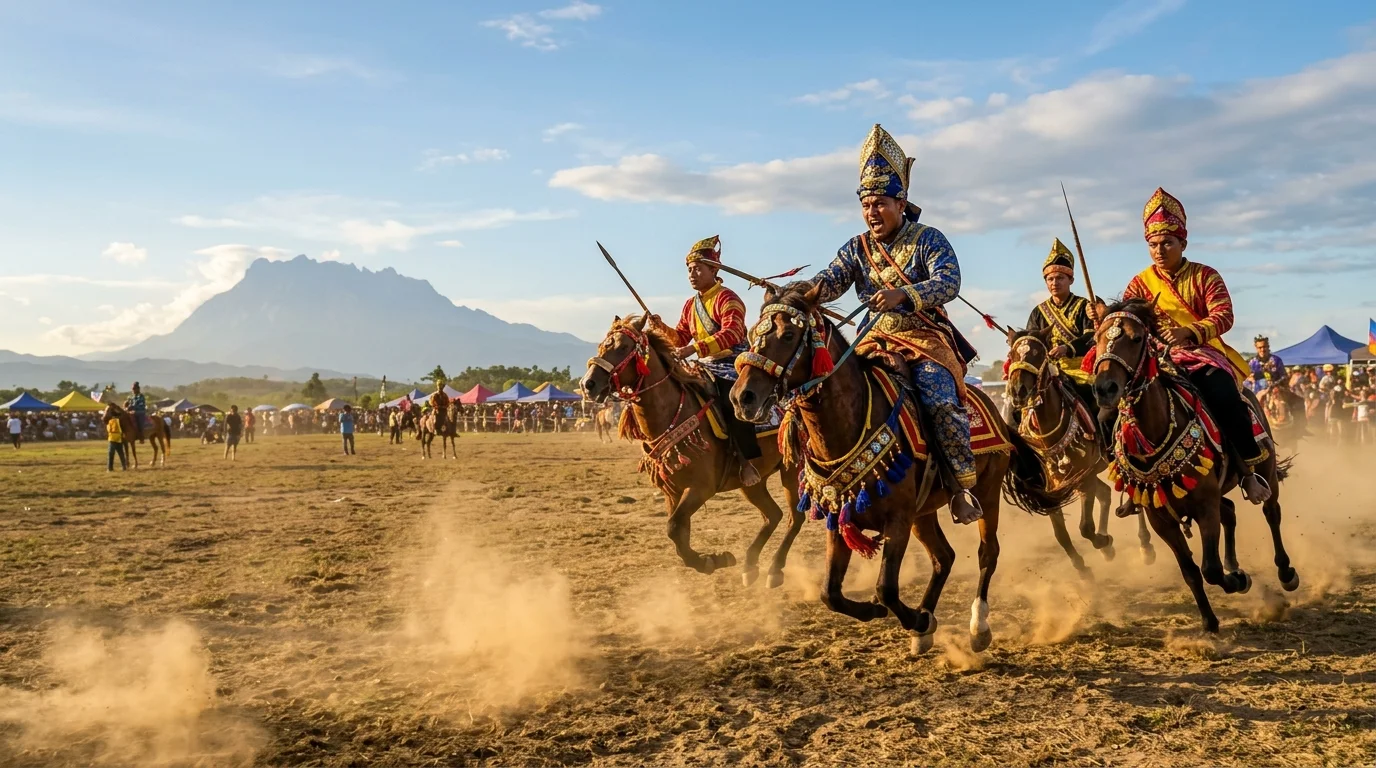
The horses themselves are a Sabah institution. They are smaller than typical thoroughbred horses — closer to a sturdy pony — but are strong, sure-footed, and well-suited to the coastal lowlands of Kota Belud. The Bajau decorate their horses with elaborate ceremonial gear for the annual Tamu Besar: woven fabric saddle cloths, brass bells, colourful tassels, and ornamental headpieces. The riders wear their finest traditional attire — bright yellow and green with silver jewellery — and perform coordinated galloping displays across open fields.
The tradition is believed to date back to trade connections with the Philippines and the Islamic trading networks of the Sulu Sea. Horses were status symbols and practical tools for patrolling the coastal territories of Kota Belud, Tempasuk Bay, and Tuaran. Today, the horse tradition is primarily ceremonial but remains a powerful symbol of Bajau identity and pride.
What is the Tamu Besar Kota Belud horse parade?
The Tamu Besar Kota Belud is Sabah's most iconic cultural gathering — an annual market and festival held in November in Kota Belud town, approximately 75 km north of Kota Kinabalu. The centrepiece is the Bajau horse parade: dozens of horsemen in full ceremonial regalia galloping across a large open field in coordinated formations, to the sounds of gongs and traditional music.
The tamu (market) component of the event brings together Bajau, Kadazan-Dusun, Rungus, and other communities from across northern Sabah. The market features fresh produce, livestock, traditional weapons, handwoven Bajau cloth, silver jewellery, and local crafts. It's one of Sabah's most authentic cultural markets — not designed primarily for tourists but for local trade and community gathering.
For visitors, the Tamu Besar offers a rare window into Bajau equestrian culture at its most formal and ceremonial. The horse parade typically runs for 2-3 hours in the morning. Photography is welcome. Sabah Tourism Board usually lists the exact November date on their events calendar at sabahtourism.com.
Beyond the Tamu Besar, the regular Kota Belud Sunday Tamu operates every week and is one of Sabah's best weekly markets for experiencing authentic Bajau community life, local crafts, and fresh highland produce.
Kota Belud is about 75 km from Kota Kinabalu — roughly 1.5 hours by car via the coastal highway. Mini-buses operate from Inanam Bus Terminal in KK. For the Tamu Besar horse parade, arrange your own transport as public buses may be overcrowded. Several KK-based tour operators offer day-trip packages to the Tamu Besar in November.
What does traditional Bajau attire look like?
Traditional West Coast Bajau attire is visually striking — bright, bold colours (yellow, green, red, gold) contrasting sharply with the black-dominated dress of Kadazan-Dusun neighbours. It reflects the Bajau's proud Islamic heritage and seafaring aesthetic.
Women's attire: A bright-coloured blouse and sarong or skirt, decorated with gold thread embroidery. The sarempak is a two-part silver headpiece worn by unmarried women, resembling the curved prow of a traditional boat — a visual echo of the Bajau's maritime origins. Silver jewellery — necklaces (rantai), bracelets, rings — is worn in abundance. The colours vary by occasion: brighter for weddings, more subdued for daily wear.
Men's attire (horsemen): For the Tamu Besar, horsemen wear a bright-coloured satin or brocade baju (top) and sarong or pants, a silver-decorated belt, and a destar (ceremonial head covering). Silver kris sheaths and ornamental weaponry are carried as ceremonial accessories. The combination of rich colour and silver metalwork is meant to project both Islamic elegance and martial pride.
Bajau traditional attire can be seen year-round at craft stalls in Kota Belud's Sunday Tamu, and at full ceremonial intensity at the Tamu Besar. Some Penampang craft shops also stock Bajau cloth alongside Kadazan-Dusun items.
What language do the Bajau speak?
West Coast Bajau speak the Bajau West dialect of the Sama-Bajau language family — an Austronesian language closely related to Tausug (spoken by the Suluk of East Sabah) and to various Philippine Sama languages. The language is also called Sama Taud or simply Bajau.
West Coast Bajau language has an estimated 150,000–200,000 speakers in Sabah, making it one of the larger indigenous languages. Malay is widely spoken as a second language — most Bajau in urban and peri-urban areas use Sabah Malay as their primary daily language, with Bajau reserved for family and community settings.
The language has an oral tradition of daling-daling (traditional songs often dealing with love and longing), iko-iko (storytelling), and gong music compositions. UNESCO classifies West Coast Bajau as Vulnerable — generational transmission is weakening in urban areas as young people shift to Malay.
What is Bajau traditional food and culture?
West Coast Bajau cuisine reflects their coastal location and agricultural lifestyle — seafood, rice, and tropical fruits are staples. Traditional Bajau dishes include:
Nasi Kuning (turmeric rice): Yellow rice cooked with coconut milk and turmeric, served at weddings and celebrations with curried fish or chicken. A visual and flavour centrepiece of Bajau festive food.
Ikan Bakar (Grilled Fish): Fresh fish from Tempasuk Bay grilled over charcoal with spice rubs. The coastal villages of Kota Belud are renowned for the quality of their daily catch including tenggiri (Spanish mackerel), kerapu (grouper), and prawns.
Ambuyat: Sago starch dish — also eaten by Brunei Malay and Murut communities. Thick, starchy porridge-like paste eaten by twirling onto a bamboo fork and dipping into sharp sour-spicy sauces.
Kuih-muih Bajau: Traditional Bajau sweets and cakes, often made with coconut, glutinous rice, and palm sugar. Prepared in large quantities for Hari Raya celebrations.
Beyond food, Bajau cultural life centres on Islamic celebrations — Hari Raya (Eid al-Fitr and Eid al-Adha) are the biggest community festivals, featuring communal prayers, open-house visits, and traditional music. Kompang (frame drum) processions are central to weddings, circumcision ceremonies, and Maulid al-Nabi celebrations.
What religion do the Bajau follow?
The West Coast Bajau are Sunni Muslim and have been so for several centuries. Their conversion to Islam came through the influence of the Brunei Sultanate from the 15th-16th century, and through maritime trade networks connecting Sabah's west coast to Sulawesi, Sulu, and the Malay heartland. Their Islamic identity is deeply felt and central to Bajau self-understanding.
The Friday mosque is the social and spiritual heart of every Bajau village. Masjid attendance, Quran recitation, and Islamic education are prioritised from childhood. The Bajau observe all Islamic practices including daily prayers, Ramadan fasting, and the Hajj pilgrimage for those who can afford it.
The Bajau's Islamic identity sometimes creates cultural contrasts with neighbouring Kadazan-Dusun (predominantly Christian) communities — yet in Sabah's famously tolerant social environment, inter-ethnic and inter-religious friendships, business partnerships, and even marriages between Bajau and Kadazan-Dusun families are common. The Kota Belud Sunday Tamu is a perfect example: Christians, Muslims, and animists shop, trade, and socialise together without friction.
Where do the Bajau originally come from?
The origins of the Bajau are one of Southeast Asian history's most debated questions. Linguistic analysis places the Sama-Bajau language family within the Austronesian migrations that dispersed from the Taiwan-Philippines corridor approximately 2,500-4,000 years ago. The Bajau's closest linguistic relatives are the Tausug of the Sulu Archipelago and various Sama-speaking communities scattered across the Philippine and Indonesian islands.
One historical theory traces the Bajau to the Riau Islands of Indonesia or the Philippines, from which they spread across the Sulu Sea and into the waters of North Borneo. The name "Bajau" itself has unclear etymology — some linguists suggest it derives from a word meaning "people who have gone to sea." Traditional Bajau oral histories describe a great dispersal from a homeland (often referenced as somewhere in the Philippine archipelago) after a political collapse or natural disaster.
The West Coast Bajau's horse tradition distinguishes them historically from other maritime Austronesian peoples. Horses were likely introduced through trade with the Philippines and possibly Sulawesi, where horse culture is also strong among related groups. The Bajau's integration of horse culture into their coastal, rice-farming identity makes them uniquely positioned between the maritime and agricultural worlds of Sabah.