Languages of Sabah: 80+ Languages & Endangered Tongues
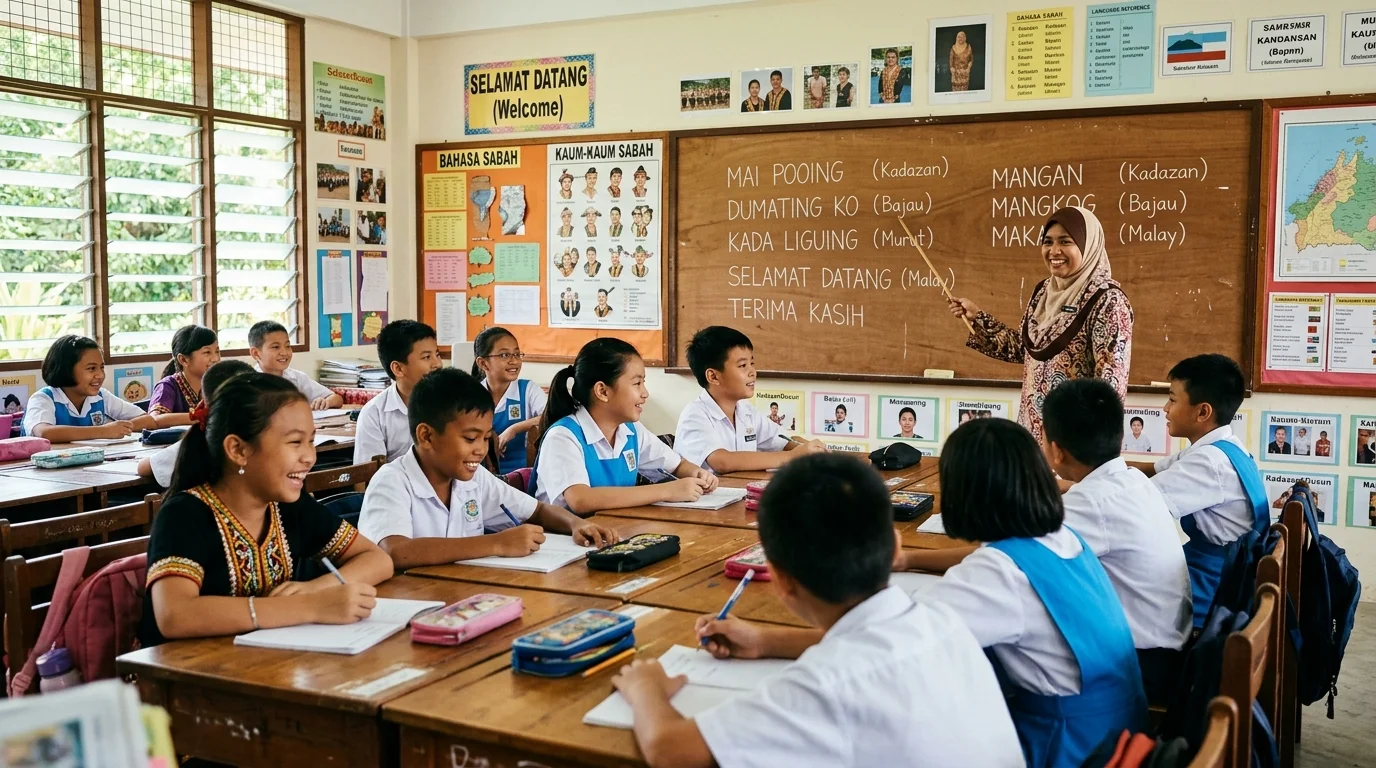
Sabah is a linguistic wonder. A state of 4 million people is home to over 80 distinct languages — more linguistic diversity than many entire countries. These languages span multiple families, represent thousands of years of migration and cultural exchange, and range from widely spoken regional languages to tongues spoken by fewer than 500 people in remote valleys. Understanding Sabah's languages is understanding Sabah itself.
How Many Languages Are Spoken in Sabah?
Sabah has over 80 languages and dialects, according to surveys by Universiti Malaysia Sabah (UMS) and the Summer Institute of Linguistics (SIL). Ethnologue (2024 edition) catalogues approximately 62 living languages for Sabah, but this count excludes many local dialects treated as variants. The Summer Institute of Linguistics Malaysia recognises closer to 80 when sub-dialects are included.
To put this in perspective: the entire European Union has around 24 official languages across 27 countries. Sabah, a state roughly the size of Ireland, has more than three times that number. This extraordinary diversity is the result of thousands of years of Austronesian migration, trade-route contact, and geographic isolation across Borneo's mountain ranges and river systems.
What Language Families Are Found in Sabah?
Nearly all of Sabah's indigenous languages belong to the Austronesian family — the world's largest language family by number of languages, stretching from Madagascar to Easter Island. Within Austronesian, Sabah's languages fall into several branches:
| Branch / Family | Key Languages | Spoken By | Approx. Speakers in Sabah |
|---|---|---|---|
| Dusunic | KadazanDusun, Rungus, Bundu-Liwan, Lotud | KadazanDusun, Rungus | ~550,000+ |
| Murutic | Timugon, Tagal, Kalabakan, Paluan | Murut subgroups | ~100,000 |
| Paitanic | Rungus, Tombonuo, Abai Sungai | Rungus, Tombonuo | ~100,000 |
| Sama-Bajau | Sama Taud, Sama Dilaut, West Coast Bajau | Bajau, Bajau Laut | ~450,000 |
| Malayo-Polynesian (Malay) | Brunei Malay, Kedayan, Sabah Malay, Bisaya | Melayu Sabah, all communities (lingua franca) | ~600,000+ (incl. L2 speakers) |
| Philippine-type (Sulu) | Tausug, Yakan, Molbog | Suluk / Tausug | ~250,000+ |
| Lun Bawang / Lundayeh | Lundayeh, Lun Bawang | Lundayeh | ~15,000 |
| Sino-Tibetan (Chinese) | Hakka, Cantonese, Hokkien, Mandarin | Chinese Sabahans | ~300,000 |
What Are the Major Languages of Sabah?
Several languages dominate by speaker count and cultural visibility:
KadazanDusun is the largest indigenous language group in Sabah, with an estimated 550,000–600,000 speakers across numerous dialects. The standardised written form, developed by the Kadazan Dusun Cultural Association (KDCA), uses a Latin alphabet. Major dialects include Bundu-Liwan (Ranau), Lotud (Tuaran), Rungus (Kudat), and Kadazan Penampang.
Bajau (Sama-Bajau group) languages are spoken by approximately 450,000 people across Sabah. West Coast Bajau (Sama Taud) and Bajau Laut (Sama Dilaut) are distinct languages rather than dialects — mutually intelligible to a limited degree, with significant vocabulary and phonological differences.
Murut languages form a cluster of roughly 15 related languages spoken by an estimated 100,000 people in Sabah's interior. Timugon Murut, spoken in the Tenom valley, is the largest and became the first Murut language to be piloted in Sabah primary schools in 2024.
Tausug (Suluk) is spoken by an estimated 250,000+ people in Sabah's east coast, though stateless populations inflate uncertainty in exact figures. It belongs to the Philippine language group and is mutually intelligible with dialects spoken across the Sulu archipelago.
Why Is Sabah Malay Everyone's Second Language?
Sabah Malay (also called Bahasa Sabah or simply "BM Sabah") is the creole-influenced lingua franca that emerged from centuries of inter-ethnic contact in Sabah's coastal trading centres. Unlike Standard Bahasa Malaysia, it was never designed by committee — it evolved organically as communities needed a common tongue.
Key features that distinguish Sabah Malay from standard Malay include the iconic "bah" discourse particle (used for agreement, emphasis, and casual sentence endings), the use of "sudah" as a past tense marker (e.g., "Saya makan sudah" — "I have eaten"), vocabulary borrowed from KadazanDusun and Bajau, and a generally faster, more clipped cadence.
Crucially, Sabah Malay is spoken across ethnic lines. A KadazanDusun farmer from Tambunan, a Bajau fisherman from Kota Belud, and a Chinese shopkeeper in Sandakan will all switch to Sabah Malay when communicating with each other. This makes it functionally more important for daily life than either Bahasa Malaysia (formal) or any individual ethnic language.
Which Sabah Languages Are Endangered?
UNESCO's Atlas of the World's Languages in Danger classifies several Sabah languages as vulnerable or endangered. The primary threat is language shift — younger speakers choosing to use Sabah Malay or Bahasa Malaysia in daily life rather than their ancestral tongue, because these offer greater economic and social mobility.
| Language | UNESCO Status | Est. Speakers | Threat |
|---|---|---|---|
| Timugon Murut | Vulnerable | ~30,000 | Youth shifting to Sabah Malay; school pilot started 2024 |
| Sungai (Abai Sungai) | Vulnerable | ~8,000 | Small community; no formal education support |
| Ubian (Sama-Bajau subgroup) | Endangered | <5,000 | Marginalised stateless community; no institutional support |
| Paluan (Murut) | Endangered | <3,000 | Interior Sabah; limited documentation |
| Tombonuo | Vulnerable | ~20,000 | Paitanic branch; Kinabatangan area; limited resources |
| Bisaya (Sabah) | Vulnerable | ~25,000 | Shifting to Sabah Malay; no school programme |
Linguists at UMS estimate that without intervention, several smaller languages with fewer than 5,000 speakers could become dormant (no fluent speakers under 40) within two generations — by approximately 2060–2080. The loss of a language means the loss of the entire knowledge system encoded in it: plant names, ecological knowledge, ceremonial traditions, and oral history.
What Chinese Languages Are Spoken in Sabah?
Sabah's Chinese community (~310,000 people, 9% of citizen population) maintains several distinct Chinese languages brought by different waves of immigration since the 1880s:
Hakka is the dominant Chinese language in Sabah, spoken by approximately 57% of Sabah's Chinese population. This reflects the deliberately Hakka-focused immigration policy of the British North Borneo Chartered Company, which recruited Hakka settlers from Guangdong and Fujian provinces beginning in 1883 to work in agriculture. Sabah's Hakka dialect retains distinctive features that differ from Hakka spoken in Peninsular Malaysia.
Cantonese is prominent in Sandakan, historically Sabah's most cosmopolitan port city, where Cantonese merchants dominated trade in the early 20th century. Hokkien is concentrated in Kota Kinabalu and coastal trade communities. Teochew is spoken in Tawau, linked to the economic migration of Teochew traders from Sibu (Sarawak). Hainanese is the smallest group, associated with the restaurant and hospitality trade.
Mandarin is increasingly the common language among younger Chinese Sabahans who attended Chinese-medium primary schools (SJKC), where Mandarin is the medium of instruction. This represents a language shift from ancestral dialects toward a more standardised Chinese language.
What Is Being Done to Preserve Sabah Languages?
Language preservation in Sabah is happening on multiple fronts — government, academic, community, and digital.
The Kadazan Dusun Cultural Association (KDCA) is the most active language preservation body in Sabah. The KDCA publishes KadazanDusun dictionaries, organises language competitions at the Pesta Kaamatan festival, and funds curriculum development for the Pupil's Own Language (POL) programme. A landmark 2024 initiative — a RM7.5 million partnership between Yayasan Bank Rakyat and Sultan Idris Education University — funds KadazanDusun language scholarships and cultural studies, supporting 30 students annually over five years.
Universiti Malaysia Sabah (UMS) runs a Department of Language Studies and an Indigenous Knowledge Research Centre that conducts field documentation of endangered languages. Faculty linguists collaborate with SIL International and international universities on grammatical descriptions, dictionaries, and corpus development. Notable recent projects include comprehensive grammars for Timugon Murut and Tombonuo.
SIL International Malaysia has operated in Sabah since the 1970s and has been instrumental in developing writing systems for previously unwritten languages, translating the Bible into indigenous languages (a key literacy driver), and producing bilingual educational materials. The Murut Timugon Bible (completed in the 1990s) and the KadazanDusun Bible remain the most-used texts in those communities' literacy programmes.
At the community level, social media is playing an increasingly important role. Facebook groups, YouTube channels, and TikTok accounts in KadazanDusun, Bajau, and Murut are organically building digital archives of songs, vocabulary, and folk stories — often without formal institutional support.
How Are Indigenous Languages Treated in Sabah Schools?
Malaysia's Pupil's Own Language (POL) programme allows indigenous languages to be taught as an elective subject in national primary schools. In Sabah, the languages currently offered under POL include KadazanDusun and Murut (Timugon dialect). The Murut language pilot in 10 Tenom district schools, launched in 2024, marks the first time a Murut language has entered the national school curriculum.
However, coverage remains limited. Of Sabah's 80+ languages, only a handful have any formal educational support. Most indigenous language speakers learn their mother tongue at home and through community events, with schools providing instruction entirely in Bahasa Malaysia and English. This structural gap accelerates language shift among children who spend more time in Bahasa Malaysia than in their ancestral tongue.
Chinese-medium primary schools (SJKC) operate as a largely self-funded parallel system and have been highly successful in maintaining Mandarin literacy across generations. As of 2024, Sabah has approximately 47 Chinese primary schools with a combined enrolment of around 35,000 students — including non-Chinese students attracted by the perceived academic rigour.
Useful Words and Phrases Across Sabah Languages
Even knowing a few words in a local language creates immediate goodwill. Here is a comparison of common words across five major Sabah languages:
| Meaning | Sabah Malay | KadazanDusun | Bajau (West Coast) | Murut (Timugon) | Rungus |
|---|---|---|---|---|---|
| Hello / Welcome | Selamat datang | Miagayo / Kumusta | Salamat | Salam | Miagayo |
| Thank you | Terima kasih | Tontolou / Tulun korikatan | Salamat | Tima kasih | Sikuru |
| Delicious | Sedap | Nando / Osonong | Namit | Namit | Nando |
| Water | Air | Tubig | Jow / Tubig | Danum | Tubig |
| Where? | Di mana? | Di iso? | Di iso? | Nung iso? | Di iso? |
| Yes | Iya / Bah | Iho / Io | Ow / Iya | Eeh | Iho |
The similarities between KadazanDusun, Bajau, and Rungus words for "water" (tubig) and "where" (di iso) reflect their shared Austronesian ancestry — linguists can trace these forms back to Proto-Malayo-Polynesian, spoken around 4,000 years ago. The Murut word for water (danum) is related to the Proto-Austronesian root for deep water, shared with languages as far away as Hawaii and Madagascar.