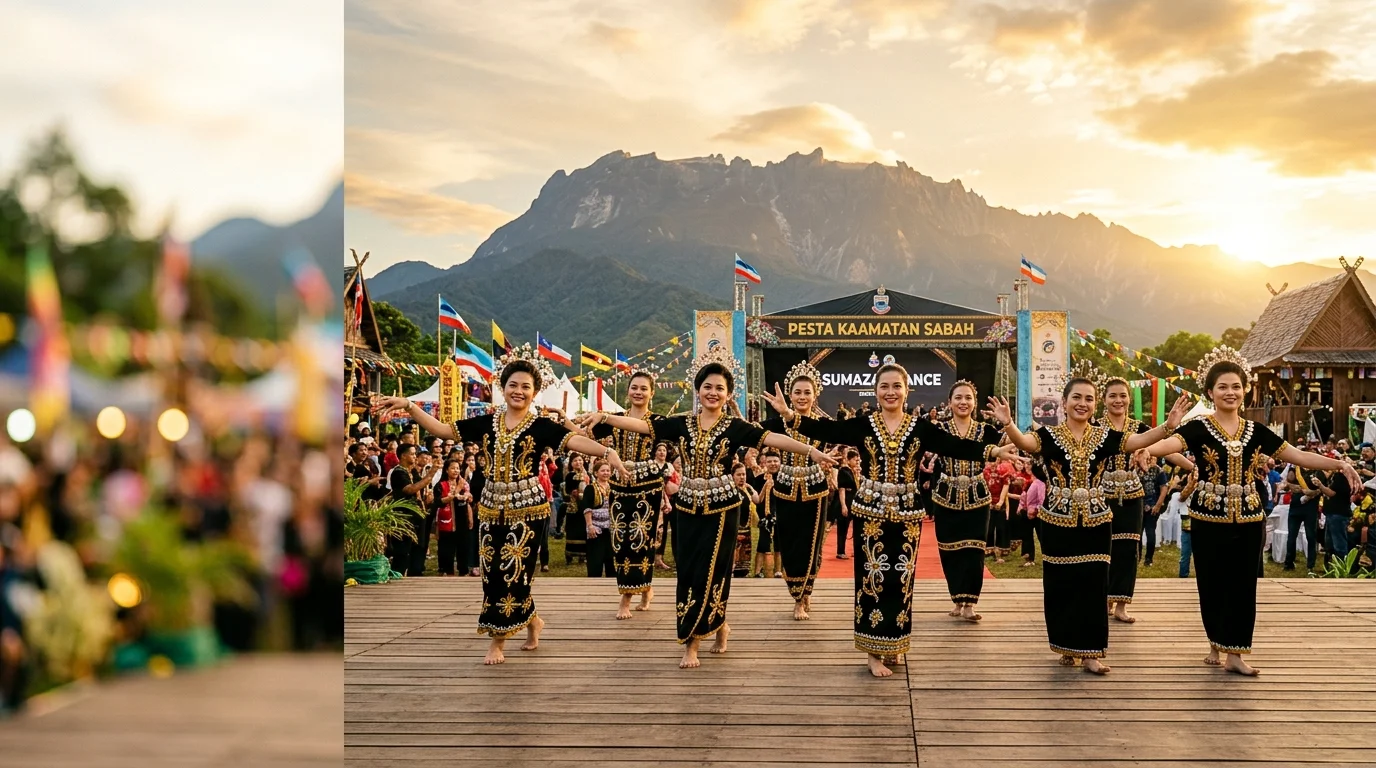
KadazanDusun People: Kaamatan, Sumazau & Sabah Culture
Who are the Kadazan-Dusun?
The Kadazan-Dusun are Sabah's largest indigenous group, making up approximately 19–30% of the state's population of 3.4 million. They are a rice-farming people of the west coast lowlands and interior highlands — the original stewards of Sabah's most fertile land. Today they number between 700,000 and 800,000, with diaspora communities in Peninsular Malaysia and beyond bringing the total above one million.
The Kadazan-Dusun are not a single homogeneous group but a collective of over 30 related sub-groups who share Austronesian linguistic roots, similar rice-cultivation traditions, and a common mythological heritage. They are bound together by the Kadazan Dusun Cultural Association (KDCA), founded in 1960, which oversees the annual Kaamatan harvest festival and advocates for Kadazan-Dusun cultural rights.
Culturally, the Kadazan-Dusun are defined by their relationship with padi (rice). Rice is not just food — it is the centre of their spiritual world. The rice spirit, Bambazon, is honoured annually at Kaamatan. The ritual specialist who communicates with spirits, the Bobolian, has guided communities through planting and harvest cycles for centuries. This deep agricultural identity shapes everything: their food, their festivals, their music, and their social structure.
Where did the Kadazan-Dusun originally come from?
According to Kadazan-Dusun oral history, the ancestral homeland of the entire people is Nunuk Ragang — a sacred site at the confluence of the Liwagu and Gelibang rivers, near present-day Tampias in Ranau district. "Nunuk" refers to the red banyan tree (Ficus retusa) that marked the site; "Ragang" means red. The story describes a great ancestral community gathered beneath this tree, who dispersed outward as their numbers grew, settling across Sabah's interior valleys, highland plains, and coastal areas.
Archaeologically, Sabah has been inhabited for at least 23,000–30,000 years. Linguistic and genetic research places the Dusunic language family within the broader Austronesian expansion that spread from Taiwan through the Philippines into Borneo approximately 3,000–4,000 years ago. The Kadazan-Dusun's ancestors were among the original Austronesian farmers who brought wet rice cultivation to Borneo.
Nunuk Ragang today is a recognised cultural heritage site. A monument stands at the confluence, and it is visited by Kadazan-Dusun as a cultural pilgrimage — particularly during Kaamatan season. The site serves as a powerful symbol of pan-Kadazan-Dusun identity that transcends sub-group distinctions.
Are "Kadazan" and "Dusun" the same people?
Historically, "Kadazan" referred specifically to the people of Penampang and Papar on the west coast — an urban, commercially active community who spoke Tangaa' (Kadazan). "Dusun" was a broader Malay term meaning "orchard people" or "hill people," applied to dozens of inland groups across Sabah's interior.
In 1989, after decades of debate, the Kadazan Cultural Association was renamed the Kadazan Dusun Cultural Association (KDCA), officially unifying Kadazan and Dusun identities under a single political and cultural umbrella. This was a pragmatic decision to increase political representation and cultural solidarity — a combined community of 700,000+ has more influence than fragmented sub-groups of 30,000–50,000.
In practice, many individuals still identify primarily by their specific sub-group — "I am Rungus" or "I am Dusun Lotud" rather than "KadazanDusun." The umbrella label is used officially (by KDCA, government, census) but daily identity remains granular. Visitors should be aware that referring to all inland Sabah indigenous peoples as simply "Kadazan" may be perceived as over-simplifying a complex mosaic of distinct communities.
What are the major Kadazan-Dusun sub-groups?
The KadazanDusun umbrella covers over 30 recognised sub-groups. Each has its own dialect, slightly distinct traditions, and geographic homeland. Below are the major sub-groups and where to find them:
| Sub-group | Primary District | Distinctive Trait | Language |
|---|---|---|---|
| Kadazan (Penampang) | Penampang, Papar | Urban centre of Kadazan identity; home of KDCA HQ | Kadazan (Tangaa') |
| Dusun Lotud | Tuaran | Renowned for ceremonial dance (Mongigol); strong weaving tradition | Lotud |
| Dusun Tempasuk | Kota Belud | Highland rice farming; border area with Bajau | Tempasuk Dusun |
| Dusun Ranau (Bundu-Liwan) | Ranau, Kundasang | Highland community near Mt Kinabalu; rice terraces | Bundu-Liwan |
| Dusun Tambunan | Tambunan | 97.6% Kadazan-Dusun district; hosts Tambunan Harvest Festival | Tambunan Dusun |
| Dusun Labuk / Sugut | Sandakan, Beluran | East coast sub-group; river valley communities | Labuk Dusun |
| Kimaragang | Kota Marudu | Northern highland group; distinct dialect | Kimaragang |
| Rungus | Kudat, Kota Marudu | Often counted separately; distinct language, famous beadwork and longhouses | Rungus (see separate guide) |
What is the Kaamatan harvest festival?
Kaamatan is the annual harvest thanksgiving festival of the Kadazan-Dusun, observed on May 30–31 as a public holiday in Sabah. It marks the end of the padi harvesting season and gives thanks to the rice spirit, Bambazon, through whom the goddess Kinoingan communicates her gift of rice to humanity.
The mythology at the heart of Kaamatan is the story of Huminodun — the daughter of the creator god Kinoingan, who willingly sacrificed herself so that her body could become the first rice plant to feed a starving world. Her spirit (Bambazon) inhabits the rice and must be honoured at harvest's end to ensure next year's abundance. The Bobolian (female ritual specialist) performs the central rites — summoning Bambazon, giving thanks, and praying for the next cycle.
The modern Kaamatan festival blends these ancient rites with a showcase of Kadazan-Dusun culture:
- Unduk Ngadau: The state beauty pageant representing Huminodun. Contestants from all districts compete at district level before the state finals at KDCA Penampang. Judging criteria include cultural knowledge, grace, and community spirit — not just appearance.
- Sumazau dance: The signature Kadazan-Dusun dance, performed by couples with slow, graceful arm movements mimicking a bird in flight. Men in black tunic and pants; women in sinuangga' (black dress) with gold belt.
- Magavau ritual: Performed by the Bobolian to call back the rice spirit; involves chanting, offerings, and the symbolic gathering of scattered rice grains.
- Lihing and Tapai: Traditional rice wines freely shared at celebrations.
- Traditional games and sports: Including buffalo races in some districts.
Kaamatan celebrations begin at district level throughout May, with the state culmination at the KDCA Hongkod Koisaan Cultural Centre in Donggongon, Penampang on May 30–31. All visitors are welcome.
For an authentic experience, attend a district-level celebration in Penampang, Tuaran, or Tambunan earlier in May rather than the main state event (which is crowded). Local celebrations feature home-cooked Hinava, Lihing served from family-made earthenware jars, and genuine community participation. Ask your hotel about district Kaamatan events in your area.
What traditional dances do the Kadazan-Dusun perform?
The Kadazan-Dusun have several distinct traditional dances, each tied to specific occasions or sub-group traditions:
Sumazau is the most widely recognised Kadazan-Dusun dance — a graceful, paired dance where arms are extended and moved slowly like a bird's wings, accompanied by the sompoton (gourd instrument) and gong ensemble. It is performed at Kaamatan, weddings, and cultural shows. It is easy for visitors to join and community members actively encourage participation.
Magunatip (also called the Bamboo Clap Dance) involves two bamboo poles clapped together rhythmically while dancers step between them, avoiding getting their feet caught. Originally associated with the Murut people, it has become widely performed at cultural events across Sabah.
Mongigol Sumundai is a traditional dance of the Lotud Dusun of Tuaran and the Rungus of Kudat. It is more stately and controlled than the Sumazau, performed by women in full traditional beaded regalia with measured, dignified movements.
Modsuling is a bamboo flute serenade — a young man traditionally played the modsuling outside a young woman's window as a form of courtship. The haunting, breathy tone of the modsuling remains one of Sabah's most distinctive musical sounds.
What traditional foods do the Kadazan-Dusun eat?
Kadazan-Dusun cuisine is rooted in the forest and the paddy field — bold, fermented flavours that reflect centuries of jungle living and subsistence farming. Several dishes have crossed into mainstream Sabah restaurant culture.
| Dish | Description | Where to Try |
|---|---|---|
| Hinava | Raw fish (usually kembung or tenggiri) marinated in lime juice, ginger, bird's eye chili, bitter gourd. Sabah's ceviche. | Kaamatan stalls; Penampang restaurants; local markets |
| Linopot | Sticky rice mixed with black rice and wrapped in layered tapisan / daun isip leaves. Traditional celebratory food, eaten as a bundle. | Kaamatan festival; Kadazan-Dusun restaurants |
| Lihing | Traditional rice wine brewed by Kadazan women using glutinous rice and natural yeast. Mild, slightly sweet, 5–15% alcohol. Served at festivals and family occasions. | KDCA events; some restaurants in Penampang; sold in bottles at Kaamatan |
| Tapai | Fermented glutinous rice or tapioca. Sweeter and lower-alcohol than Lihing. Eaten as a dessert or snack as well as a drink. | Kaamatan stalls; wet markets |
| Pinasakan | Salted/smoked fish simmered with preserved wild fruit (sosom). Deep, sour-savoury flavour. Traditional preservation method before refrigeration. | Kadazan-Dusun restaurants; local wet markets |
| Bosou | Fermented fish or pork mixed with uncooked rice and salt, packed tightly and left to ferment. Strong, pungent condiment — an acquired taste that locals love. | Kaamatan stalls; local eateries in Penampang and Tambunan |
| Tuhau | Wild ginger (torch ginger root) finely shredded and preserved with lime juice and chili. Served as a condiment or side dish. Sharp, aromatic flavour. | Kaamatan stalls; Kadazan-Dusun restaurants; night markets |
What does traditional Kadazan-Dusun attire look like?
Traditional Kadazan-Dusun attire is dominated by black cloth (symbolising the earth and fertility) with gold and silver decorative elements. The ensemble varies by sub-group — Penampang Kadazan attire differs from Tambunan Dusun or Lotud Tuaran — but shares common elements.
Women's attire (Penampang Kadazan): The sinuangga' is a black dress with gold thread embroidery along the neckline and hem. It is paired with the himpogot — a wide ornamental belt made of silver coins or decorated metal — cinched at the waist. A siga (headpiece) made of woven fabric or metalwork is worn on the head. Beaded accessories, including necklaces and bracelets, complete the ensemble. The Penampang version features the most elaborate gold-thread embroidery of all sub-groups.
Men's attire: Black tunic (siga) and pants with gold or white embroidered trim, a fabric or silver headdress (tangkong), and a decorated silver belt. Traditional weapons — the parang (machete) in a carved wooden sheath — were historically carried as part of ceremonial dress.
Traditional attire is worn at Kaamatan, weddings, KDCA cultural events, and official government ceremonies. Mass-produced versions are available at craft stalls throughout Sabah. Authentic handmade pieces — particularly those with real gold thread embroidery — can cost RM500–RM5,000 or more and are family heirlooms passed down through generations.
What language do the Kadazan-Dusun speak?
The Kadazan-Dusun speak a cluster of related but distinct Dusunic languages. Central Dusun (spoken in Ranau, Tambunan, and Keningau) has approximately 260,000 speakers and is the most widely understood dialect across sub-groups. Kadazan (Tangaa'), spoken in Penampang and Papar, has approximately 100,000 speakers. Together, the Dusunic language family encompasses 15+ dialects — not all of which are mutually intelligible.
UNESCO classifies several Dusunic dialects as Vulnerable, meaning intergenerational transmission is weakening. In urban areas, young Kadazan-Dusun increasingly use Sabah Malay as their primary language. The KDCA has published dictionaries, children's books, and educational materials to support language preservation. A landmark 2024 initiative — a RM7.5 million partnership between Yayasan Bank Rakyat and Sultan Idris Education University — provides scholarships for Kadazandusun language studies, supporting 30 students annually over five years.
Kadazan-Dusun is written in the Roman script. There is no traditional indigenous script. The KDCA established a standardised Romanized orthography to enable consistent writing and publishing across dialects.
What is the KDCA and why does it matter?
The Kadazan Dusun Cultural Association (KDCA) is the most important cultural institution in Sabah's indigenous landscape. Founded in 1960 as the Kadazan Cultural Association, it was renamed KDCA in 1989 when the Kadazan and Dusun communities formally merged their identities.
The KDCA's headquarters is the Hongkod Koisaan Cultural Centre in Donggongon, Penampang — the same complex that hosts the annual state-level Kaamatan celebrations. The centre houses a museum, performance space, library of cultural publications, and administrative offices. It is open to visitors year-round, with the most activity concentrated in May.
The KDCA's core functions include: organising the annual Unduk Ngadau at state and district level; publishing Kadazan-Dusun dictionaries, cultural guides, and children's books; advocating for Kadazan-Dusun political representation and Native Customary Rights (NCR) land issues; training Bobolian ritual specialists to preserve indigenous spiritual practices; and maintaining a database of sub-group traditions, languages, and oral histories.
The KDCA website (kdca.org.my) provides the most authoritative information on Kaamatan schedules, cultural programmes, and official positions on issues affecting the Kadazan-Dusun community.
What religion do the Kadazan-Dusun follow?
The Kadazan-Dusun are predominantly Christian — the result of Catholic and Protestant missionary activity beginning in the late 19th century and accelerating through the mid-20th century. The majority are Roman Catholic or affiliated with the Sidang Injil Borneo (SIB) Protestant church.
Before Christianity, the Kadazan-Dusun practised Momolianism — an indigenous animist religion centred on spirit worship, offerings to nature spirits, and the ritual role of the Bobolian (female shaman-priestess). Momolianism persists among older generations in more remote villages and is formally practised during Kaamatan, where the Magavau ritual retains its pre-Christian character.
In practice, many Kadazan-Dusun Christians maintain syncretic beliefs — attending church on Sundays while also participating in Kaamatan rituals, keeping traditional spirit beliefs, and observing harvest-related customs. This blending of Christian and animist practice is common across Sabah's indigenous communities and is not seen as contradictory.
A minority of Kadazan-Dusun — primarily those in border areas near Bajau communities or those who have intermarried with Muslim Malays — have converted to Islam, legally becoming "Malay" in Malaysia's official classification system. This "masuk Melayu" (entering Malay identity) phenomenon remains a sensitive political issue within Kadazan-Dusun advocacy organisations.