Rungus People: Beadwork, Longhouses & Tip of Borneo
Who are the Rungus people?
The Rungus are an indigenous people of Sabah's northernmost region — the Kudat peninsula and Tip of Borneo area — known for three things above all: their spectacular beadwork (among the finest in Borneo), their traditional longhouse (vinataang) communities, and their graceful Mongigol Sumundai dance. With a population estimated at approximately 80,000, they are a relatively small community but one of extraordinary cultural richness and visibility.
The Rungus primarily inhabit the Kudat Division — Kudat district, Kota Marudu's northern areas, Pitas district, and Banggi Island (Sabah's largest island, off the northern tip). The Kudat peninsula's red laterite roads, rolling hills, and coconut groves form the physical backdrop of Rungus life — a landscape of small farms, river valleys, and traditional villages.
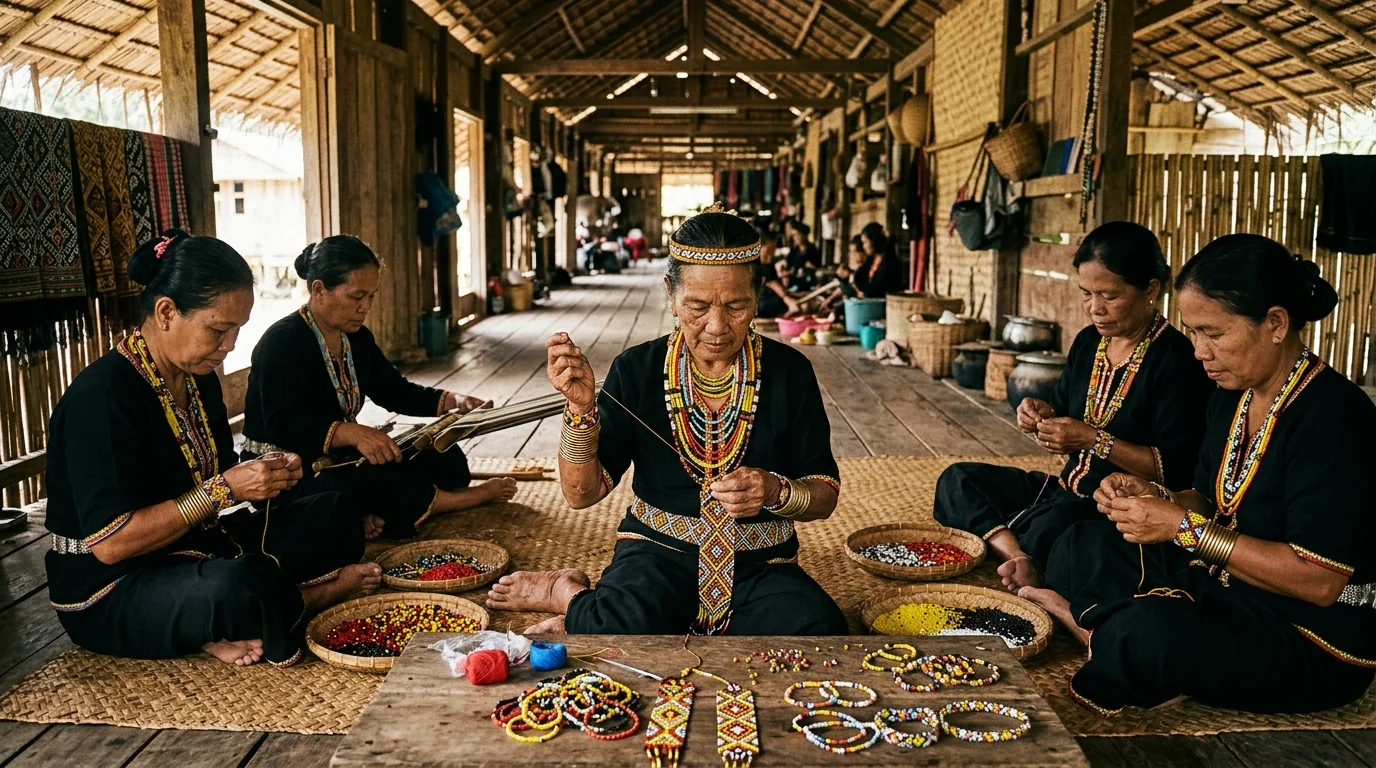
Rungus women are considered among Borneo's finest traditional artisans. The creation of beaded accessories, woven textiles, and the full pinakol beadwork vest places Rungus craftsmanship at the very top of Sabah's heritage art traditions. A single well-crafted pinakol vest may take several months of daily work and involves thousands of individually placed seed beads in intricate geometric patterns.
Are the Rungus part of the Kadazan-Dusun?
This is a nuanced question with both official and community-level answers. Officially, the Rungus are sometimes classified under the broader KadazanDusun umbrella in government census data. The KDCA (Kadazan Dusun Cultural Association) nominally represents them.
In practice and cultural identity, many Rungus consider themselves a separate and distinct ethnic group. Their language (Rungus) is classified in the Paitanic branch of the Austronesian family — linguistically related to but not mutually intelligible with Kadazan or Central Dusun. Their material culture (beadwork, longhouse architecture, dance style) is distinctly their own. Their geographic isolation on the Kudat peninsula has reinforced a separate identity for centuries.
Several Rungus organisations operate independently of the KDCA. The Rungus Development Association and community councils in Kudat maintain Rungus cultural programmes separately. When talking to Rungus individuals, refer to them as "Rungus" rather than "Kadazan-Dusun" — most will appreciate the distinction.
What is a Rungus longhouse?
The Rungus vinataang (longhouse) is one of Sabah's most intact traditional architectural forms. A longhouse is a single extended building housing 7–15 or more family units side by side under one continuous roof. Each family has its own private compartment (bilik) with a door opening onto a shared communal veranda (ruai) that runs the length of the building.
Traditional vinataang are constructed entirely from local materials: bamboo frames, rumbia leaf thatching for the roof, split bamboo floors, and hardwood structural posts. The communal veranda is the social heart of longhouse life — where daily work, socialising, celebrations, and guest reception take place. The private compartments are used for sleeping, cooking, and family storage.
Rungus longhouses function as extended family compounds. All residents share responsibilities for maintaining the building, harvesting communal rice fields, and hosting festival celebrations. The longhouse is not just architecture — it is a social and governance system. Decisions affecting longhouse residents are made collectively.
Today, full traditional longhouse living is rare in Sabah — most indigenous communities have transitioned to individual family homes. The Rungus stand out as one of the communities where longhouse culture is genuinely maintained, not as a performance for tourists but as a living reality for many families in more remote Kudat villages.
What is pinakol Rungus beadwork?
Pinakol is the signature traditional vest or jacket of the Rungus — an intricately beaded garment worn by women at cultural festivals and ceremonies. Creating a pinakol is one of the most labour-intensive traditional crafts in Sabah: thousands of seed beads are individually placed and sewn onto a black cloth base in geometric patterns using a needle and thread. A full pinakol can take three to six months of daily work to complete.
The beads themselves carry history. Traditional Rungus beadwork uses antique trade beads — Venetian seed beads, Bohemian glass beads, and Indian glass beads — collected as trade goods over generations through the Sulu Sea and Indian Ocean trade networks. These historical beads (called goboton) are treasured family heirlooms. Their colour, shape, and origin determine their cultural and monetary value. Some family bead collections contain pieces that are centuries old.
Beyond the pinakol vest, Rungus beadwork encompasses:
- Sigar — beaded necklace, stacked in multiple strands
- Rongkob — beaded collar piece worn close to the neck
- Kagang — beaded armband
- Linangkit — hand-woven skirt with geometric motifs in contrasting colours
- Beaded headdresses for special ceremonies
Each colour and geometric pattern has symbolic meaning within Rungus cosmology. Red signifies life and vitality; white represents purity and ancestral spirits; blue and black connect to the earth and night sky. The specific pattern arrangement on a piece can identify the maker's family lineage and district origin to those who can read the code.
Authentic handmade pieces are sold at Bavanggazo Longhouse, Kudat's town market, and some craft stalls in Kota Kinabalu. Prices range from RM30 for a simple bracelet to RM3,000+ for a full pinakol vest. When buying, ask the seller to explain the pattern meaning and bead origin — authentic sellers know this information; generic souvenir sellers typically do not.
What is the Mongigol Sumundai dance?
The Mongigol Sumundai is the traditional dance of the Rungus — a graceful, stately performance by women in full traditional beaded regalia. Unlike the more dynamic Sumazau (Kadazan-Dusun) or the acrobatic Lansaran (Murut), the Mongigol is characterised by controlled, measured elegance. The arms move slowly and deliberately; the footwork is precise; the overall effect is one of dignified ceremony rather than energetic performance.
The dance is accompanied by a togunggak — a bamboo tube idiophone set — and gong ensemble. Traditionally performed at longhouse ceremonies, harvest thanksgiving, and important community events, the Mongigol Sumundai has become one of the dances most associated with Rungus cultural identity.
The dance is also performed by the Lotud Dusun of Tuaran district (where it takes a slightly different form), reflecting the broader Dusunic cultural connections across northern Sabah. However, the Kudat Rungus version, performed in the full pinakol and beaded accessories ensemble, is considered the most elaborate and authentic presentation.
Where can visitors experience Rungus culture?
Kampung Bavanggazo is the primary cultural tourism destination for Rungus experiences. Located approximately 40 km south of Kudat town (30 minutes by car), Bavanggazo hosts a traditional vinataang (longhouse) where visitors can stay overnight, watch cultural performances including the Mongigol Sumundai, try traditional Rungus food, and purchase authentic beadwork directly from village women.
Maranjak Longhouse Lodge in Matunggong (also in the Kudat area) is another established option for longhouse overnight stays with cultural experiences. Both are community-operated and contribute directly to Rungus families.
Beyond these dedicated cultural destinations, the Kudat area itself rewards slow exploration. The Tip of Borneo (Tanjung Simpang Mengayau) — where the South China Sea meets the Sulu Sea — is 25 km from Kudat town and is one of Sabah's most striking natural landmarks. Combining a Bavanggazo longhouse visit with a Tip of Borneo sunset makes for an excellent Kudat day trip or overnight from Kota Kinabalu (approximately 190 km, 2.5–3 hours drive).
| Destination | Distance from Kudat | What's Available | Booking |
|---|---|---|---|
| Kampung Bavanggazo | ~40 km south | Overnight longhouse stay, cultural performance, beadwork shopping | Advance booking recommended; check Sabah Tourism or direct |
| Maranjak Longhouse Lodge | ~150 km from KK, Matunggong | Overnight stay, cultural activities, traditional food | Advance booking required |
| Kudat Town Market | In town | Fresh produce, local food, some beadwork stalls | Walk-in; morning market is most active |
| Tip of Borneo | ~25 km from Kudat | Natural landmark; Rungus surrounding area | No booking needed; entry fee applies |
What language do the Rungus speak?
The Rungus speak Rungus — classified in the Paitanic branch of the Austronesian language family. It is related to Kadazan and Dusun dialects through their shared Austronesian roots but is not mutually intelligible with them. Rungus has an estimated 80,000 speakers in Sabah, making it one of the larger indigenous languages by speaker count.
UNESCO classifies Rungus as Vulnerable — young people in urban Kudat are increasingly using Sabah Malay as their primary daily language, with Rungus maintained in family and community settings. The Rungus language has no traditional writing system and uses the Roman script in modern publications.
In addition to Rungus, community members widely speak Sabah Malay (for inter-community communication), Kadazan/Dusun (for interaction with neighbouring groups), and increasingly English (especially for tourism). The Kudat area's relative remoteness has helped preserve Rungus language use compared to more urbanised Kadazan-Dusun communities nearer Kota Kinabalu.
What religion do the Rungus follow?
The majority of Rungus today are Christian — primarily through the Sidang Injil Borneo (SIB) church and to a lesser extent Catholic missions. Conversion accelerated from the 1950s onwards, following the same pattern as the Murut and many other Sabah interior communities.
Before Christianity, the Rungus practised Momolianism — the same indigenous animist religion shared with the Kadazan-Dusun, centred on spirit world communication, the Bobolian ritual specialist, and agricultural thanksgiving rituals tied to rice planting and harvest cycles.
As with other Sabah indigenous communities, syncretic practice is common — Rungus Christians participate in harvest thanksgiving ceremonies that retain pre-Christian cosmological elements. The traditional spirit world vocabulary (harvest spirits, protective spirits of the longhouse, ancestral spirits) continues to inform cultural expression even as formal practice shifts to the church calendar. Easter and Christmas are celebrated with traditional foods, dance, and community gatherings that blend Christian and indigenous cultural elements.