Chinese Sabahans: Hakka Heritage & Sandakan History
Who are the Chinese community in Sabah?
The Chinese community in Sabah numbers approximately 310,000 — about 9% of the state's population. They are predominantly descendants of Hakka agricultural migrants who arrived from Guangdong province starting in 1883 under the British North Borneo Chartered Company's organised settlement programme. Over 140 years, the Chinese community built much of Sabah's commercial infrastructure, pioneered rubber and pepper cultivation, established the kopi tiam (coffeehouse) culture that defines Sabah's morning ritual, and created a distinctive Sabah-Chinese cuisine that blends Hakka cooking traditions with local ingredients.
Unlike other Malaysian states where specific Chinese dialect groups dominate (Hokkien in Penang, Cantonese in KL, Teochew in Johor), Sabah is uniquely Hakka. The Hakka dialect functions as the Chinese community's internal lingua franca — the language that allows a Sandakan Cantonese and a Tenom Hakka farmer to communicate. This Hakka dominance makes Sabah's Chinese community culturally distinct from Chinese communities anywhere else in Malaysia.
When did the Chinese first arrive in Sabah?
The first organised Chinese migration to Sabah occurred in 1883, when the British North Borneo Chartered Company brought approximately 400 Hakka Chinese from Huizhou and Meixian regions of Guangdong province to develop agricultural land. The BNCC recognised that the Hakka — known as industrious, adaptable highland farmers throughout their diaspora history — could develop the interior lands of North Borneo that indigenous communities were not farming intensively.
These 1883 Hakka pioneers settled in Kudat first, then spread across Sabah's interior: Sandakan, Tenom, Keningau, Beaufort, and eventually Jesselton (present-day Kota Kinabalu). They planted rubber, pepper, tobacco, and cocoa — crops that became the economic foundation of colonial North Borneo.
Subsequent waves followed: pre-World War II immigration through the 1920s–30s brought more Cantonese merchants to Sandakan (which became the "Little Hong Kong" of Sabah by the 1930s), Hokkien traders to the west coast, and Hainanese coffeehouse operators who established the kopi tiam culture that persists today. The Japanese occupation (1942–1945) devastated Sandakan's Chinese community — many were killed or displaced. Post-war reconstruction brought further immigration before Malaysia's independence in 1963 effectively ended new Chinese immigration.
The arrival of 400 Hakka farmers from Guangdong in 1883 is considered the founding moment of Sabah's Chinese community. A Chinese Consulate commemorative publication notes: "客家人到处是家" (Hakka people are at home everywhere) — capturing the Hakka spirit of adaptability. Many Sabah Chinese families today can trace their lineage directly to these 1883 pioneers. The centenary of their arrival in 1983 was marked by major community celebrations across Sabah.
What dialect groups make up Sabah's Chinese community?
Sabah's Chinese community comprises several dialect groups, each with their own cultural traditions and geographic concentrations:
| Dialect Group | Proportion | Main Cities | Historical Role |
|---|---|---|---|
| Hakka (客家) | ~57% (largest group) | Statewide; strong in Tenom, Keningau, Beaufort, rural areas | Agricultural pioneers (1883 onwards); pepper, rubber, cocoa farming |
| Cantonese (广东) | Significant minority | Sandakan (dominant), some in KK | Merchants and traders; Sandakan timber and rubber trade |
| Hokkien (福建) | Smaller presence | Kota Kinabalu, Tawau | Traders and shopkeepers; west coast commercial activity |
| Teochew (潮州) | Smaller presence | Various towns | Traders; some agricultural communities |
| Hainanese (海南) | Smaller presence | KK, Sandakan | Kopi tiam (coffeehouse) operators; historically the 'coffee shop people' |
Within Sabah, Hakka functions as the inter-Chinese lingua franca — a Chinese Hokkien from KK and a Chinese Cantonese from Sandakan will typically communicate in Hakka rather than Mandarin or Malay. This is unique to Sabah and reflects the historical dominance of Hakka migration. Mandarin is widely spoken by younger, school-educated generations. Cantonese remains strong in Sandakan.
Why is Sandakan called "Little Hong Kong"?
Sandakan earned the "Little Hong Kong" nickname through the 1920s–1950s because of its thriving Chinese merchant community, its cosmopolitan port atmosphere, and its dense shophouse architecture that genuinely resembled the Hong Kong of that era. The Cantonese community dominated Sandakan's commercial life — controlling the timber trade, rubber export, and retail commerce in a way that shaped the city's architecture and social character for generations.
American writer Agnes Keith lived in Sandakan from 1934–1952 with her British colonial administrator husband and wrote about the city's multicultural vibrancy in her 1939 memoir Land Below the Wind. She described Sandakan's Chinese quarter as one of the most sophisticated commercial environments in British North Borneo — Chinese merchants hosting elaborate dinners, opera performances, and maintaining social rituals that connected them to Hong Kong and Canton more than to Kuala Lumpur.
Sandakan's Japanese occupation (1942–1945) devastated this community. The famous Sandakan Death Marches — forced marches of Allied prisoners of war — passed through or near Sandakan's Chinese neighbourhoods. Many Chinese residents were killed for supporting resistance activities. Post-war Sandakan rebuilt, but the population never fully recovered to pre-war levels.
Today, Sandakan's old town still has colonial-era Chinese shophouses from before World War II. The Sandakan colonial history page covers this heritage in detail. The Sam Sim Kung Temple and several clan association buildings remain active community institutions.
What is uniquely Sabah Chinese food?
Sabah Chinese food is a blend of Hakka, Cantonese, and Hokkien traditions adapted to local ingredients over 140 years. Several dishes are unique to Sabah or have distinct Sabah versions:
| Dish | Description | Origin | Where to Try |
|---|---|---|---|
| Tuaran Mee | Wavy egg noodles — pan-fried crispy then tossed in wok with broth, char siu, prawns. Unique to Sabah. | Tuaran district; Sabah creation | Any KK coffee shop; Tuaran town itself |
| Hakka Mian Xian | Thin wheat noodle in clear pork broth; topped with meatballs and braised tofu. Simple, clean flavour. | Hakka Guangdong tradition | Pasar malam; breakfast stalls in KK, Keningau, Tenom |
| Dim Sum (Yumcha) | Major Sunday morning tradition in KK. Restaurants open from 6am. Dozens of varieties of har gow, siu mai, char siu bao. | Cantonese tradition; adopted statewide | Major KK restaurants on weekends; also Sandakan |
| Kopi C + Roti Kahwin | Hainanese-style kopi tiam coffee (with evaporated milk) + toast with kaya (coconut jam) and butter. Sabah morning ritual. | Hainanese kopi tiam tradition | Any traditional kopi tiam in KK, Sandakan, Tawau |
| Wonton Mee (Sandakan style) | Sandakan's Cantonese wonton noodle is considered among the best in East Malaysia — thin egg noodles with bouncy wontons in clear broth. | Cantonese; Sandakan refinement | Sandakan old town coffee shops |
| Bakuteh (Bah Kut Teh) | Pork rib herbal soup — lighter Sabah style compared to darker Klang-style Peninsula versions. Popular at weekend markets. | Hokkien/Teochew; adapted locally | Weekend pasar malam; specialist restaurants in KK |
What festivals do Sabah Chinese celebrate?
Sabah Chinese observe all major Chinese festivals with significant community participation. Several festivals have particularly vibrant Sabah-specific celebrations:
Chinese New Year (Jan/Feb): The biggest annual celebration. KK's Gaya Street and Waterfront are decorated with red lanterns and banners for the 15-day celebration. Lion dance processions visit businesses and homes. Firecracker Night (Chap Goh Mei, the 15th night) is marked publicly in designated areas. The Sabah state government officially participates in Chinese New Year open house events, reflecting Sabah's inclusive cultural politics.
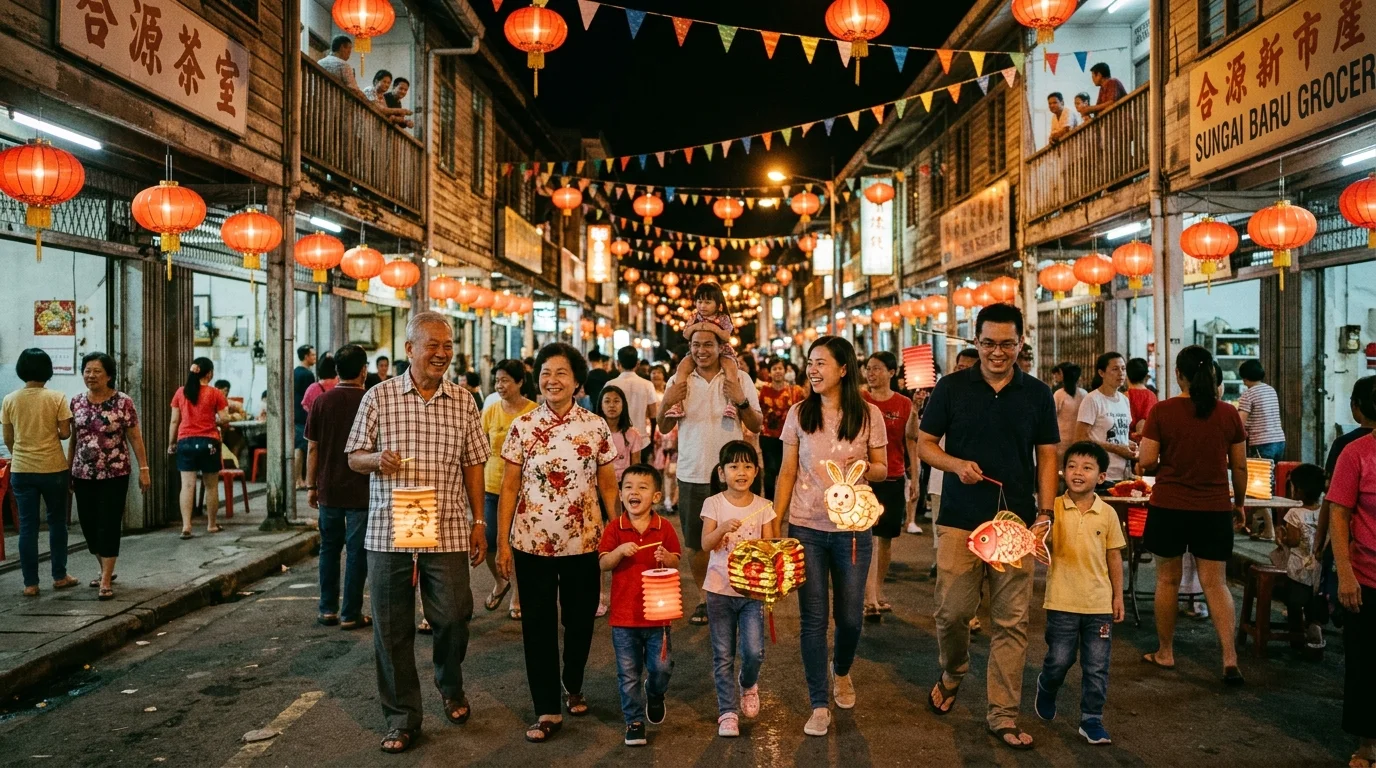
Pesta Tanglung — Mid-Autumn Festival (Sep/Oct): The Mooncake Festival is celebrated elaborately in KK, with the main event at Likas Central Park featuring hundreds of lit lanterns, children's lantern processions, lion dances, and mooncake stalls. The night event is visually spectacular and openly inclusive — all ethnicities participate.
Hungry Ghost Festival (7th Lunar Month): One of the most distinctive Chinese festivals in Sabah. Wayang (traditional opera) performances and getai (modern stage shows) are staged for the spirits throughout the month. Large burnings of "hell money" and paper offerings happen at community sites. KK's Likas district hosts some of the largest Hungry Ghost Festival getai performances in Malaysia.
Qingming (Tomb Sweeping, Mar/Apr): Families visit ancestral graves at Chinese cemeteries across Sabah — particularly the large Chinese Cemetery on Jalan Tuaran in KK. Food offerings, incense burning, and family gatherings at grave sites.
Dongzhi (Winter Solstice, Dec 22): Family reunion dinner; tang yuan (glutinous rice balls in sweet soup) prepared and eaten together. The most private and family-centred of the major Chinese festivals.
What are the major Chinese associations in Sabah?
Chinese clan and dialect associations have been central to community life since the earliest migrations. They provided mutual aid, dispute resolution, credit facilities, and cultural continuity for immigrants far from their ancestral homes.
Sabah Chinese Cultural Association (SCCA) — The largest Chinese civic organisation in Sabah, umbrella body for Chinese community advocacy and cultural programming.
Hakka Association of KK (客家公会) — The most prominent dialect clan association, reflecting the Hakka majority. Organises cultural events, scholarship programmes, and community welfare.
Chinese Chamber of Commerce — KK and Sandakan — Business advocacy bodies representing Chinese-owned businesses in their respective cities. Both are significant voices in Sabah's economic discussions.
Sandakan Cantonese Association — Reflects Sandakan's Cantonese community heritage; organises cultural performances and community events.
Hokkien Association, Teochew Association, Hainanese Association — Smaller dialect associations maintaining specific community traditions and mutual aid functions.
These associations collectively operate schools, temples, welfare programmes, and cultural events. Their clan house buildings — some dating from the colonial era — are architectural heritage of Sabah's Chinese presence.
What Chinese schools exist in Sabah?
Sabah has a network of Chinese-medium primary schools (Sekolah Jenis Kebangsaan Cina, or SJK(C)) that teach in Mandarin alongside the national Bahasa Malaysia curriculum. These schools enrol not only Chinese students but also significant numbers of non-Chinese Sabahans — reflecting Sabah's genuinely multi-ethnic approach to education.
Sabah has one of the highest proportions of Chinese school enrollment relative to total Chinese population in East Malaysia, reflecting the community's strong commitment to Mandarin-language education and cultural transmission. Chinese schools are maintained by Parent-Teacher Associations and Chinese community organisations, supplemented by government funding.
Chinese school education typically produces students who are trilingual in Mandarin, Malay, and English — a significant practical advantage in Sabah's multicultural business environment. Many Sabah Chinese school graduates go on to tertiary education in Taiwan, China, or local universities before entering business or professional careers in Sabah.