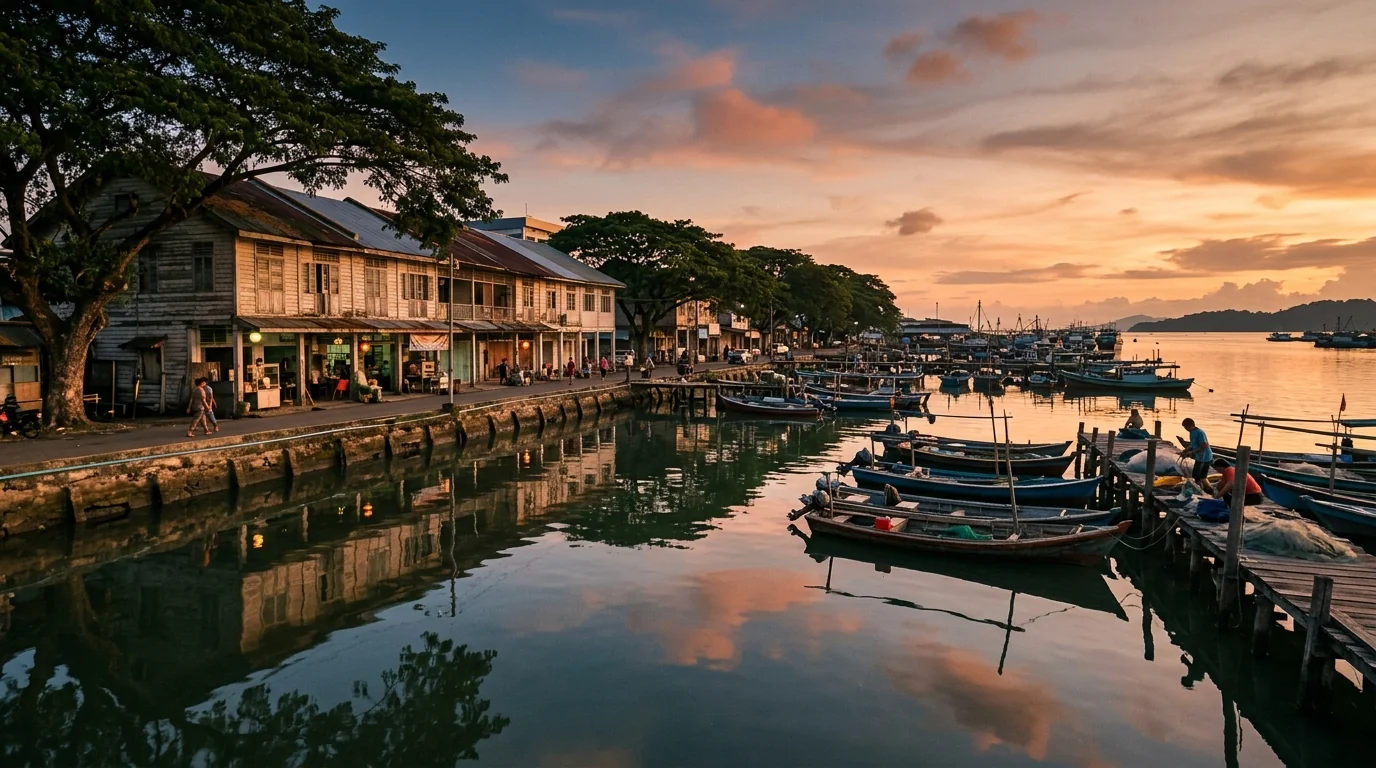
Sandakan — Capital of British North Borneo and the City That Was Destroyed Twice
Why Sandakan replaced Kudat as capital in 1883
When the BNCC relocated its capital from Kudat to Sandakan in 1883, it was a decision driven by commercial opportunity and practical geography. Kudat, the northernmost point of the territory, had proven to be isolated, unhealthy, and commercially limited. Sandakan, by contrast, possessed a superior deep-water harbour, access to rich timber resources, and position on major regional sea routes.
The Sulu and Celebes seas, which converge at Sandakan, were major thoroughfares for maritime trade in Southeast Asia. Ships bound for Jolo, Makassar, Celebes, and beyond regularly passed through or near Sandakan. This geographic position made Sandakan ideal for a trading centre and colonial capital. A merchant or colonial vessel could reach Sandakan more easily than inland settlements, making it practical for administrative and military logistics.
More importantly, the forests surrounding Sandakan contained vast quantities of valuable timber—hardwoods that were in high demand in regional markets. Chinese merchants recognised this opportunity and began establishing logging camps and trading posts in the Sandakan region. By moving the capital to Sandakan, the BNCC positioned itself to maximise profit from the timber trade, which would become the principal economic activity of British North Borneo for the next half-century.
The decision to relocate was also influenced by health considerations. While Sandakan was also tropical and disease-ridden, it was perceived as less isolated than Kudat and thus more habitable for European administrators. The larger potential for population growth and commercial activity also meant that Sandakan could support a more substantial colonial infrastructure and social community.
By 1884, the capital had been effectively transferred. Fort Cowie in Kudat became a secondary garrison, while Sandakan rapidly grew into the economic and political centre of British North Borneo.
Sandakan under the BNCC — timber, trade, and growth
From 1883 onwards, Sandakan was the driving force of British North Borneo's economy and politics. The city grew rapidly as a trading centre and colonial capital, attracting merchants, traders, adventurers, and labourers from across Southeast Asia. Chinese merchants dominated commerce, establishing shops, trading houses, and logging operations. The waterfront bustled with activity: ships loading timber, trading goods changing hands, and sailors from multiple nations coming ashore.
The timber trade was the foundation of Sandakan's prosperity. Vast tracts of interior forest were logged, with timber transported downriver or overland to Sandakan, where it was processed and loaded onto ships for export. British, Chinese, and local entrepreneurs invested in logging camps and mills. The scale of timber extraction was immense—Sandakan became one of Asia's largest timber-exporting centres. This wealth flowed to merchants, to the BNCC government (through taxation and fees), and to the colonial economy more broadly.
Alongside timber, other commodities contributed to Sandakan's economy. Rubber was planted on estates in the surrounding region and exported. Copra (dried coconut), which was processed for oil and other products, was also significant. Tobacco cultivation was attempted. The BNCC government encouraged economic development and granted monopolies and concessions to merchants willing to invest in resource extraction and export.
The population of Sandakan grew dramatically. Chinese merchants and traders arrived in large numbers, establishing a vibrant merchant community that dominated commerce. Chinese coolies and labourers provided the workforce for logging, trading, and port operations. Bajau, Bugis, and other maritime peoples provided shipbuilding and seafaring expertise. A small European community of colonial officials, planters, and business people directed overall policy and controlled key monopolies.
The BNCC government established administrative offices, a resident's residence, military barracks, and public works in Sandakan. The city developed an urban character, with shops, warehouses, hotels, and residential areas. By the early 20th century, Sandakan was a busy, cosmopolitan trading port—rough at the edges, with gambling, vice, and frequent conflicts, but economically vibrant and politically significant.
The prosperity of Sandakan under the BNCC lasted until the Japanese invasion in 1941. For nearly 60 years, the city was the centre of British North Borneo's government and commerce, a symbol of colonial rule and imperial expansion in Southeast Asia.
Agnes Keith and colonial life 1934-1952
Agnes Newton Keith arrived in Sandakan in 1934 as the wife of Harry Keith, a British colonial official. Her vivid accounts of colonial life in Sandakan provide one of the most detailed and engaging records we have of the BNCC period. Keith was an author and observer of extraordinary skill, documenting colonial society, indigenous cultures, the natural environment, and the dramatic upheaval of the Pacific War.
In her books, particularly "Land Below the Wind" (1939), Keith described the expatriate community of Sandakan: the tennis clubs, dinner parties, and social hierarchies of colonial society. She captured the contrast between the material comforts enjoyed by European colonists and the exploited labour conditions endured by Chinese coolies and indigenous workers. She wrote about her fascination with indigenous Sabah cultures and her efforts to understand and document them.
When Japan invaded North Borneo in 1941, Agnes Keith remained in Sandakan. She, her young son, and other European civilians were initially placed under house arrest and then interned in a Japanese civilian internment camp. The conditions were harsh: overcrowding, malnutrition, disease, and brutality. Many internees, including children, died. Keith's account of this experience, published as "Three Came Home" (1947), became an influential wartime testimony.
After the war ended in 1945, Keith was released from internment. She eventually returned to Sabah and documented the post-war period and the transition from British colonial rule to Sabah's eventual independence. Her books and writings made her one of the most prominent Western voices interpreting Sabah's history and culture to international audiences.
The Agnes Keith House, her colonial residence in Sandakan, has been carefully restored and is now a museum. It stands as one of the few surviving structures from the pre-war BNCC era and offers visitors insight into colonial life, wartime occupation, and post-war recovery. Keith's legacy continues to inform how Sabahans and visitors understand the colonial period and World War II.
Sandakan Chinese community — the founding merchants
The Chinese merchant community was the economic foundation of Sandakan's prosperity. Chinese traders and merchants, operating from commercial networks that spanned the China Sea and Southeast Asian coast, recognised the opportunities offered by Sandakan's location and timber resources. They established trading houses, shops, and warehouses that funnelled goods (particularly timber) to regional and international markets.
The most successful Chinese merchants acquired substantial wealth and influence. Some became towkays (business bosses) commanding networks of suppliers, labourers, and trading partners. These men wielded considerable power in Sandakan society and politics, often negotiating directly with BNCC officials. The Chinese merchant class created a vibrant commercial culture and contributed substantially to Sandakan's growth and cosmopolitanism.
Chinese also provided the labour force for logging, trading, and port operations. Chinese coolies arrived from China, Malaya, and other Southeast Asian locations, seeking employment and income opportunities. They worked in difficult conditions, often exploited by employers and subjected to harsh living conditions. The mortality rate among Chinese coolies was high due to disease, accidents, and poor nutrition.
Over generations, Chinese families established themselves in Sandakan, marrying locally, adopting Sabah as home, and creating hybrid Sino-Sabah communities. Chinese temples, schools, and associations were established, creating institutional structures that preserved Chinese culture while adapting to the Sabah context. By the mid-20th century, the Chinese community was integral to Sandakan's identity.
However, the Chinese community faced discrimination and exploitation. BNCC policies favoured European merchants and officials, and Chinese were often taxed more heavily. During the Japanese occupation, the Chinese community was specifically targeted, and many Chinese residents suffered violence, internment, or forced labour. These experiences left deep scars and contributed to post-war Chinese support for Sabah's independence and Malayan federation.
WWII and the Sandakan Death Marches
When Japan invaded North Borneo in 1941, Sandakan was seized and quickly converted into a Japanese military stronghold. The Japanese established military bases, camps, and fortifications throughout the territory. Sandakan became a command centre for Japanese operations in Borneo and the southern Philippines.
The Japanese military required vast quantities of labour for construction, mining, logging, and supply operations. Thousands of POWs (primarily Australian soldiers captured in the fall of Singapore and elsewhere) and conscripted indigenous labourers were forced to work under brutal conditions. Many died from disease, malnutrition, overwork, and brutality.
As Allied forces advanced in the Pacific in 1944-1945, the Japanese military became increasingly desperate and paranoid. They feared that POWs might be liberated and join Allied forces. In an effort to prevent this, the Japanese ordered the evacuation and forced march of POWs from Sandakan inland, supposedly to move them to a more secure location. What followed were the notorious Sandakan Death Marches.
Australian POWs—primarily soldiers from the 2/22 and 2/40 Battalions—were forced to march into the interior over a distance of approximately 260 kilometres (160 miles). The journey, undertaken on foot without adequate food, water, or medical care, in the tropical heat and humidity, killed the vast majority of the prisoners. Of approximately 2,400 POWs who began the marches, fewer than 150 survived. The exact death toll remains uncertain, but estimates suggest around 2,200 deaths.
The Sandakan Death Marches represent one of the Pacific War's most tragic episodes. They are commemorated in memorials throughout Sabah and Australia. The memorial park in Sandakan honours the victims and serves as a site of remembrance for Australians and international visitors. The marches remain a symbol of the brutality of the Japanese occupation and the sacrifices made during the Pacific War.
Allied bombing and destruction 1944-1945
As Allied forces advanced towards Borneo in late 1944 and early 1945, Sandakan became a target for aerial bombardment. The city was the capital of Japanese-occupied British North Borneo and home to military installations, supply depots, and administrative facilities. The Allies conducted sustained bombing campaigns to destroy Japanese military infrastructure and weaken their hold on the territory.
The bombing was intensive and devastating. The urban centre of Sandakan was repeatedly attacked, with bombs destroying buildings, infrastructure, and killing civilians. Much of the pre-war colonial architecture—the government buildings, merchant houses, warehouses, and other structures—was destroyed or severely damaged. The destruction was so comprehensive that very little of the original colonial-era city survived the war.
This destruction was partially deliberate policy. Allied commanders recognised that a completely devastated city would be harder for the Japanese to defend and would prevent them from using the port and facilities for continued supply operations. Additionally, the presence of large Japanese military installations in Sandakan made the city a strategic military target of paramount importance.
By the time the war ended in August 1945, Sandakan had been reduced to rubble. The colonial capital lay in ruins. Japanese forces were defeated or in the process of withdrawing. The damage was so extensive that post-war Sandakan had to be rebuilt from the ground up.
Capital moved to Jesselton in 1947
After the war ended, the British returned to North Borneo to re-establish colonial rule. However, the decision was made to relocate the capital from Sandakan to Jesselton (now Kota Kinabalu), a location on the west coast that had suffered less damage during the war and offered better prospects for post-war reconstruction.
Jesselton had existed as a trading post but was much less developed than Sandakan before the war. However, its geographic position on the west coast made it accessible to the main shipping lanes and to Malaya and Singapore. The west coast location was also more central to the territory overall. Additionally, Jesselton had less wartime damage, making reconstruction more feasible.
The decision to move the capital reflected changing British colonial priorities. Post-war British Malaya and Borneo were increasingly integrated into a single strategic sphere, and locations with better connections to Malaya (which lay directly across the South China Sea from Sabah's west coast) were preferred. Jesselton offered these advantages.
Sandakan, though remaining important as a port and district centre, was relegated to secondary status. The city would gradually rebuild, but never regained its pre-war prominence as the political and economic centre of British North Borneo. When Sabah achieved independence in 1963, the capital was Jesselton, not Sandakan.
Sandakan today
Modern Sandakan is Sabah's second-largest city, a regional centre with a population of approximately 400,000-500,000 people (including the wider district). It remains an important port and economic centre, though its role is now secondary to Kota Kinabalu. The economy is based on fishing, palm oil processing, timber milling (though at much reduced scales from the colonial era), and increasingly on tourism and trade.
The city has been rebuilt entirely since the war. Almost no pre-war colonial architecture remains in the urban centre. A few colonial-era buildings, most notably the Agnes Keith House, have been carefully preserved, but the overwhelming majority of modern Sandakan is post-war construction. This is why Sandakan, unlike some other Asian colonial cities, lacks the visual continuity with its colonial past.
However, Sandakan remains deeply conscious of its history. The Sandakan Memorial Park, dedicated to the victims of the Death Marches, is a significant site of remembrance. Museums and cultural institutions preserve accounts of the colonial period and the Pacific War. The Agnes Keith House has been restored and is now a museum drawing visitors interested in colonial history and WWII. Educational institutions teach local history, ensuring that young Sabahans understand their city's significant place in regional and world history.
Sandakan remains an important gateway to the Kinabatangan River, one of Sabah's primary wildlife areas, famous for its orang-utan rehabilitation centres, wildlife lodges, and river cruises. Visitors to Sandakan often use the city as a base for accessing Kinabatangan and other natural attractions.
| Year / Period | Event / Status | Significance |
|---|---|---|
| 1883 | Capital relocated from Kudat | BNCC recognises commercial and geographic advantages; Sandakan becomes economic engine |
| 1883-1941 | Colonial prosperity | Timber trade drives growth; Chinese merchant community dominates commerce; expatriate society flourishes |
| 1934-1939 | Agnes Keith era | Colonial life documented; pre-war prosperity at its height; Agnes Keith writes influential books |
| 1941-1945 | Japanese occupation | City seized; POWs enslaved; Sandakan Death Marches; city bombed and destroyed |
| 1944-1945 | Allied bombing campaign | Colonial-era infrastructure destroyed; city reduced to rubble; strategic victory for Allies |
| 1945-1947 | Post-war reconstruction | British return; decision made to relocate capital to Jesselton; Sandakan becomes secondary centre |
| 1947-1963 | Secondary city | Rebuilt but no longer capital; Sabah moves toward independence; Jesselton becomes political centre |
| 1963-present | Regional port and centre | Second-largest city; fishing and trade; gateway to Kinabatangan; heritage tourism |