Suluk of Sabah: Sulu Sultanate, Pangalay Dance & Culture
Who are the Suluk and Tausug?
The Suluk (the local Sabah name) and Tausug (the self-designation, meaning "People of the Current") are the same ethnic group: descendants of the Sulu Sultanate who inhabit Sabah's east coast. They are one of Sabah's largest communities, with an estimated 300,000+ documented residents, though the actual number including undocumented and stateless individuals is believed to be significantly higher.
The Suluk are concentrated in Semporna, Lahad Datu, Sandakan, and Tawau — the east coast towns historically connected to the Sulu Sea trading networks. Their presence in Sabah is ancient: the Sulu Sultanate exercised sovereignty over much of North Borneo before the British North Borneo Chartered Company (BNCC) arrived in 1881. The connection between Sabah and the Tausug people thus predates the Malaysian nation by centuries.
The Tausug are known for a proud, assertive cultural identity, deep Islamic faith, beautiful brass metalwork traditions, the elegant Pangalay hand dance, and the kulintangan gong ensemble — a musical tradition that places them at the heart of the broader Sulu Sea cultural world shared with southern Philippines communities.
What was the Sultanate of Sulu and what is its connection to Sabah?
The Sultanate of Sulu was one of Southeast Asia's most powerful maritime polities, controlling trade routes across the Sulu Sea from the 14th to the 19th century. At its height, the Sultanate's territory encompassed the Sulu Archipelago (centred on Jolo island in the southern Philippines), Palawan, parts of Mindanao, the Turtle Islands, and — critically — the northern coast of Borneo including present-day Sabah.
The Sulu Sultans were sophisticated maritime rulers who collected tribute from Chinese merchants passing through their waters, traded in sea cucumber, pearls, forest products, and slaves, and maintained diplomatic relations with the Spanish colonial government in Manila, the Dutch in Batavia, and the British in Penang and Singapore.
In 1878, the Sulu Sultan Abdul Momin signed an agreement with British North Borneo Chartered Company representatives Alfred Dent and Baron von Overbeck. Under this agreement, the BNCC received rights to administer North Borneo (Sabah) in exchange for annual payments to the Sultan. The critical ambiguity: Malaysia interprets these payments as a permanent cession of sovereignty; the Philippines and heirs of the Sulu Sultanate interpret them as a lease that is still in force.
This interpretation dispute is the legal basis of the Philippines' territorial claim on Sabah. The cession payments (now approximately RM5,300 per year) continue to be paid by Malaysia to heirs of the Sulu Sultanate — which Malaysia argues demonstrates historical acknowledgment of the cession, and which claimants argue proves the lease is still active.
In 2022, a Paris arbitration tribunal ruled in favour of heirs of the Sulu Sultanate and ordered Spain and Malaysia to pay billions in compensation for historical territorial rights. Malaysia rejected the ruling as outside the jurisdiction of French courts, and the matter remains contested internationally. The ruling has no practical effect on Sabah's status as a Malaysian state but has kept the Sabah claim issue in international headlines.
What is the 2013 Lahad Datu intrusion?
In February 2013, a group of approximately 200 armed men calling themselves the "Royal Sulu Army" — followers of Sultan Jamalul Kiram III, one claimant to the Sulu Sultanate succession — landed by boat on the coast near Lahad Datu in Sabah's east coast, claiming to reclaim Sabah for the heirs of the Sulu Sultanate.
The Malaysian government responded with security forces. After initial negotiations failed, a military and police operation was launched. By mid-March 2013, most of the intruders had been killed or captured. The official toll was 56 killed (including 8 Malaysian police officers and 48 intruders). Several more died in follow-up security sweeps in Semporna.
The Lahad Datu intrusion had important consequences: it significantly increased Malaysian security presence on the east coast; it heightened tensions around Suluk and Filipino communities in Sabah (many of whom had no connection to the incident but faced increased scrutiny); and it reinvigorated the Philippines' Sabah territorial claim debate. The event also prompted Malaysia to accelerate the ESSCOM (Eastern Sabah Security Command) framework for east coast maritime patrol.
It is crucial to distinguish between the 2013 armed group — a politically motivated external actor — and the longstanding Suluk community resident in Sabah, whose members are overwhelmingly ordinary residents with no affiliation to armed claims. The Lahad Datu intrusion was perpetrated by a specific political faction, not by the Sabah Suluk community at large.
What is the Suluk stateless situation in 2024-2025?
A significant portion of Sabah's Suluk community — those born to undocumented Filipino parents — lack Malaysian citizenship and are classified as stateless or undocumented. In early 2024, Malaysian authorities identified 538 squatter colonies sheltering over 140,000 undocumented migrants in Sabah, including approximately 90,000 Filipinos (DOSM and immigration data). Many of these are multigenerational families with no legal status in any country.
The 2024 introduction of the SWIMS (Sabah Workers Integrated Management System) biometric database provided a pathway for undocumented workers to obtain temporary work permits (PLKS) — allowing legal work in specific sectors. However, this is not citizenship, and the pathway to permanent residency or citizenship for Suluk born in Sabah remains extremely limited.
A 2024 academic paper (Tandfonline: Territorial Claims, Unclaimed People) examines the "postcolonial geopolitics of statelessness in Sabah" — noting that the Suluk's stateless condition is a direct product of colonial border-drawing that cut through existing Sulu Sultanate territory without reference to the populations living there.
A 2025 LSE Southeast Asia Blog analysis highlighted how "deportability" has become a commodity in Sabah — with enforcement being selective and occasionally corrupt, trapping undocumented Suluk in vulnerable legal limbo that makes them susceptible to exploitation.
| Documentation Status | Estimated Numbers (2024) | Key Rights |
|---|---|---|
| Malaysian citizens (registered Suluk) | ~150,000-200,000 | Full citizenship rights, vote, public education, healthcare |
| PLKS (temporary work permit via SWIMS) | Expanding rapidly post-2024 | Legal to work in specific sectors; no citizenship rights |
| Undocumented / Stateless | ~100,000-150,000 (est.) | No legal rights; risk of arrest; no formal education or healthcare |
What is traditional Suluk / Tausug culture?
The Tausug are a people of profound cultural richness — shaped by centuries of maritime trade, Islamic scholarship, and political sovereignty. Their material culture reflects this heritage at every level.
Brass culture: Brass craftsmanship is central to Tausug cultural identity. Traditional brass objects include lantaka (brass cannons, historically used to defend Sulu trading vessels), ornamental betel nut boxes with intricate geometric engravings, oil lamps, vases, and ceremonial serving vessels. Brass objects were symbols of status and accumulated wealth. Today, traditional brass craftsmanship is maintained by specialist craftsmen in Semporna and in the Sulu Archipelago.
The Kris (Keris): The Tausug carry the keris — the wavy-bladed ceremonial dagger of the Austronesian world — as a powerful cultural symbol. Tausug kris are decorated with intricate gold and silver work and carved wooden hilts. They are carried at ceremonies, presented as gifts at weddings, and passed as family heirlooms.
Malong: The traditional wrap-around cloth worn by both men and women. Tausug malong feature bold geometric batik-like patterns in rich colours — reds, golds, and greens. They are used as clothing, prayer mats, baby carriers, and decorative wall hangings.
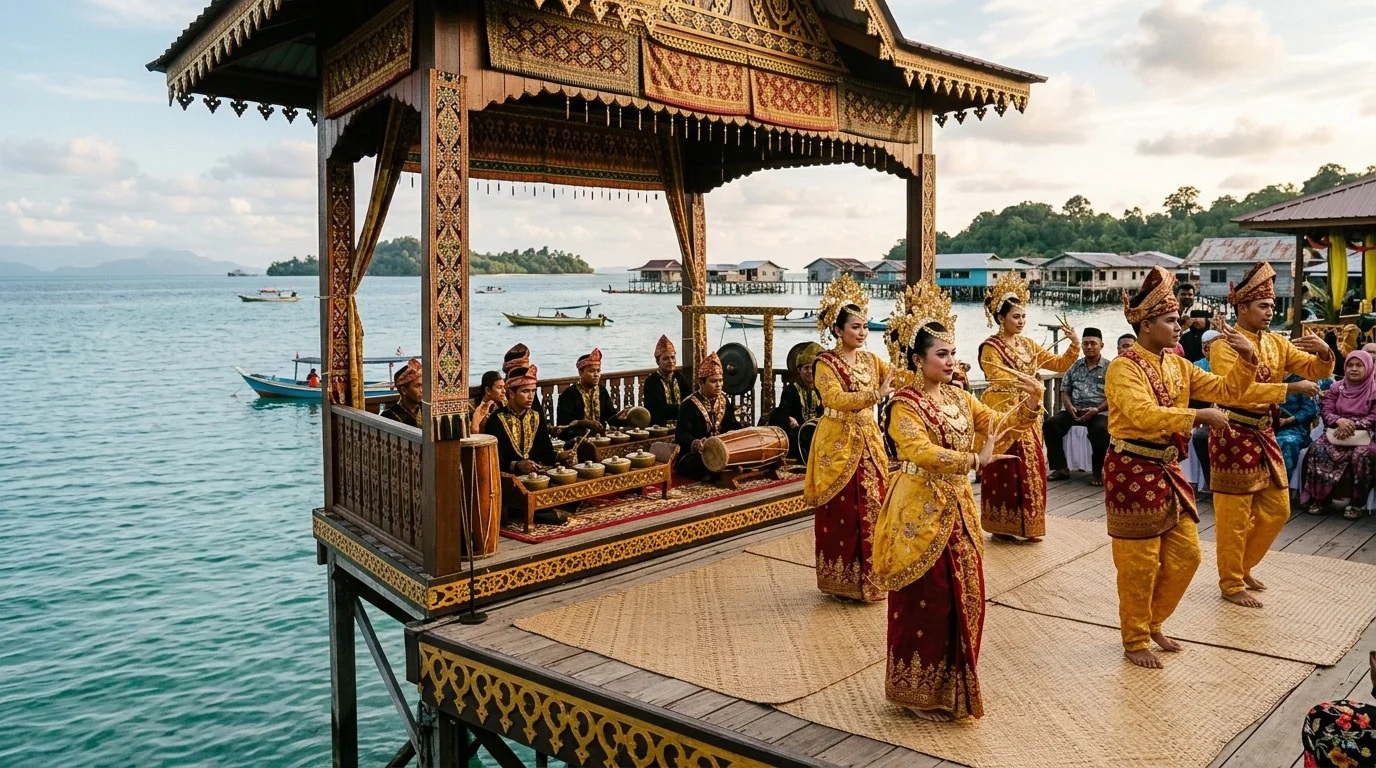
Kulintangan: The gong ensemble that is the musical heart of Tausug cultural life. A set of 8-9 small gongs of varying pitches, played by a single performer with padded sticks, produces interlocking melodic patterns. Accompanied by larger hanging gongs (agong) and a drum (gandang), the kulintangan ensemble creates the characteristic sound of Tausug celebrations — weddings, circumcisions, and cultural festivals.
What is the Pangalay dance?
The Pangalay is the traditional hand and finger dance of the Tausug — one of Southeast Asia's most refined classical dance forms. Performed by women, the Pangalay emphasises incredibly fluid, hypnotic movements of the hands, wrists, and fingers — bent back at extreme angles, flowing in wave-like sequences, alternating between sharp angular positions and liquid grace.
The Pangalay is strikingly similar to classical Thai and Cambodian court dance — reflecting the shared Hindu-Buddhist dance heritage that preceded Islam across much of mainland Southeast Asia and the maritime world. In the Tausug case, the dance absorbed this older aesthetic tradition and preserved it within an Islamic cultural framework, maintaining the aesthetic while stripping away its religious Hindu-Buddhist content.
Skilled Pangalay dancers wear brass janggay — elongated finger extensions of polished brass that exaggerate the finger movements and catch the light. The janggay make the flowing hand gestures even more visually dramatic. The full performance costume includes a malong, beaded accessories, and elaborate headdress.
The Pangalay can be seen at Suluk cultural celebrations in Semporna, at Sabah-wide cultural festivals, and occasionally at the Regatta Lepa festival.
What language do the Suluk speak?
Tausug (Bahasa Sug, meaning "language of the current") is the language of the Suluk community. It belongs to the Sama-Bajau branch of the Austronesian language family — making it linguistically related to the West Coast Bajau language and Sama Dilaut (Bajau Laut), though not mutually intelligible with either. Tausug is also widely spoken in the Philippines' Sulu Archipelago, where it functions as a regional lingua franca among diverse island communities.
In Sabah, the estimated 300,000+ Suluk make Tausug one of the largest non-Bumiputera languages by speaker count. The language is relatively stable — younger generations maintain Tausug as a community language while using Sabah Malay for wider communication.
Tausug has a strong oral literary tradition: lugu (traditional love songs), oral epics (kay) recounting heroic histories of Sulu Sultanate figures, and pamanday (blacksmithing songs accompanying brass-work). Many of these oral traditions are maintained by older community members, though transmission to younger generations in Sabah is weakening.