Fun Facts About Sabah — Did You Know?
Last updated: 1 March 2026
A collection of genuine, verified facts about Sabah. No clickbait, no exaggeration — just things about this state that are genuinely interesting, surprising, or worth knowing.
Geography
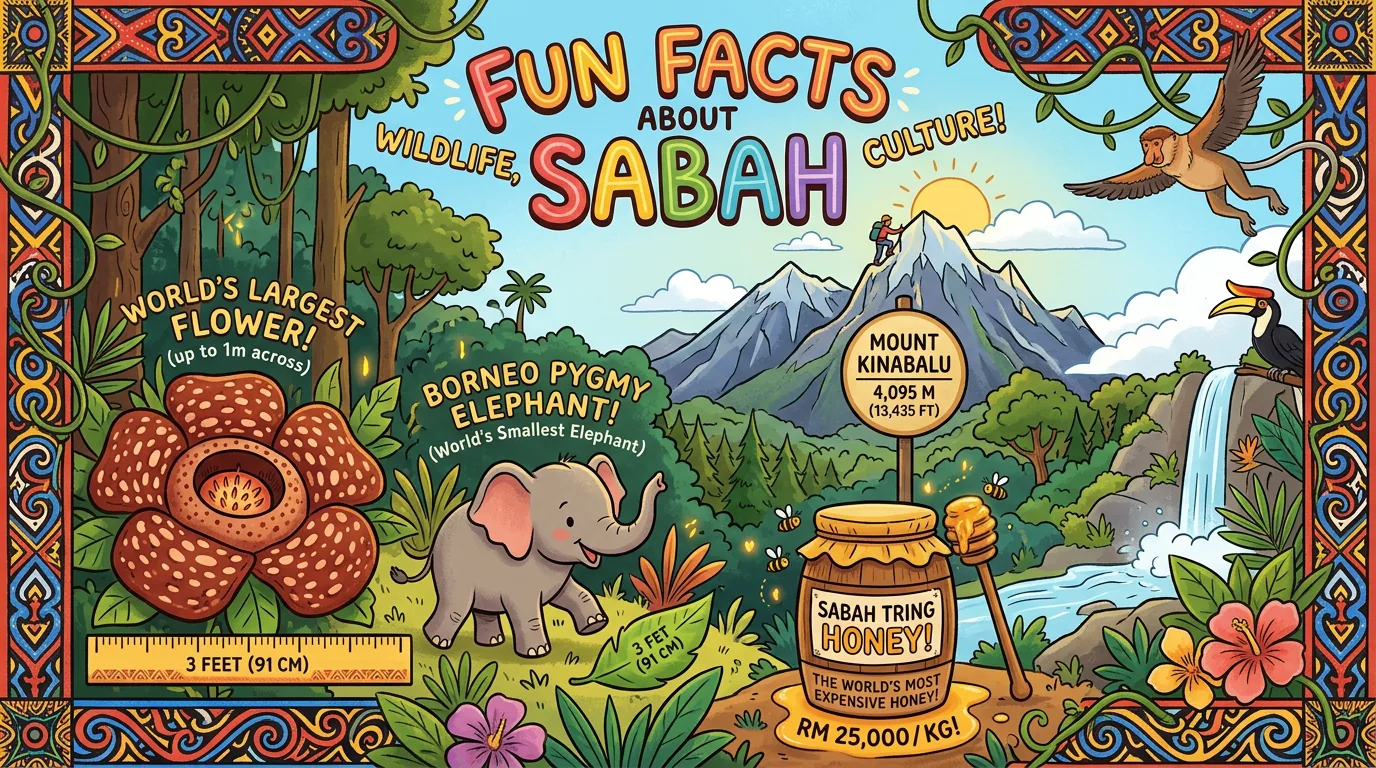
- Mount Kinabalu (4,095m) is the highest peak between the Himalayas and New Guinea. It’s also one of the youngest mountains in the world — still growing at about 5mm per year.
- Sabah has 1,440 km of coastline — facing the South China Sea, Sulu Sea, and Celebes Sea simultaneously.
- The state is roughly the same size as Ireland (73,631 km²), making it Malaysia’s second-largest state after Sarawak.
- Sabah sits on the Coral Triangle, the global centre of marine biodiversity. The waters around Sipadan contain more fish species than the entire Caribbean.
- The Kinabatangan River (560 km) is the longest river in Sabah and one of only two places in the world where you can see 10 primate species in a single area.
Wildlife & Nature
- Sabah is home to the Borneo pygmy elephant — the smallest elephant in Asia. Only about 1,500 remain in the wild.
- The Rafflesia, the world’s largest flower (up to 1 metre across), grows in Sabah’s rainforests. It blooms for only 5–7 days before rotting.
- Sabah has over 6,000 plant species, many of which are found nowhere else on Earth.
- The proboscis monkey is endemic to Borneo. Males have enormous noses that scientists believe amplify their mating calls.
- Sipadan Island has a 600-metre deep underwater wall that drops straight down from the reef — one of the reasons it’s consistently rated among the world’s top dive sites.
- Sabah’s Danum Valley contains rainforest that has been undisturbed for 130 million years — older than the Amazon.
Biodiversity hotspot
Sabah’s rainforests contain more tree species in a single hectare than the entire continent of North America.
Culture & People
- Sabah has over 30 ethnic groups and more than 80 local dialects, making it one of the most ethnically diverse places in Southeast Asia.
- The Kadazan-Dusun are the largest indigenous group, making up about 30% of the population. Their harvest festival (Kaamatan) is celebrated every May.
- Sabah is sometimes called the "Land Below the Wind" because it sits below the typhoon belt and is rarely hit by major storms.
- The Bajau Laut (sea nomads) of eastern Sabah are among the last true seafaring people. Some have lived their entire lives on boats.
- Sabah holds a Malaysia record for having the most public holidays of any state — locals get more days off than anywhere else in the country.
Food & Drink
- Hinava (raw fish salad) is often called "Sabah’s sashimi" — it predates Japanese influence by centuries and is a Kadazan-Dusun tradition.
- Tuhau, a wild ginger found only in Borneo’s jungles, is used in Kadazan cooking. It can’t be commercially cultivated — it only grows wild.
- Sabah produces some of the world’s finest chocolate. Sabah Chocolate is made from locally grown cacao beans in Tenom.
- Tapai (rice wine) is the traditional alcoholic drink of the Kadazan-Dusun. Every family has their own recipe, and it’s a staple at all celebrations.
- The state’s coffee industry, centred in Tenom, produces Liberica coffee — a rare variety that makes up less than 2% of global coffee production.
History
- Sabah was known as North Borneo until 1963 when it joined the Federation of Malaysia.
- The British North Borneo Chartered Company administered the territory from 1881 to 1946 — one of the last chartered companies in the world.
- During World War II, the Japanese forced 2,400 Allied prisoners of war on the Sandakan Death Marches. Only 6 survived. The Sandakan Memorial Park marks this history.
- Jesselton (now Kota Kinabalu) was almost entirely destroyed during WWII and had to be rebuilt from scratch.
- The name "Kinabalu" may derive from the Kadazan-Dusun words "Aki Nabalu" — meaning "the revered place of the dead."
Modern Sabah
- Sabah and Sarawak have immigration autonomy — they control their own borders, and even Peninsular Malaysians need to go through immigration when entering.
- The state contributes significantly to Malaysia’s palm oil production, which is the largest industry by revenue.
- KK was designated a UNESCO Creative City of Gastronomy candidate — a recognition of its incredible food diversity.
- Sabah’s tourism sector was growing at 8–10% annually pre-pandemic, with over 4 million visitors in 2019.
Share these
Found a fact that surprised you? Share this page. The more people know about Sabah, the better.