Sabah Biodiversity 2026 — Species, Endemics & Conservation
We are working through the statistics in this section against their original sources. The headline figures above were re-checked on 16 August 2026. Detailed figures further down the page have not yet been individually verified, and some may be out of date or wrong.
If you spot something that looks wrong, please tell us — it genuinely helps.
Sabah is a global biodiversity hotspot with 6,000+ plant species, 680+ birds, 210+ mammals. The state harbours 100+ endemic species found nowhere else on Earth. Forest cover is ~50% of remaining state area; 30% is totally protected (30% TPA target achieved Feb 2026). Threats include deforestation, illegal wildlife trade, and climate change.
Sabah’s biodiversity spans all major taxa. Fish and invertebrates dominate marine ecosystems; plants and birds lead terrestrial diversity.
Source: Sabah Wildlife Dept, IUCN, research institutions
Sabah’s Biodiversity Hotspot Status
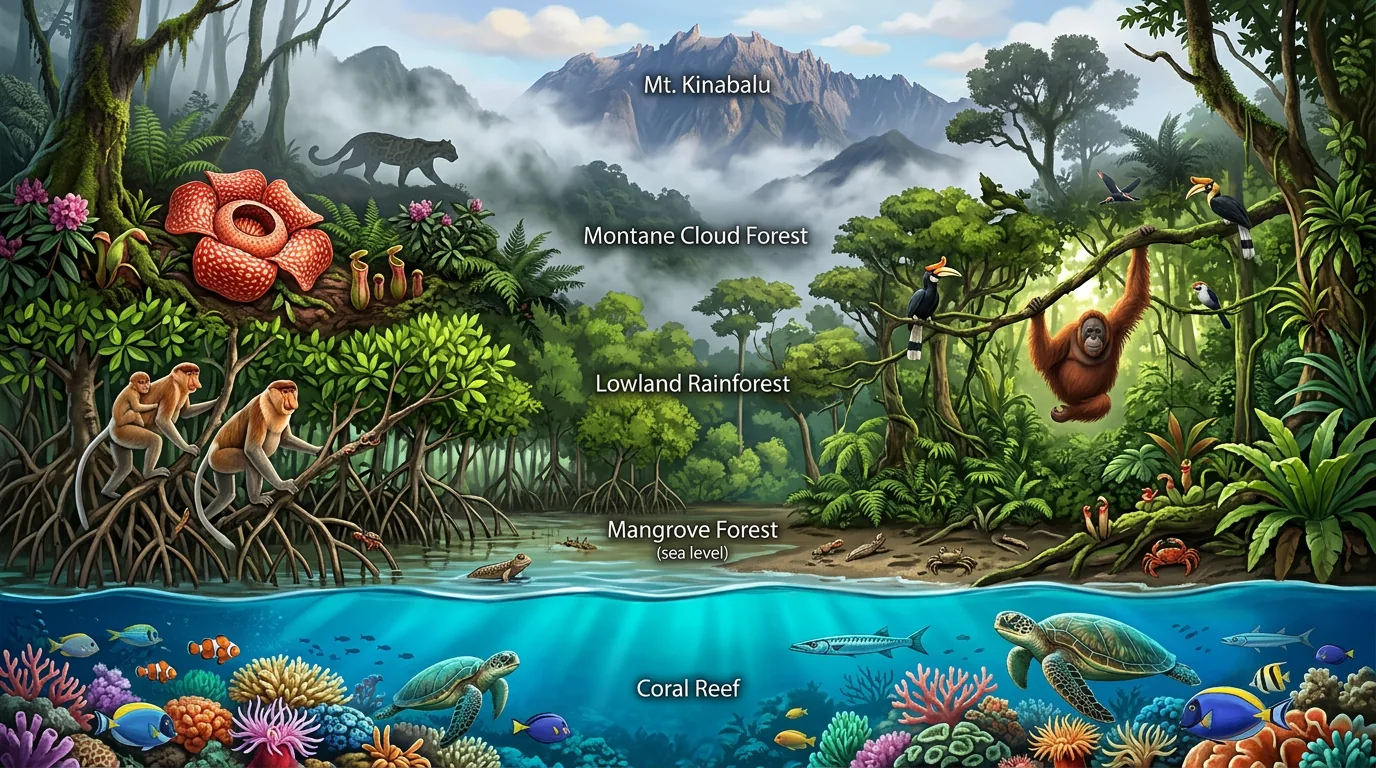
Sabah is recognized as one of the world’s most biodiverse regions — a hotspot where evolution, isolation on Borneo, and tropical climate have created exceptional endemism and species richness. Sabah alone contains roughly one-third of Borneo’s total plant species despite occupying only one-third of the island’s land area.
This concentration of biodiversity is driven by:
- Tropical rainforests: Ancient, undisturbed ecosystems spanning from sea-level to alpine zones.
- Elevation gradients: Mount Kinabalu and other mountains create distinct ecological zones — each with specialized species.
- Coral Triangle edge: Marine biodiversity rivalling terrestrial forests. The Coral Triangle as a whole holds 605 coral species and 2,228 reef fish species (WWF) — six-country figures, not Sabah's alone.
- Isolation: Borneo’s separation from mainland Asia has allowed millions of years of endemic speciation.
Flora
6,000+ vascular plant species are documented in Sabah. Highlights include:
- Mount Kinabalu: 4,000+ species on one mountain — including 800+ orchids (Borneo total: 1,500+), 500+ ferns, 50+ pitcher plants (Nepenthes), and 24 rhododendron species (5 endemic to Kinabalu alone).
- Lowland dipterocarp forest: Giant hardwood trees (dipterocarps) over 60m tall. Dominated the pre-logging landscape; now heavily reduced.
- Rafflesia: 6 species in Sabah (R. keithii, R. pricei, etc.). World’s largest flower (up to 1m diameter). Parasitic, rare, increasingly threatened.
- Mangroves: Coastal ecosystems now under pressure from development and sea-level rise.


Birds
680+ bird species are recorded in Sabah. Highlights:
- Borneo endemics: 52–66 species (depending on taxonomy) found only on the island. Examples: Kinabalu Serpent-Eagle, Scarlet-rumped Trogon, Blue-headed Pitta.
- Hornbills: 9 species, including the iconic Rhinoceros Hornbill. Massive casqued beaks; monogamous; sighted in pairs year-round.
- Kingfishers, pittas, babblers: High diversity of forest birds; numerous endemic subspecies.
- Best locations: Kinabalu Park (alpine endemics), Danum Valley (340 species), Lower Kinabatangan (203 species).
Marine Biodiversity
Many of Sabah’s iconic species are under threat. Only a small fraction are stable (Least Concern).
Source: IUCN Red List assessments, Sabah Wildlife Dept
Sabah’s marine realm sits at the edge of the Coral Triangle, the world’s epicenter of marine biodiversity:
- Coral species: 600+ species — Tun Sakaran Marine Park alone has 255 coral species.
- Fish diversity: no Sabah-wide reef fish count has been published. Park by park: Tunku Abdul Rahman 573 species, Tun Sakaran 528, Tun Mustapha around 350, Sipadan over 300 (Sabah Parks).
- Sea turtles: Green turtle, Hawksbill — 13 nesting beaches across Sabah. Turtle Islands Park is Malaysia’s largest sea turtle rookery.
- Whale sharks: World’s largest fish; seasonal visitors (peak Apr–May) around Sipadan and Semporna.
- Sharks & rays: 68 shark species, manta rays, eagle rays.
Habitat Types & Conservation
Lowland forest (historically the most biodiverse) has been most heavily cleared. Mountain and wetland habitats retain higher percentages.
Source: Sabah Forestry Department, habitat mapping 2024
Conservation Status
Over 50% of Borneo’s original forest has been cleared. Sabah’s forest cover has declined from ~87% (1970s) to ~50% today. The remaining forests face continued pressure from logging, plantations, and development. Protected areas (30% TPA) are critical refugia, but fragmentation isolates wildlife populations.
Key conservation outcomes:
- 30% TPA achieved (Feb 2026): Sabah is the first Malaysian state to reach the 30% totally protected area target — a major conservation milestone protecting 2.23 million hectares.
- Protected area network: Kinabalu Park (UNESCO World Heritage + Biosphere + Geopark), Crocker Range, Danum Valley, Maliau Basin, Lower Kinabatangan Ramsar site, marine parks.
- Wildlife corridors: Ulu Segama Malua (UNESCO conservation model) connects habitat fragments, allowing species migration and genetic exchange.
- Research & monitoring: Danau Girang Field Centre, Danum Valley Research Station, and HUTAN conduct long-term population monitoring.
- Anti-poaching efforts: Enforcement against illegal wildlife trade of orangutans, pangolins, rhinos, and bird species — though demand remains high globally.
Frequently asked questions
Q How does Sabah compare to Borneo overall in biodiversity?
Q What is the Heart of Borneo initiative?
Q What is the most endangered species in Sabah?
Q Where is the best place to see Sabah's biodiversity?
Q Are there citizen science programs for biodiversity monitoring?
Q How is climate change threatening Sabah's biodiversity?
Q How does Sabah combat illegal wildlife trade?
Sources & References 6 sources
Last verified: 11 April 2026
Government & Conservation
Scientific & NGO
- IUCN Red List Global conservation status assessments for Sabah species
- WWF Malaysia — Heart of Borneo Transnational conservation initiative and research
- HUTAN — Kinabatangan Orangutan Conservation Orangutan population monitoring and habitat research
- Danau Girang Field Centre Long-term wildlife research and population monitoring