Sabah Population 2026 — 3.76M People & 30+ Groups
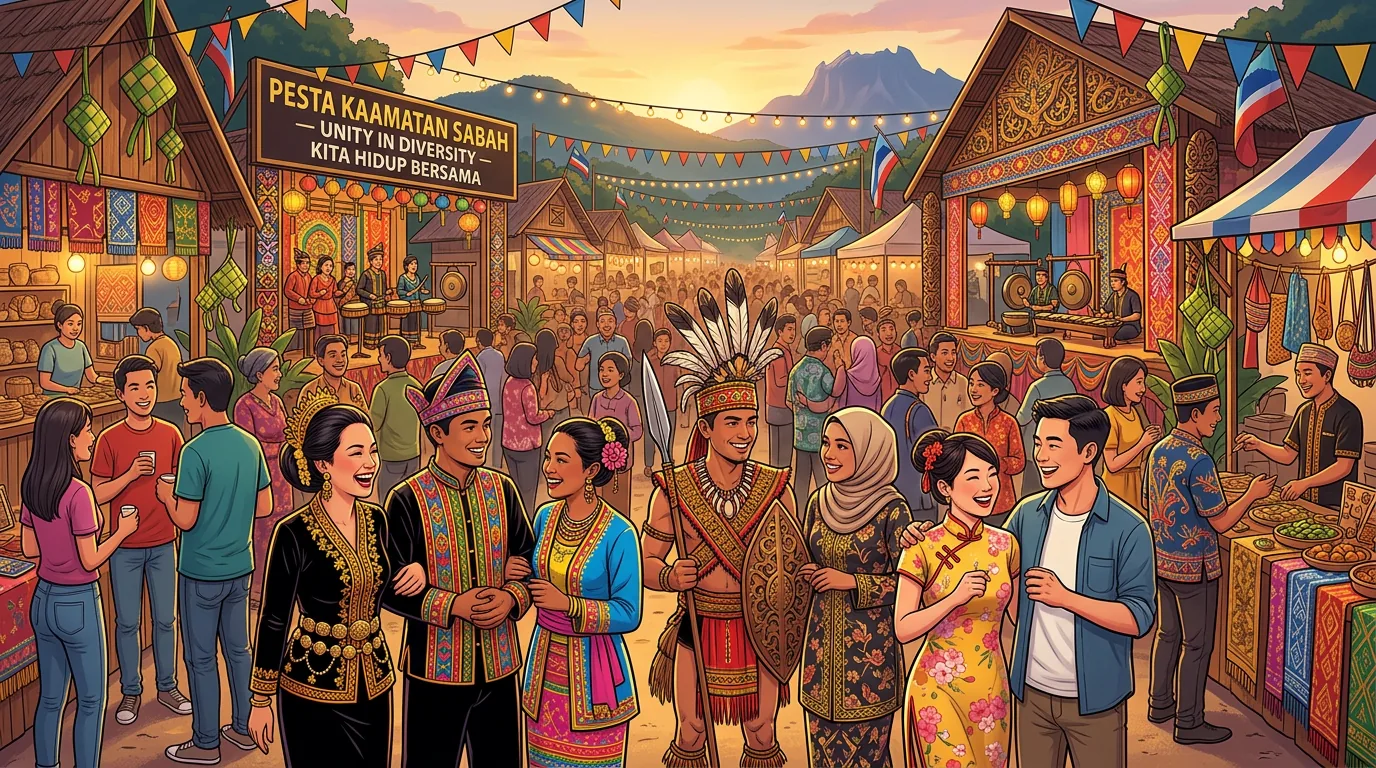
Sabah has a population of 3.76 million people in 2025 (DOSM mid-year estimate), making it Malaysia’s third-largest state. The population is spread across 27 districts and includes more than 30 ethnic groups — the most diverse of any Malaysian state. About 54.7% live in urban areas, and the median age is 27.2 years.
Sabah’s population grew 5.3x in 55 years — but annual growth has slowed from 4.8% in the 1980s to around 0.6% today.
Source: DOSM Census & Mid-Year Estimates (1970–2025)
Sabah at a glance
Sabah is Malaysia’s third most populous state, behind Selangor and Johor. Its 3.76 million residents (2025) are spread across 73,631 km² of land — making it the second-largest state in Malaysia by area — at an overall density of just ~51 people per km². That density masks enormous variation: the west coast around Kota Kinabalu is dense and urban, while interior districts like Tongod and Pensiangan remain sparsely populated.
What makes Sabah demographically unique in Malaysia is ethnic diversity. Unlike Peninsular Malaysia, which is dominated by Malay, Chinese and Indian communities, Sabah is home to more than 30 indigenous groups — Kadazan-Dusun, Bajau, Murut, Rungus, Lotud, Bisaya, Suluk, and many more — alongside Chinese, Malay, and a large non-citizen population of Filipino and Indonesian workers.


Ethnic composition
Sabah’s ethnic breakdown (2020 Census) shows how no single group dominates. The Kadazan-Dusun are the largest indigenous group but still account for less than 20% of citizens — the most evenly distributed ethnic mix in Malaysia.
Kadazan-Dusun and Bajau together make up about a third of Sabah’s citizen population.
Source: DOSM 2020 Population & Housing Census
This page focuses on the numbers. For the cultural and historical story of each community, see our Ethnic Groups of Sabah pillar — it covers languages, traditions, festivals, and where to experience each culture today.
Religion
Sabah is one of Malaysia’s most religiously diverse states. Islam is the largest religion, but Christianity has a much stronger presence here than in Peninsular Malaysia — particularly among the Kadazan-Dusun, Murut, and Rungus communities.
69.6% Muslim, 27% Christian, 6% Buddhist — Sabah has Malaysia’s second-largest Christian population after Sarawak.
Source: DOSM 2020 Population & Housing Census
Population by district
Sabah’s 27 administrative districts have wildly different population sizes. The three biggest — Kota Kinabalu, Tawau, and Sandakan — together account for roughly a third of the state’s people. The interior districts are vast in area but home to only a few tens of thousands each.
Kota Kinabalu is the largest district — but the greater KK metro (including Penampang and Putatan) brings the urban total to ~750,000.
Source: DOSM 2020 Census — Administrative District
The three big cities
- Kota Kinabalu (~500,000 in district, ~750,000 metro) — State capital, main airport, tourism and government centre.
- Tawau (~373,000) — Second-largest district, gateway to the east coast and Tun Sakaran Marine Park.
- Sandakan (~300,000) — Historic capital until 1946, gateway to the Kinabatangan River and Sepilok orangutan sanctuary.
Growth and trends
Sabah’s population grew rapidly from the 1970s through the 2000s, more than tripling in 30 years. Much of that growth came from immigration — especially from the southern Philippines and Indonesia — and a high birth rate. Both drivers have now tapered off.
Earlier DOSM projections (made before 2020) put Sabah’s 2025 population at ~3.9 million. The current estimate is 3.76 million — about 140,000 lower. This is not a population decline. It reflects three methodological changes:
- The 2020 Census revised non-citizen counts downward after better fieldwork.
- DOSM now uses a cohort-component method for intercensal estimates, which is more conservative than the older trend-extrapolation method.
- Post-COVID, some non-citizen residents returned home and haven’t fully returned.
The citizen population is still growing at about 1.7% per year — it’s the non-citizen total that’s moved sideways.
Urban vs rural
About 54.7% of Sabah’s population is classified as urban (2020 Census) — noticeably lower than Malaysia’s national average of 77%. Urbanisation is highly concentrated on the west coast: greater Kota Kinabalu alone accounts for roughly a fifth of the state’s population. The east coast has secondary urban centres at Sandakan, Tawau, and Lahad Datu, while the interior remains mostly rural.
Rural-to-urban migration is ongoing — especially among younger Kadazan-Dusun and Murut people moving from the interior to KK for education and work. Several interior districts are losing population, while Penampang and Putatan (KK’s suburbs) are growing the fastest.
Age structure and median age
Sabah has one of Malaysia’s youngest populations. The median age is 27.2 years, compared to a national median of 30.3 years. This reflects historically high birth rates and the large share of young non-citizen workers. Only about 7% of Sabahans are 65 or older, compared to ~8% nationally.
That youth is an asset and a pressure point: a young workforce supports economic growth, but also means high demand for schools, housing, and first jobs — and explains why youth unemployment in Sabah is more than double the national rate.
Frequently asked questions
Q What is the current population of Sabah?
Q Why did Sabah’s population drop from earlier projections of 3.9 million?
Q How many ethnic groups live in Sabah?
Q What is the largest city in Sabah by population?
Q What is Sabah’s population growth rate?
Q What percentage of Sabah’s population is urban?
Q What is the median age in Sabah?
Q What is the dominant religion in Sabah?
Sources & References 6 sources
Last verified: 11 April 2026
Government — DOSM
- DOSM Population Estimates by State 2025 Annual mid-year state population estimates — primary source for 2025 figures
- DOSM 2020 Census Key Findings — Sabah Full Sabah breakdown by district, ethnicity, age, and religion
- OpenDOSM Kawasanku — Sabah Dashboard Interactive dashboard with district-level indicators
- DOSM Labour Force Survey 2024 Working-age population and labour participation by state