Kulintangan: Sabah's Traditional Gong Music
What is kulintangan?
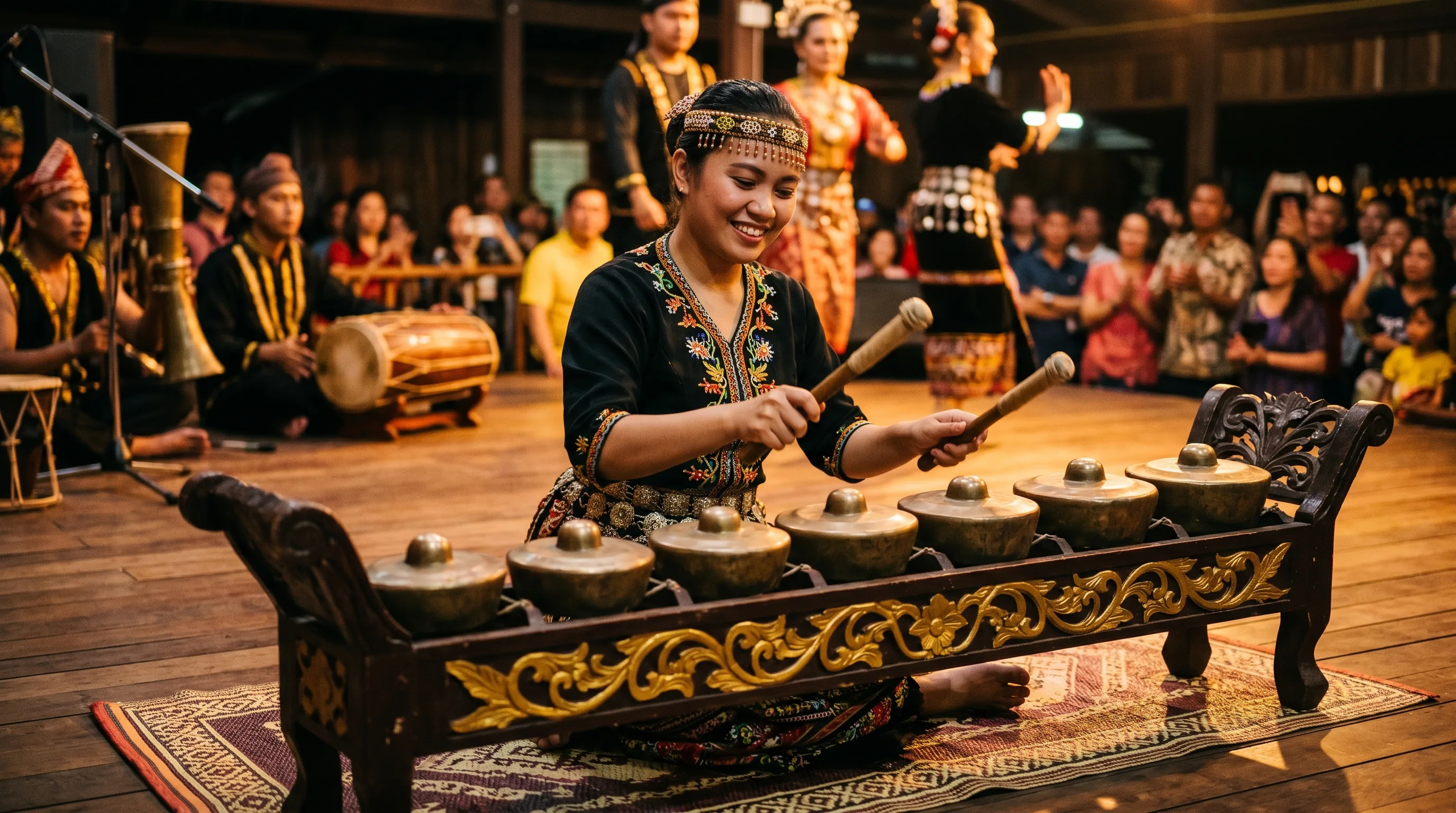
Kulintangan is a traditional instrument played by almost every ethnic group in Sabah. A row of small gongs, usually 8 or 9, is laid on a wooden frame and struck with two wooden beaters, often alongside larger gongs and a drum.
What is kulintangan
Kulintangan is a traditional musical instrument deeply rooted in Sabah. According to the National Department for Culture and Arts (JKKN), it is inherited by almost every ethnic group in the state, with differences between districts in the number of gongs and the instruments played alongside it (JKKN cultural mapping, checked 7 October 2026).
This page explains the instrument and how it is played, the ensemble around it, the occasions on which it is heard, how it varies across Sabah, and the related Kadazan-Dusun sompoton.
The instrument and how it is played
A kulintangan is a set of small gongs arranged horizontally on a wooden frame. It usually has 8 or 9 gongs, each giving a different note (JKKN cultural mapping, checked 7 October 2026).
The gongs are laid out by pitch, with the low notes on the left and the high notes on the right from the player's side. The player sits in front of the row and strikes each gong in the middle with two wooden beaters, made of wood that is not too hard so the sound is not harsh (JKKN cultural mapping, checked 7 October 2026).
Traditional kulintangan are made of metal such as iron or copper, shaped by hand by local craftsmen. Zinc is now also used because it is cheaper and easier to shape. Kudat is known as Sabah's gong-making centre (JKKN cultural mapping, checked 7 October 2026).
The kulintangan is not one gong but a set of usually 8 or 9 small gongs on a wooden frame. The player strikes them with two wooden beaters, low notes on the left and high notes on the right (JKKN cultural mapping, checked 7 October 2026).
Rhythm and ensemble
Kulintangan rhythms are usually repetitive patterns that the player follows to produce a continuous melody. The pattern can change with the song or the mood, and players may add small improvisations as long as they keep the basic rhythm (JKKN cultural mapping, checked 7 October 2026).
Kulintangan is often played with a large gong (gong ibu), small gong (gong anak), tambul (drum) and babandil, and the player has to keep in time with the other instruments (JKKN cultural mapping, checked 7 October 2026).
When and why it is performed
Kulintangan plays an important role at traditional ceremonies, festive occasions and gatherings. It is often heard at weddings, where it creates a happy, lively atmosphere, and when welcoming guests of honour such as community leaders and dignitaries (JKKN cultural mapping, checked 7 October 2026).
For some groups, such as the Bajau Laut, kulintangan accompanies ritual ceremonies connected with the spirit world, and its sound is believed to communicate with the spirits of ancestors (JKKN cultural mapping, checked 7 October 2026).
How it differs across Sabah
The number of gongs varies by district. The Dusun Labuk of Telupid and Beluran usually use 9, while groups in some other districts use only 6 or 7 (JKKN cultural mapping, checked 7 October 2026).
The accompaniment varies too. On the West Coast, kulintangan is often played on its own. In Telupid and Beluran on the East Coast it is accompanied by three gongs of different sizes, and among the Bajau and Suluk around Semporna, Tawau and Lahad Datu it is played with the gong ibu, gong anak and tambul (JKKN cultural mapping, checked 7 October 2026).
The related sompoton
Alongside kulintangan, Sabah is home to another distinctive instrument: the sompoton, a Kadazan-Dusun wind instrument made of bamboo and gourd. It has 8 small bamboo pipes arranged around a dried water gourd, which acts as the wind chamber as the player blows in or draws air out (JKKN cultural mapping, checked 7 October 2026).
Local history traces the sompoton to Tikolod Village in Tambunan. It is played at traditional ceremonies and celebrations, especially the Kaamatan harvest festival, and is now also heard in jazz and fusion performances (JKKN cultural mapping, checked 7 October 2026).
Cultural performances and festivals are the best places to hear both the kulintangan and the sompoton in their proper setting, played by Sabahan musicians.