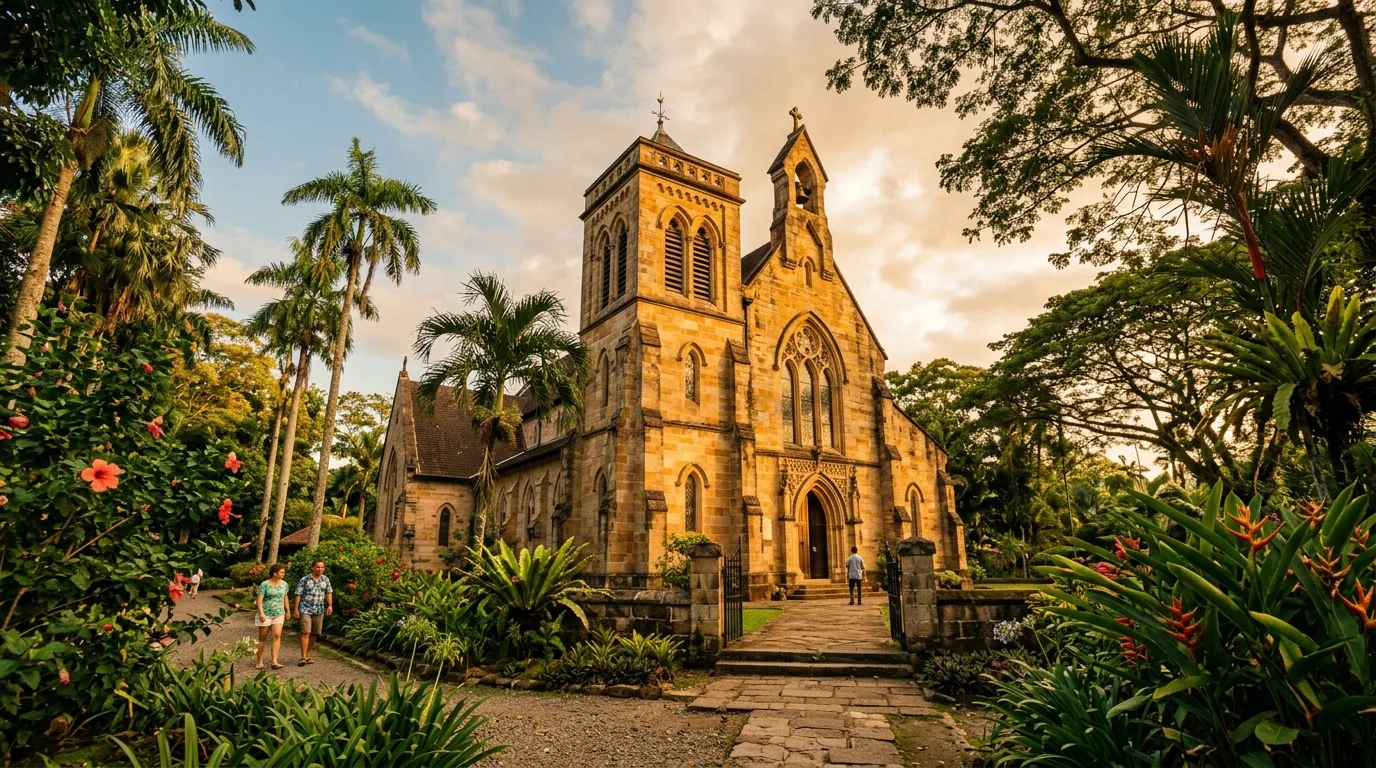
St Michael and All Angels Church Sandakan — Sabah's Oldest Stone Church
What is St Michael and All Angels Church?
St Michael and All Angels Church is Sabah's oldest stone church, a heritage landmark located on Jalan Puncak in Sandakan overlooking Sandakan Bay. Built from local sandstone and dedicated in 1893, the church stands as a testament to the Anglican missionary presence in British North Borneo during the colonial era. Its distinctive golden-hued sandstone walls, Gothic Revival architecture with pointed arches, and hilltop location make it one of Sabah's most recognizable heritage structures.
The church was established by the Church of England missionary community to serve the spiritual needs of the British colonial population and the growing Christian community among Chinese and local peoples in colonial Sandakan. As a place of continuous worship for over 130 years, the church has witnessed Sandakan's transformation from a small trading post under the British North Borneo Chartered Company to a major port city and gateway to Sabah's east coast.
Today, St Michael and All Angels remains an active Anglican parish church, holding regular Sunday services and functioning as both a place of worship and a heritage site. The church's unique use of local sandstone, its survival through wartime destruction, and its continued community role make it historically significant not only to Christian communities but to all who value Sabah's architectural and cultural heritage.
The name "St Michael and All Angels" comes from the church's dedication to the Archangel Michael and the feast of Michaelmas. In Christian tradition, St Michael is depicted as a warrior angel defending against evil, symbolizing protection and spiritual strength—themes that resonated with colonial-era missionaries establishing their faith in a frontier environment.
How was the church built using local sandstone?
The decision to build St Michael Church from local sandstone was both practical and architectural. In the 1880s–1890s, when the church was being planned, importing large quantities of building materials from overseas to Sandakan was expensive, time-consuming, and logistically challenging. Sandstone deposits were found in the Sandakan area, making local quarrying the most feasible option. This choice reflects the practical ingenuity of colonial builders working in a remote frontier settlement.
The sandstone used—sourced from Sandakan's local geological formations—is warm in colour, ranging from golden to pinkish tones. This distinctive warmth gives the church its inviting, glowing appearance, especially in morning and late afternoon light. The stone is relatively soft compared to granite or harder igneous rocks, making it easier to quarry and cut into blocks suitable for construction, yet durable enough to withstand tropical weather and time.
The construction technique involved quarrying the sandstone into blocks, dressing them (shaping them to fit), and laying them in mortar. The walls are built with multiple layers of stone, providing structural integrity. The building's Gothic Revival style—with its characteristic pointed arches, buttresses, and emphasis on vertical lines—was well-suited to the sandstone medium. The arches and vaulted ceilings required skilled stonework and understanding of load-bearing principles to ensure the structure could support its own weight and resist tropical storms and earthquakes.
Local craftspeople and labourers, working under the direction of colonial architects and engineers, carried out the construction. The process would have taken months or years, depending on the complexity of the work and availability of skilled workers. Once completed and dedicated in 1893, the stone walls proved sufficiently durable to survive over a century of tropical climate exposure—intense heat, high humidity, heavy rainfall, and occasional earthquakes—as well as the severe damage of World War II bombing.
| Aspect | Details |
|---|---|
| Year Dedicated | 1893 |
| Building Material | Local Sandakan sandstone (golden to pinkish tone) |
| Architectural Style | Gothic Revival — pointed arches, buttresses, stone walls |
| Denomination | Church of England (Anglican) |
| Heritage Status | Sabah's oldest stone church; designated heritage site |
| WWII Damage | Structural damage from Allied bombing; windows shattered; interior fittings damaged |
| Current Use | Active parish church; place of worship and heritage site |
| Notable Feature | Warm golden sandstone walls; hilltop location overlooking Sandakan Bay; original and restored stained glass |
| Location | Jalan Puncak, Sandakan — hilltop overlooking town and bay |
| Entry Fee | Free |
What happened to the church during World War II?
When Japan invaded British North Borneo on 8 December 1941, Sandakan was quickly occupied. The small British garrison offered minimal resistance, and within days, Sandakan came under Japanese military administration. The church, as a visible colonial landmark and symbol of British presence, could have been either destroyed or repurposed as Japanese military infrastructure. In fact, the church survived the initial occupation, though this was not guaranteed.
The greater threat came from Allied bombing campaigns. Between 1942 and 1945, British and Australian aircraft conducted bombing raids on Sandakan to disrupt Japanese military operations, destroy supply lines, and soften Japanese defences in preparation for eventual liberation. These raids were extensive and indiscriminate by the standards of the time. Large areas of Sandakan were destroyed, and civilian casualties were significant. The hilltop location of St Michael Church, while beautiful, made it a visible landmark that could be damaged by aerial bombardment.
The church did sustain damage during the bombing campaign. Windows were blown out by blast pressure or destroyed by shrapnel, leaving the interior exposed to the elements. Walls were cracked in places, and interior fittings—wooden pews, furnishings, and ornaments—were damaged or lost. The stone structure itself, being robust, did not collapse, but the building was substantially compromised. After the initial bombing, the church would have stood damaged and unused for the remainder of the occupation until liberation in September 1945.
In the immediate post-war period, the church was carefully restored by the Anglican community and colonial authorities. The restoration work was substantial: windows were repaired or replaced (some with new stained glass), walls were re-mortared and stabilized, and the interior was reconstructed. Some of the stained glass windows seen in the church today date to the post-war restoration period, while others are original pre-war pieces. The church's survival and restoration are testament both to the durability of sandstone construction and to the determination of the Anglican community to rebuild their place of worship after wartime devastation.
What does the interior of the church look like?
Stepping inside St Michael and All Angels Church, visitors are greeted by the cool, dim interior typical of a stone-built church. The main architectural features are immediately apparent: pointed arches supporting the roof, stone walls that echo footsteps and voices, and wooden pews arranged in traditional nave configuration facing the altar.
The stained glass windows are among the most beautiful features. Some windows are original or date to the early post-war restoration and feature traditional Christian iconography—images of saints, biblical scenes, and religious symbols rendered in coloured glass. The light passing through these windows casts coloured patterns on the stone floor and walls, creating an atmosphere of reverence and contemplation. Each window tells a story or commemorates an individual or family significant to the church's history.
The altar and sanctuary occupy the eastern end of the church, as is traditional in Anglican architecture. The altar area is typically furnished with a wooden altar table, cross, candlesticks, and religious ornaments. Some windows at the altar end may feature images of St Michael the Archangel or other subjects related to the church's patron saint. The sanctuary conveys solemnity and spiritual purpose.
The wooden pews in the nave are simple but solid, crafted for durability and comfort during lengthy services. Some pews date to the original construction or early 20th century; others were replaced or restored after WWII. The wood has darkened with age and tropical humidity, giving the interior a sense of history and permanence.
The ceiling and roof structure showcase the skill of colonial builders. Wooden beams and stone or plaster vaulting support the roof. The pitched roof allows tropical rainfall to drain away, essential in Sabah's climate of heavy monsoon rains. The interior height creates a sense of space and grandeur appropriate to a house of worship.
The overall atmosphere is one of quiet dignity and historical depth. The stone walls, cool interior temperature, dim natural light supplemented by artificial lighting, and the scent of stone and old wood create a contemplative environment. For visitors, it's a place to pause, reflect, and sense the presence of over 130 years of worship, wartime suffering, and post-war resilience.
How do I visit St Michael Church in Sandakan?
Location and Accessibility: St Michael and All Angels Church is located on Jalan Puncak in Sandakan, approximately 2 kilometres from the town centre and about 12 kilometres from Sandakan International Airport. The church sits atop a small hill, offering views over Sandakan Bay. The approach road is well-maintained, and parking is available near the church entrance, though spaces are limited during services.
Hours of Operation: The church is open during daylight hours daily for visitors. Sunday services are held at 8:00am and 10:00am. Weekday services are less frequent but may be announced at the church or via local Anglican network. If planning a visit during service times, check with the church in advance to confirm schedules, as times may vary seasonally or during special occasions.
Entry Fee: Entry to the church is completely free. There is no admission charge for visitors. A donation box is typically available inside for those who wish to contribute to the church's maintenance and operations.
How to Get There: From Sandakan Airport, a taxi or Grab ride to St Michael Church costs approximately RM25–35 and takes 20–25 minutes depending on traffic. From central Sandakan (harbour area or town centre), it's about 5–10 minutes by taxi. If you have a rental car, follow signs to Jalan Puncak. GPS coordinates and Google Maps navigation work well for locating the church. Public bus services in Sandakan are available but infrequent; ride-sharing (Grab) is more reliable and economical.
What to Bring and Wear: Modest dress is appreciated (covering shoulders and knees). Bring water, sunscreen, a hat for the walk, and comfortable walking shoes—the approach involves some steps and the hilltop can be warm. A camera is useful for photographing the exterior architecture and the views of Sandakan Bay. The church's interior can be cool and may require a light sweater if you are sensitive to temperature changes.
Etiquette and Guidelines: Respectful behaviour is expected. Speak softly, especially if a service is in progress or other worshippers are present. Photography inside the church is generally permitted but should be done without flash or disruption to services or worship. If attending a service, sit quietly in the pews at the back if you are a visitor and not participating in the liturgy. Remove shoes if requested or if advised by church staff.
Contact Information: For inquiries about service times, special events, or accessibility needs, contact the Sabah Museum Department or local Anglican Church authorities in Sandakan. The Sabah Tourism Board can provide updated information and directions.
What other heritage sites are near the church?
Agnes Keith House: About 1–2 kilometres from St Michael Church, Agnes Keith House is a restored colonial mansion that now serves as a heritage museum. It preserves the home of American author Agnes Newton Keith, who documented life in colonial Sandakan in her books "Land Below the Wind" and "Three Came Home." The museum offers insight into colonial-era domestic life and personal accounts of the Japanese occupation. Entry is RM15 for foreign visitors. Allow 1–1.5 hours for a visit.
Sandakan Memorial Park: Located at Mile 8, about 8 kilometres from the town centre, this solemn and moving park commemorates those who died in Sandakan's POW and civilian internment camps during World War II. The park features the names of 2,434 Allied servicemen and civilians who perished, a war memorial, gardens, and a museum. A visit provides essential context on Sandakan's WWII experience and complements the church visit. Entry is free. Allow 45 minutes to 1.5 hours.
Sandakan Heritage Trail: Both St Michael Church and Agnes Keith House are part of Sandakan's Heritage Trail—a self-guided walking and driving route connecting colonial-era buildings, war memorials, and historical landmarks. Maps are available at the Sandakan Tourist Information Centre. The trail is designed for leisurely exploration and typically takes 2–3 hours depending on your pace and which sites you visit.
Sandakan Harbour and Waterfront: The town's waterfront area, near the historic Sandakan Harbour, offers views of the bay and modern Sandakan life. It's a pleasant place to walk, observe local activity, and gain perspective on how Sandakan has developed as a port and commercial centre. The harbour is about 2 kilometres from St Michael Church.
English Tea House and Library: This charming heritage building in central Sandakan houses a library, café, and small museum. It's a restored colonial-era structure offering a glimpse into colonial-era leisure and culture. It's an ideal spot for afternoon tea and light refreshment after visiting heritage sites.
Gomantong Caves: About 40 kilometres from Sandakan, these limestone caves are famous for birds' nest harvesting. The caves are home to millions of swiftlets, and the nests are harvested for traditional Chinese cuisine. A visit to Gomantong is a half-day excursion combining natural and cultural interest. Allow 3–4 hours including travel time.
Frequently asked questions
Q Is St Michael Church still an active place of worship?
Q Can non-Christians visit the church?
Q Why was sandstone used to build the church?
Q Was the church damaged during World War II?
Q How do I get from Agnes Keith House to St Michael Church?
Resources and further reading
- Sabah Museum Official Website — Heritage site information and museum resources
- Sabah Tourism Board — Official tourism guide, heritage sites, and visitor information
- Wikipedia: St Michael and All Angels Church Sandakan — Detailed history and architectural notes
- Google Maps — Location, directions, and nearby attractions
- Agnes Keith House — Colonial heritage and WWII internment accounts
- Sandakan Memorial Park — WWII POW and civilian memorial