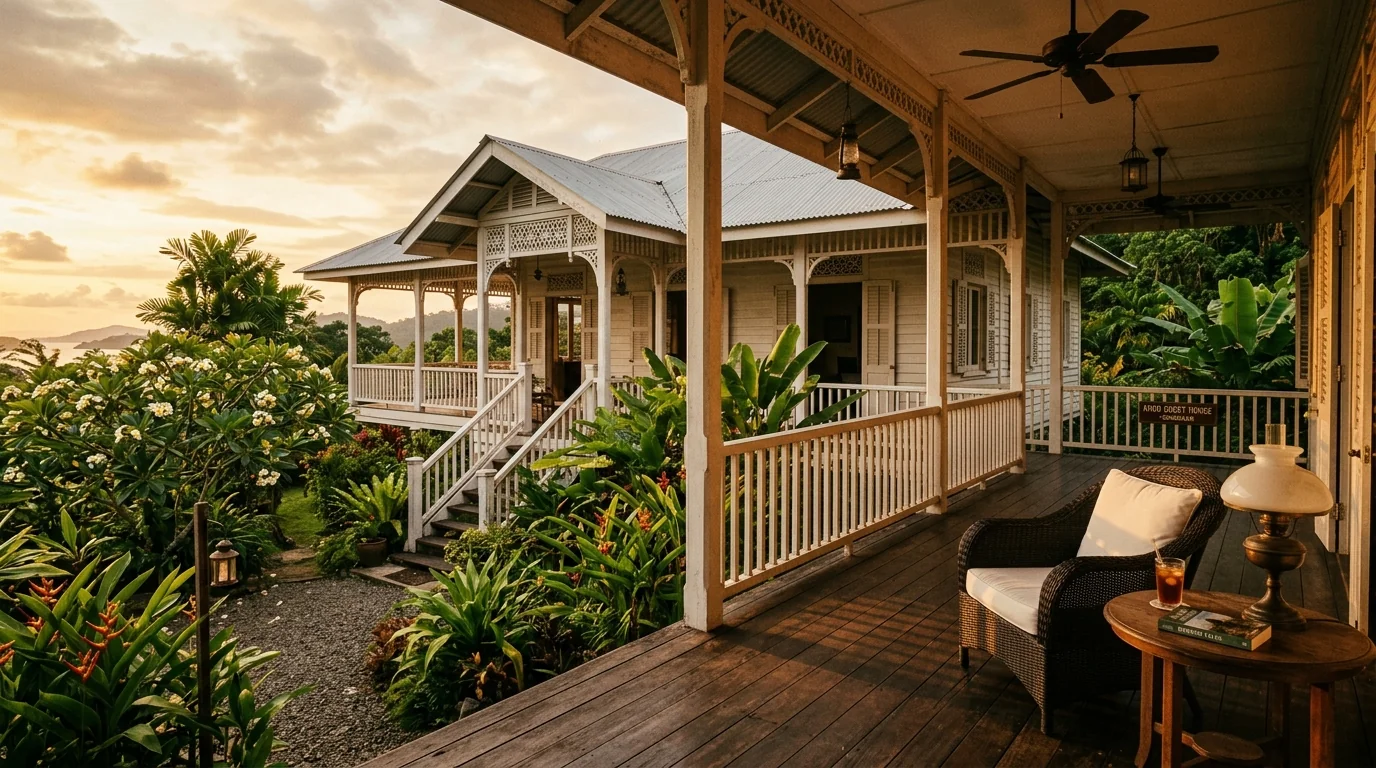
Agnes Keith House Sandakan — Colonial Museum & Heritage Site
Who was Agnes Keith and why is she important to Sabah?
Agnes Newton Keith (1901–1982) was an American author born in California who became one of the most important Western chroniclers of life in British North Borneo. She arrived in Sabah (then British North Borneo) in 1934 to join her husband, Harry Keith, who was appointed Conservator of Forests—a senior position in the colonial administration. What began as a sojourn in a remote colonial outpost became the material for literary works that would introduce Sabah to international audiences and preserve intimate accounts of pre-war colonial society, wartime survival, and post-war recovery.
Agnes Keith's first and most celebrated book, "Land Below the Wind" (1939), won the Atlantic Monthly Non-Fiction Prize and remains a classic of travel literature. The title itself comes from the local expression for the region south of the equator. In "Land Below the Wind," Keith offers vivid, sometimes lyrical, sometimes wry descriptions of colonial Sandakan life—the heat, the insects, the isolation, the unexpected social hierarchies, and the beauty of the natural world. She wrote about the challenges of being a colonial wife, raising a child in the tropics, and navigating the complex relationships between British administrators, local communities, and the indigenous peoples of Borneo.
Her second memoir, "Three Came Home" (1947), documents her experience of Japanese internment during World War II and stands as one of the most powerful first-person accounts of civilian suffering in the Pacific War. In this book, Keith describes her family's separation, her internment in camps, near-starvation, disease, and the will to survive. The book was adapted into a 1950 film starring Claudette Colbert, bringing Agnes Keith's story to international cinema audiences. A third book, "White Man Returns" (1951), chronicles the family's post-war return to Sabah and the process of rebuilding their lives and the colony.
Agnes Keith's writings remain essential sources for historians, anthropologists, and anyone seeking to understand colonial Borneo, the Japanese occupation, and the resilience of civilians during wartime. Her literary legacy ensures that the voices and experiences of British North Borneo are remembered globally.
What was life like in colonial Sandakan?
When Agnes Keith arrived in Sandakan in 1934, the town was the capital of British North Borneo and an active trading and administrative centre. It was also remote, humid, and populated by a small expatriate community—British administrators, merchant families, and a diverse population of local Malays, Chinese traders, indigenous Dusun and Bajau peoples, and labourers from various regions. For newcomers, especially Western women unaccustomed to tropical living, the adjustment could be jarring.
Colonial Sandakan was governed by rigid social hierarchies. The British colonial administration occupied the highest tier, followed by merchants and professional men. Wives of officials and businessmen formed their own society, with strict protocols around dress, social calls, and appropriate behaviour. The climate was punishing—temperatures regularly exceeded 30°C (86°F) with high humidity. There was no air conditioning; homes were built with wide verandahs, high ceilings, and ceiling fans to catch whatever breeze existed. Water was hauled by hand or drawn from wells. Fresh food was limited; meat was salted or preserved. Diseases like malaria, dengue fever, and dysentery were constant risks.
Yet colonial Sandakan also had pleasures. The natural environment was spectacular—rainforests, coral reefs, and the ocean. Society events—dances, dinners, amateur theatricals—provided entertainment and social bonding. Some expatriates developed genuine friendships with local families and showed real interest in indigenous cultures. Agnes Keith, in particular, was curious about local life and respectful of the people she encountered, which set her apart from some of her contemporaries. She learned about the town's history, attended local markets, and observed daily life with a writer's attention to detail.
The colony was administered by the British North Borneo Chartered Company (BNBCC), which held a monopoly on trade, land, and natural resource extraction. The governor and chief administrator ruled from Sandakan. By the 1930s, the colony was relatively stable, though underlying tensions existed between European interests and local populations, and awareness of rising Japanese militarism in the Pacific was growing among informed officials.
What happened to Agnes Keith during World War II?
On 8 December 1941, Japan invaded British North Borneo. Within weeks, Sandakan fell. The rapid collapse of the colony caught many expatriates unprepared. British men of military age were ordered to report for internment as prisoners of war. British women and children, and other foreign nationals, were to be assembled and interned separately as civilian prisoners.
The Keith family faced separation. Harry Keith, as a senior colonial official, was classified as a POW and imprisoned at various camps, including Batu Lintang in Kuching, Sarawak. Agnes, her young son George (born 1936), and their daughter Christine were ordered to surrender to Japanese authorities. Agnes describes in "Three Came Home" the harrowing process of reporting to internment, the shock of loss of freedom, and the terror of uncertainty about what lay ahead.
Agnes and her children were initially held at Berhala Island, an internment camp established in Sandakan Harbour. Conditions deteriorated rapidly. Food was scarce—mostly rice and brackish water. Sanitation was primitive. Disease was rampant. Children grew weak. Many internees, especially the elderly and those already weakened by illness, did not survive. Agnes worked as a camp nurse, drawing on her education and inner strength to help others while struggling to keep her children alive. She was resourceful, hiding small amounts of food and medicine, sharing knowledge about hygiene and wound care, and maintaining hope despite despair surrounding her.
Later, the family (along with other internees) was relocated to Batu Lintang camp near Kuching, Sarawak, where conditions were only marginally better. The journey itself was an ordeal—crammed into ships with hundreds of other prisoners, exposed to disease and malnutrition. Throughout her captivity, Agnes kept mental notes and secretly wrote observations, determined that her experiences—and those of others—would be remembered and recorded.
The family was liberated in September 1945 when British and Australian forces reached the camps. All three—Agnes, Harry, and their children—survived, though weakened. Agnes's survival and that of her children was not guaranteed; many families were separated permanently, and many women and children perished in captivity. Her account of internment in "Three Came Home" is both a personal testimony and a historical record of civilian suffering in the Pacific War. The book's power lies in its honesty about fear, trauma, loss, and the reserves of human endurance.
What can you see inside the museum today?
The Agnes Keith House museum has been carefully restored and curated to evoke life in the 1930s–1940s. The restored house retains period furnishings, colonial-era antiques, and personal objects that belonged to the Keith family, creating an intimate sense of how they lived.
The Living Areas: Visitors walk through the house's main rooms—living room, dining room, bedrooms, and kitchen—furnished with pieces typical of colonial households of the era. Ceiling fans, wooden furniture, oil lamps, and period textiles transport you to the pre-war period. Personal photographs of Agnes, Harry, and their children are displayed, humanizing the historical accounts.
Agnes Keith's Writing Desk: One of the most poignant exhibits is Agnes's writing desk, where she worked on her manuscripts. Seeing the physical space where she composed "Land Below the Wind" and drafted notes for "Three Came Home" creates a tangible connection to her literary legacy.
Book Exhibits and Memorabilia: Displays include first editions of her published works, correspondence, photographs from pre-war Sandakan, and newspaper clippings about her life and publications. There are also exhibits on the history of British North Borneo and the broader context of colonial Borneo.
WWII Documentation: A section of the museum is dedicated to the Japanese occupation and civilian internment. Photographs, documents, personal testimonies, and artifacts illustrate the experience of internment. This exhibit is historically significant but emotionally heavy, as it documents one of the Pacific War's lesser-known civilian tragedies.
Post-War Restoration: Exhibits cover the family's return to Sabah after the war and the process of rebuilding. This section illustrates resilience and the complex emotions of return after trauma.
Museum Shop: A small shop sells Agnes Keith's books, other books on Sabah history, and postcards. All purchases support the museum's preservation and operations.
| Title | Year | About | Awards & Notes |
|---|---|---|---|
| Land Below the Wind | 1939 | Memoir of life in colonial Sandakan and British North Borneo; observations on culture, environment, and colonial society | Won the Atlantic Monthly Non-Fiction Prize; remains a classic of travel literature |
| Three Came Home | 1947 | First-person account of Japanese internment during WWII; family separation, survival, and liberation | Adapted into a 1950 film starring Claudette Colbert; essential WWII civilian testimony |
| White Man Returns | 1951 | Post-war memoir; the family's return to Sabah, rebuilding, and adjusting to a transformed colony | Chronicles post-war recovery and the challenges of re-establishing life after internment |
How do I get to Agnes Keith House?
Location: Agnes Keith House is located on Jalan Istana in Sandakan, approximately 1 kilometre from central Sandakan and about 10 kilometres from Sandakan International Airport. The house sits on a hilltop, overlooking the town and bay.
Hours of Operation: Monday–Sunday, 9:00am–5:00pm. The museum is closed on public holidays. There may be a lunch break (typically 12:00pm–1:00pm), though this can vary seasonally, so it's best to call ahead if visiting around midday.
Entry Fees: Foreign visitors RM15 | Malaysian citizens (MyKad) RM2 | Children under 12 with MyKid Free | Malaysian seniors (55+) Free. Tickets are purchased at the entrance. Group discounts may be available for groups of 10 or more; contact the Sabah Museum Department in advance.
Getting There: From Sandakan Airport, a taxi or ride-share (Grab) to Agnes Keith House costs approximately RM20–30 and takes 15–20 minutes depending on traffic. From central Sandakan (Sandakan Harbour or town centre), it's about 5–10 minutes by car. The house is accessible by vehicle via Jalan Istana; parking is available near the entrance, though spaces are limited.
Public Transportation: Sandakan has local buses (minivans/vans), but routes and schedules can be irregular. It's more practical to use a taxi or ride-share service. If using public transport, ask at your hotel for directions to the correct van stand.
What to Bring: Water bottle, sunscreen, hat, comfortable walking shoes (the house is on a slope), camera, and a small notebook if you want to jot observations. The museum is not air-conditioned (it's a heritage building), so dress in light, breathable clothing.
Accessibility: The house is a timber heritage building with stairs and narrow corridors. Wheelchair access is limited. Visitors with mobility concerns should contact the Sabah Museum Department in advance to discuss options.
Contact Information: Sabah Museum Department | Phone: (+60) 89-225199 | Email: sabahmuseum@sabah.gov.my (for group bookings or accessibility inquiries)
What other Sandakan heritage sites should I visit?
Sandakan Memorial Park: About 1 kilometre from Agnes Keith House, this poignant park is a tribute to those who died in Sandakan camps during WWII. It features the names of 2,434 Allied POWs and civilians who perished, a war memorial, gardens, and a museum. Admission is free, and a visit complements the Agnes Keith House experience by providing broader context on the human cost of the occupation. Allow 45 minutes to 1.5 hours.
St. Michael's Church Sandakan: This is the oldest stone church structure in Sabah, originally built in the 1880s (though rebuilt several times). The church overlooks the bay and is a peaceful, historic place of worship. Located about 2 kilometres from Agnes Keith House; entry is free, and a visit takes 20–30 minutes.
Sandakan Heritage Trail: A walking route through central Sandakan connects several heritage sites, colonial buildings, and points of historical interest. Agnes Keith House is part of this trail. The trail is designed for self-guided exploration and typically takes 2–3 hours depending on your pace and interests. Detailed maps are available at the tourist information centre.
Sabah Museum (Sandakan Branch): If visiting during your Sandakan trip, the main Sabah Museum in Kota Kinabalu is worth a visit. However, Sandakan also has local history exhibits available through tourism information services. Contact Sandakan Tourist Information Centre for details.
Sandakan Harbour Market (Pasar Baru Sandakan): A bustling local market near the waterfront offering fresh seafood, local crafts, and street food. It provides an authentic glimpse of contemporary Sandakan life and is about 1.5 kilometres from Agnes Keith House. Best visited early morning (6:00–9:00am) for the freshest produce and least crowding.
Gomantong Caves and Kinabatangan River Wildlife Sanctuary: Beyond Sandakan's heritage sites, the nearby Gomantong Caves (where birds' nests are harvested) and Kinabatangan River (one of Borneo's most biodiverse wildlife zones) are natural attractions. These are typically day trips or multi-day excursions from Sandakan and offer opportunities to experience Sabah's extraordinary biodiversity.
Frequently asked questions
Q Is the Agnes Keith House suitable for children?
Q How long does a typical visit take?
Q Are photographs allowed inside the museum?
Q Can I buy Agnes Keith books at the museum?
Q Is the house wheelchair accessible?
Resources and further reading
- Sabah Museum Official Website — Agnes Keith House museum information and opening hours
- Sabah Tourism Board — Official tourism guide to Agnes Keith House and Sandakan attractions
- Wikipedia: Agnes Keith — Biographical information and literary legacy
- Malaysia Traveller — Detailed visitor guide, photos, and practical information
- Google Maps — Location, directions, and nearby attractions