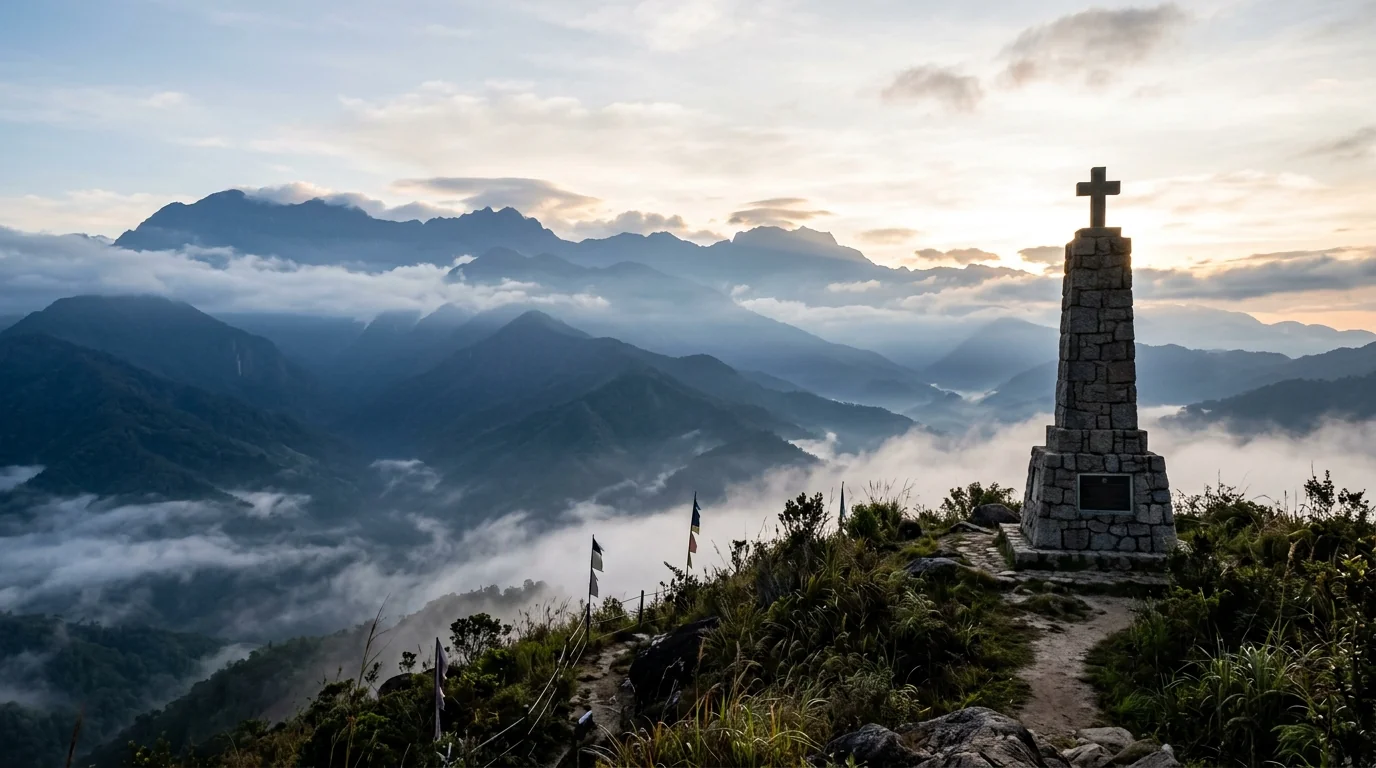
Mat Salleh Memorial Monument — Tambunan's Tribute to Sabah's National Hero
What is the Mat Salleh Memorial Monument?
The Mat Salleh Memorial Monument is a heritage site managed by the Sabah Museum Department, located in Tibabar village in Tambunan district. The monument commemorates Mat Salleh, Sabah's most celebrated resistance leader, who led an armed uprising against British colonial rule from 1895 to 1900. The memorial marks the location where Mat Salleh's final fortress stood—the site of his last major engagement with British forces in January 1900.
Mat Salleh (c. 1845–1900) was a Bajau chief from Brunei who became the symbol of indigenous resistance to colonial expansion in Sabah. For nearly five years, he organized and led a rebellion that unified various local communities against the encroaching British North Borneo Chartered Company administration. His cause attracted followers from Bajau, Bajau Laut, and other indigenous groups across Sabah, making his rebellion one of the most significant anti-colonial uprisings in Borneo's history.
Although the monument itself is modest—consisting of a memorial marker or obelisk and informational plaques—its historical significance is profound. Mat Salleh is venerated in Sabah as a national hero, representing the indigenous struggle for self-determination and dignity against colonial domination. Tambunan, as the site of his final stand, holds sacred meaning for many Sabahans and serves as a pilgrimage site for those honouring his legacy.
The memorial site is free to visit and is accessible during daylight hours. The Sabah Museum Department maintains the site and provides historical information to visitors. For many, visiting the monument is an act of respect and remembrance—a way to acknowledge a pivotal moment in Sabah's resistance history.
Why is the monument located in Tambunan?
Tambunan was strategically chosen as Mat Salleh's final stronghold for several interconnected reasons. First, the location is in the interior highlands of Sabah, far from the coastal bases of British military power. The Crocker Range mountains, which ring Tambunan, provided defensible high ground and natural barriers against colonial forces armed with modern weapons. Interior location meant longer supply lines and logistical challenges for the British, favouring a resistance force that knew the terrain intimately.
Second, Tambunan's population, primarily Kadazan-Dusun and Bajau communities, were sympathetic to Mat Salleh's anti-colonial cause. Unlike some other areas where indigenous leaders had made peace with the British or were collaborating with colonial authorities, Tambunan's local leadership and population largely supported Mat Salleh's resistance. This local support was essential—without it, he could not have sustained a military operation for nearly five years.
Third, Tambunan sits at a crucial junction in Sabah's interior geography, where trade routes converge and multiple ethnic groups interact. Control of Tambunan gave Mat Salleh influence over interior commerce and the ability to move between different regions of Sabah. The location also positioned him to challenge British authority in a highly visible way—showing that the colonial power could not dominate all of Sabah's territory.
Finally, there is a spiritual and cultural dimension to Tambunan's significance. For the Kadazan-Dusun peoples, Tambunan is home—ancestral lands and a centre of cultural identity. Mat Salleh's choice to make his final stand here suggests his understanding that indigenous resistance must be rooted in the homeland and must have the support of the people whose lands were at stake. By fighting in Tambunan, Mat Salleh was defending not just abstract political principles but the specific lands and communities of Sabah's indigenous peoples.
| Location | Mat Salleh's Connection | Can Visitors Go? | Distance from KK |
|---|---|---|---|
| Lingkabo/Sugut River | Birthplace area; early life | Limited access; requires local guides | ~200km north |
| Jambongan | Village burned 1895 — trigger of rebellion | Yes; visited as part of interior tours | ~150km northeast |
| Gaya Island | 1897 raid on British settlement; now resort island | Yes; accessible by boat from KK | ~20km offshore from KK |
| Tambunan/Tibabar | Final fortress and last stand 1900 — memorial here | Yes; free memorial site open daily | ~80km south |
| Ranau/Interior Highlands | Various engagements 1897–1899 | Yes; mountain trekking routes | ~100km east |
What can I see at the memorial site?
Visitors to the Mat Salleh Memorial Monument should approach with realistic expectations. The site is modest in scale—it is not a large, grand museum or elaborate monument complex. Rather, it is a quiet, respectful commemoration of a historic location.
The Memorial Marker: The focal point is a monument or memorial obelisk/stone marker inscribed with Mat Salleh's name, dates, and acknowledgment of his historical significance. The marker itself is typically made of stone or concrete and features Malay and English text explaining its purpose. The design is simple and dignified, appropriate to a heritage site managed by the Sabah Museum.
Informational Plaques and Signage: Near the monument, informational plaques provide historical context in Malay and English. These plaques typically outline Mat Salleh's life, the dates of his rebellion, key events, and his significance to Sabah's history. Reading these plaques takes 10–15 minutes and provides essential background for understanding the site's historical value.
The Landscape and Setting: The memorial site sits in Tambunan's highland landscape—at about 800 metres altitude, the environment is notably cooler and more lush than coastal Kota Kinabalu. The immediate surroundings include cultivated fields, trees, and the distant view of Tambunan's agricultural landscape and the Crocker Range mountains. On clear days, Mount Kinabalu is visible in the distance. This natural setting adds to the contemplative quality of the site.
Archaeological Remnants (Limited): The original fortress built by Mat Salleh stood at or near this location. Over more than a century, the jungle has reclaimed most of the physical remains. Visitors may see subtle ground depressions or stone arrangements that could be remnants of fortifications, but these are not prominent or clearly marked. The focus of the memorial is historical remembrance rather than archaeological exhibition.
Garden and Seating Areas: Depending on the current state of the site, there may be a small garden area or seating where visitors can sit quietly and reflect. The peaceful, contemplative atmosphere is part of the memorial's purpose—a place to pause and honour Mat Salleh's legacy.
How does Tambunan honour Mat Salleh today?
Mat Salleh holds venerated status in Sabah as a national hero. Tambunan, as the site of his final stand and death, is a focal point of this veneration. The physical memorial is one expression, but Mat Salleh's legacy is woven throughout Tambunan's cultural identity and Sabah's national consciousness.
Annual Commemorations: Tambunan and Sabah at large hold commemorative events, particularly around the anniversary of key events in Mat Salleh's rebellion. Dates such as the Battle of Tambunan (January 1900) or Mat Salleh's death may be marked with speeches, ceremonies, and educational programmes. These events bring together Sabahans to reflect on the historical significance of his resistance and its continuing relevance to Sabah's identity.
Educational and Cultural Programmes: The Sabah Museum Department and local cultural organizations use Mat Salleh's story in educational materials, school curricula, and cultural promotion. Tambunan's community, particularly indigenous Kadazan-Dusun groups, transmit Mat Salleh's legacy orally and through cultural practices. The memorial site serves as a teaching location where visitors—both local and international—learn about Sabah's pre-colonial and early colonial history from an indigenous perspective.
Cultural and Symbolic Significance: Mat Salleh represents indigenous pride, resistance to oppression, and the struggle for self-determination. His image appears on murals, in literature, and in public discourse about Sabah's identity. He is featured on cultural items, books, and historical exhibitions. For many Sabahans, particularly indigenous peoples, Mat Salleh embodies dignity and the moral legitimacy of resisting unjust colonial authority.
Integration into Heritage Tourism: Tambunan has positioned itself as a heritage and cultural tourism destination. The Mat Salleh Memorial is marketed as part of Sabah's historical narrative, inviting visitors to engage with Sabah's pre-colonial and colonial past. Tourism revenue and renewed interest in heritage help ensure that sites like the memorial are maintained and that Mat Salleh's story continues to be told to new generations.
Historical Scholarship: Academics, historians, and researchers continue to study Mat Salleh's rebellion and its impact on Sabah's trajectory toward independence. This scholarly work ensures that Mat Salleh's historical significance is properly understood and integrated into broader narratives of Sabah's development and Southeast Asian colonial history.
How do I get to the Mat Salleh Memorial from Kota Kinabalu?
Distance and Travel Time: Tambunan is approximately 80 kilometres south of Kota Kinabalu. The journey takes about 1.5 to 2 hours by car, depending on traffic conditions and driving pace. The route is mostly well-maintained highway (the Crocker Range Highway), though some sections pass through mountain terrain with curves.
Route: From central Kota Kinabalu, head south on the main highway (Federal Route 1/Jalan Utama). Follow signs toward Tambunan via the Crocker Range. The road climbs through the Crocker Range National Park, offering scenic views of Sabah's interior highlands and distant views of Mount Kinabalu on clear days. The road descends into Tambunan valley. Follow local signs or GPS navigation to Tibabar village and the memorial site.
By Private Car: Renting a car from Kota Kinabalu airport or town gives maximum flexibility. Rental agencies are available, and the drive is straightforward on main highways. Allow 2–2.5 hours for the drive, accounting for stops to enjoy scenery or for fuel/refreshments. Parking is available near the memorial site.
By Public Transport: Regular minivans and express vans operate routes from Kota Kinabalu to Tambunan and continue south to Keningau and Tenom. Journey time is 2–3 hours depending on stops. These services are economical (typically RM10–15 per person) but less flexible in terms of schedule and individual site visits. Minivans typically depart from central KK town or the central bus station. Ask hotel staff for current schedules and departure locations, as these can vary.
By Organized Tour: Tour operators in Kota Kinabalu offer day tours or multi-day trips to Tambunan and surrounding sites (Rafflesia Reserve, war memorials, etc.). Organized tours typically include transportation, a guide, and entry fees to paid attractions. This option suits visitors without their own transport or those preferring guided experience. Tours typically cost RM100–250 per person depending on what is included.
Travel Timing and Conditions: The best time to travel is morning (7:00am–10:00am) to avoid afternoon traffic and allow enough daylight for sightseeing. The Crocker Range Highway can experience rain and reduced visibility, particularly during monsoon seasons (November–January and May–June). Avoid night driving on mountain roads if unfamiliar with the terrain. The road is generally safe but requires attentive driving.
What to Bring: Bring water, snacks, sunscreen, a hat, comfortable walking shoes, and a camera. The memorial site itself is simple, requiring no special equipment. If visiting the Tambunan Rafflesia Reserve on the same trip, bring sturdy hiking shoes and rain gear, as forest trails can be muddy.
Contact for Information: Sabah Museum Department can provide detailed directions and information about the memorial. Local Tambunan tourism offices can assist with arranging guides or transport. Hotels in Kota Kinabalu can facilitate tour bookings or provide detailed travel advice.
What else can I do in Tambunan district?
Tambunan Rafflesia Reserve: The world's largest flower, Rafflesia pricei, blooms in this protected reserve. A guided walk through the forest to see the flower (when in bloom) is a unique natural experience. Bloom times vary and are unpredictable, so check with the reserve in advance. A typical visit takes 2–3 hours and includes a forest walk with educational interpretation. The reserve is managed by the Sabah Parks and requires entry fees (approximately RM30 per person). Contact: Tambunan Rafflesia Centre.
Tambunan Village Rice Wine Centre (Tapai Tuan): This cultural attraction showcases the traditional production of tapai (glutinous rice wine), a significant part of Kadazan-Dusun culture. Visitors can observe the fermentation process, learn about traditional preparation methods, taste the product, and purchase bottles as souvenirs. A visit takes 1–2 hours. The centre is simple but authentic and offers insights into local food culture. No admission fee, though purchases are encouraged.
Tambunan Culinary Experience: Tambunan is known for vegetable farming and produces excellent highland vegetables, rice, and local dishes. Dining at local restaurants or homestays allows visitors to experience authentic Sabahan cuisine. Dishes feature local produce and traditional recipes passed down through Kadazan-Dusun communities. Several restaurants and homestay operations cater to visitors.
Agricultural Landscape and Scenic Drives: Tambunan's landscape is dominated by rice paddies, vegetable farms, and fruit orchards set against the backdrop of the Crocker Range. Scenic drives through agricultural areas offer photogenic views, particularly during planting and harvest seasons. The landscape is peaceful and representative of Sabah's interior highland communities.
Mount Kinabalu View: Although Mount Kinabalu (Sabah's highest peak at 4,095 metres) is not accessed from Tambunan, it is sometimes visible from certain Tambunan vantage points on clear days. The Kundasang War Memorial is located on Mount Kinabalu's lower slopes, about 50 kilometres northeast of Tambunan, and offers closer views of the mountain and opportunities for hiking.
Kundasang War Memorial: About 50 kilometres north of Tambunan, near the town of Kundasang and Mount Kinabalu's foothills, this memorial commemorates Allied servicemen who died during the Pacific War in Sabah. It is a peaceful site with gardens and historical exhibits. A visit complements the Mat Salleh Memorial by broadening understanding of Sabah's modern historical experience. Allow 1–2 hours for a visit.
Homestays and Community Tourism: Several homestays operated by local Kadazan-Dusun families offer opportunities for cultural immersion. Visitors can participate in traditional cooking, agricultural activities, and cultural ceremonies. These experiences provide deep insight into contemporary indigenous life in Sabah's interior highlands.
Frequently asked questions
Q Is the Mat Salleh Memorial Monument worth visiting on its own?
Q Are there guided tours of the Mat Salleh historical sites in Tambunan?
Q What is the best time of year to visit Tambunan?
Q Is Tambunan far from Kota Kinabalu?
Q What is the Tambunan Rafflesia Reserve?
Resources and further reading
- Mat Salleh Rebellion — Detailed article on the complete history of Mat Salleh's resistance (1895–1900)
- Sabah Museum Official Website — Heritage site information and historical resources
- Sabah Tourism Board — Official tourism guide, heritage sites, and cultural attractions
- Wikipedia: Mat Salleh Rebellion — Historical overview and key events
- Google Maps — Location, directions, and nearby attractions in Tambunan
- Kundasang War Memorial — WWII memorial in Mount Kinabalu area
- Rundum Rebellion — The next major indigenous uprising after Mat Salleh