WWF Sabah: Marine and Wildlife Conservation
What is WWF's work in Sabah?
WWF Malaysia's Sabah office leads marine and wildlife conservation, including marine turtle protection in Tun Mustapha Park and Semporna, and community-based conservation partnerships with island communities.
WWF in Sabah at a glance
WWF Malaysia runs an active office in Sabah, working on some of Borneo's most important marine and coastal habitats. Its programmes span turtle nesting beaches, seagrass feeding grounds and the coastal communities that depend on healthy seas.
Much of the office's focus sits in northern and eastern Sabah, where rich biodiversity meets significant pressure from fishing, tourism and development. The team combines field conservation with community partnerships to protect species and habitats over the long term.
WWF Sabah works on marine turtle conservation and community-based conservation across Tun Mustapha Park and the Semporna area.
Marine turtle conservation
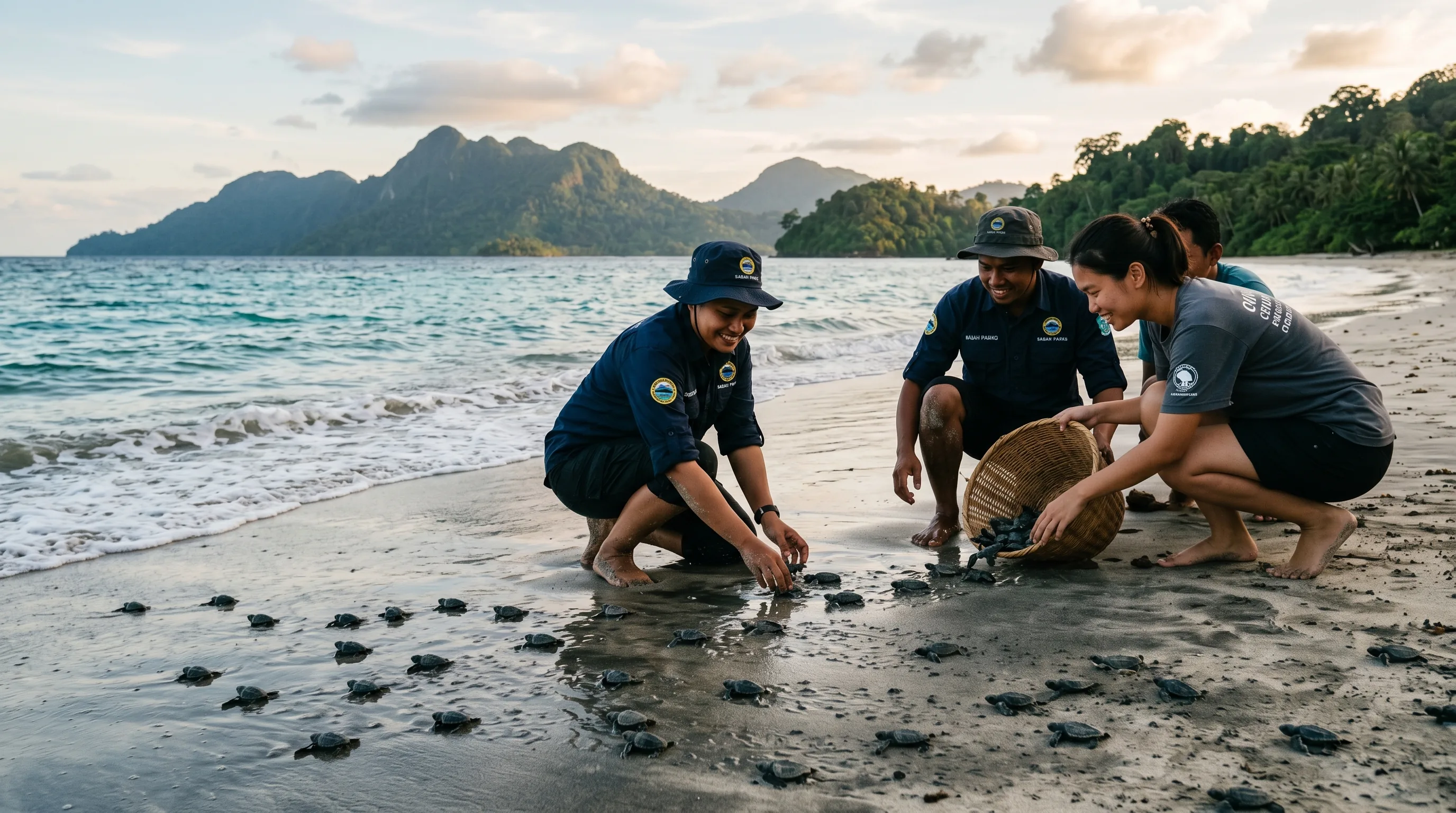
One of WWF Sabah's signature programmes is marine turtle conservation, centred on Tun Mustapha Park in northern Sabah. This large marine protected area includes islands and beaches where turtles come ashore to nest.
Beyond field protection, WWF has used events to build local pride and awareness. With the Tigabu Youth Club, it organised the first island-based Marine Turtle Festival in Tun Mustapha Park, held on Tigabu Island in 2017 (Sabah Ministry of Tourism, Culture and Environment, checked 6 October 2026).
Protecting nesting sites and reducing threats to turtles helps secure a species that is both ecologically important and a symbol of Sabah's marine heritage.
Turtle work in Semporna
On Sabah's east coast, WWF-Malaysia monitors nine nesting beaches covering 25 kilometres in Semporna, alongside 11 nesting beaches covering 13 kilometres in Tun Mustapha Park (Borneo Post, checked 6 October 2026). The work includes moving nests to hatcheries to prevent poaching, coastal surveillance and patrols.
The team also studies the seagrass beds where green turtles feed, because protecting foraging grounds matters as much as protecting nesting beaches.
Healthy seas underpin the marine economy that many Sabahan coastal communities rely on, making their protection a shared priority.
Community monitoring
WWF-Malaysia and the Sabah Wildlife Department have supported island communities to take part in beach and foraging ground monitoring, with programmes that involve both adults and youth (Borneo Post, checked 6 October 2026).
By involving local people, this work extends the reach of conservation far beyond what a small professional team could manage alone. It also builds a sense of ownership, with residents taking a direct role in protecting the species around them.
Community monitoring shows how protecting Sabah's wildlife depends on local people, not just outside organisations.
Community-based conservation
Across its work, WWF Sabah relies on community-based conservation partnerships. Rather than working in isolation, the office collaborates with villages and coastal communities whose daily lives are tied to the sea and its resources.
This approach recognises that lasting conservation needs the support of the people who live alongside protected areas. By involving communities in turtle protection and wildlife monitoring, WWF helps align environmental goals with local needs and livelihoods.
It is a model that connects Sabah's natural heritage with the communities who are, in practice, its closest guardians.
How to contact the Sabah office
The WWF Malaysia Sabah office is based in Kota Kinabalu. Its address is 6th Floor, CPS Tower, Centre Point Complex, No. 1, Jalan Centre Point, 88800 Kota Kinabalu.
You can reach the office by phone at +6088-262 420 (WWF-Malaysia, checked 6 October 2026). For broader information on programmes, campaigns and ways to get involved, the national website is wwf.org.my.
Whether you are a student, traveller or local resident, these contacts are the starting point for learning more about conservation work in Sabah.