Pan Borneo Highway 2026 — Progress & Phase Status

Phase 1 of the Pan Borneo Highway in Sabah runs 706 km from Sindumin on the Sarawak border to Tawau, at a cost of RM24.889 billion. It is split into Phase 1A (318 km, 16 work packages, RM10.9 billion) and Phase 1B (388 km, 19 packages, RM13.989 billion). As at July 2026 Phase 1A was 87.86% complete, having been 86.6% against a 97.55% schedule in February. Phase 1B was 13.56% against 19.6% in February 2026, the most recent figure published. Phase 1A now targets mid-2028, and both phases together the fourth quarter of 2030. The highway is toll-free and fully federally funded.
Progress percentages on this project change at almost every parliamentary sitting, and officials have occasionally quoted figures that conflict with each other. Every number on this page carries the date it was stated. The most recent precise figures come from the Dewan Rakyat on 26 February 2026. Last verified 14 August 2026.
Both phases are running behind schedule — Phase 1A by about 11 percentage points, Phase 1B by about 6. The headline completion figure alone understates the delay.
Source: Deputy Works Minister, Dewan Rakyat, 26 February 2026
Project overview
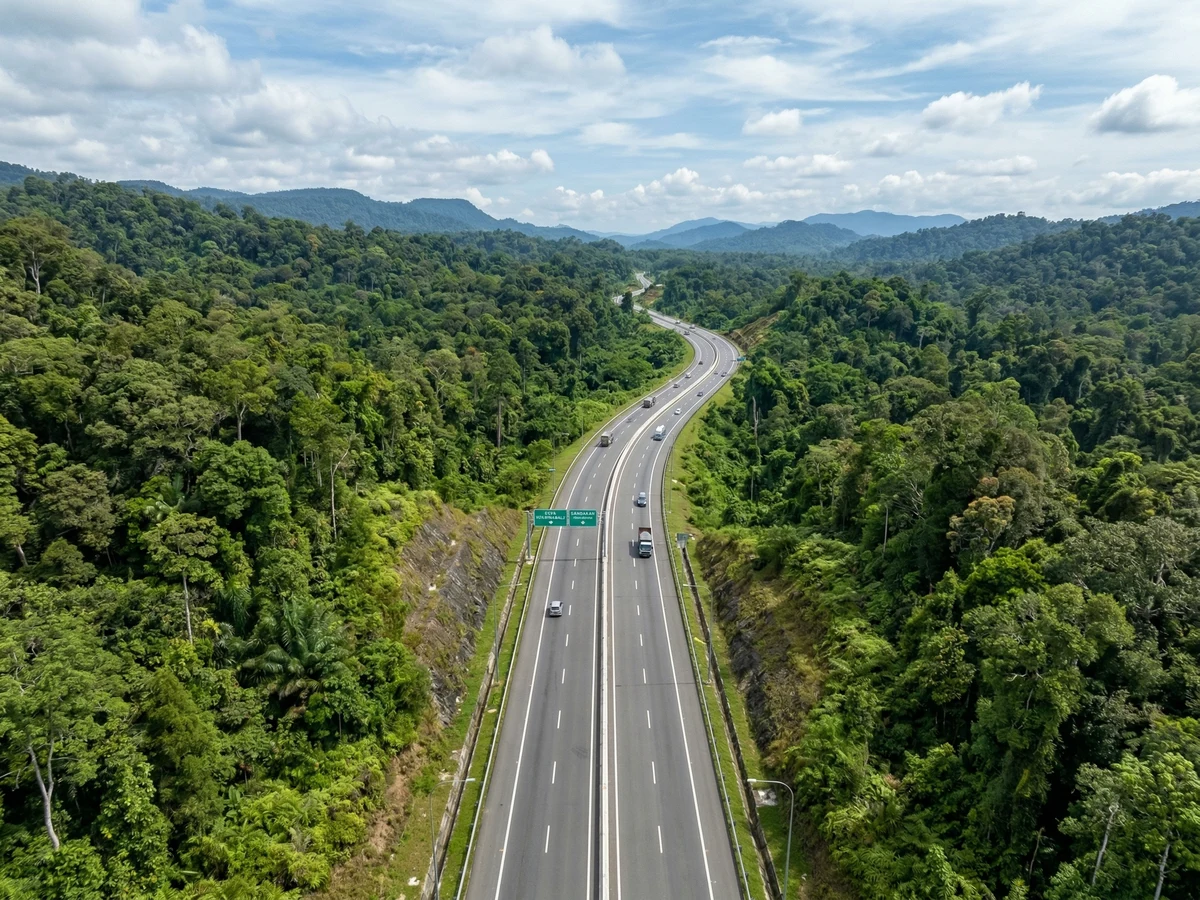
The Pan Borneo Highway is the largest road project ever undertaken in Sabah. Phase 1 covers 706 km running from Sindumin, on the Sabah–Sarawak border, through Beaufort, Papar, Kota Kinabalu, Telupid, Sandakan and Lahad Datu, to Tawau in the south-east. Rather than building new alignments everywhere, the programme mostly widens, straightens and upgrades existing trunk roads, adding new sections where the terrain demands it.
It is not a Peninsular-style tolled expressway. It is a federally funded trunk road upgrade, delivered as 35 separate work packages that open individually as they finish, which is why parts of the route are already in use while others have barely started.
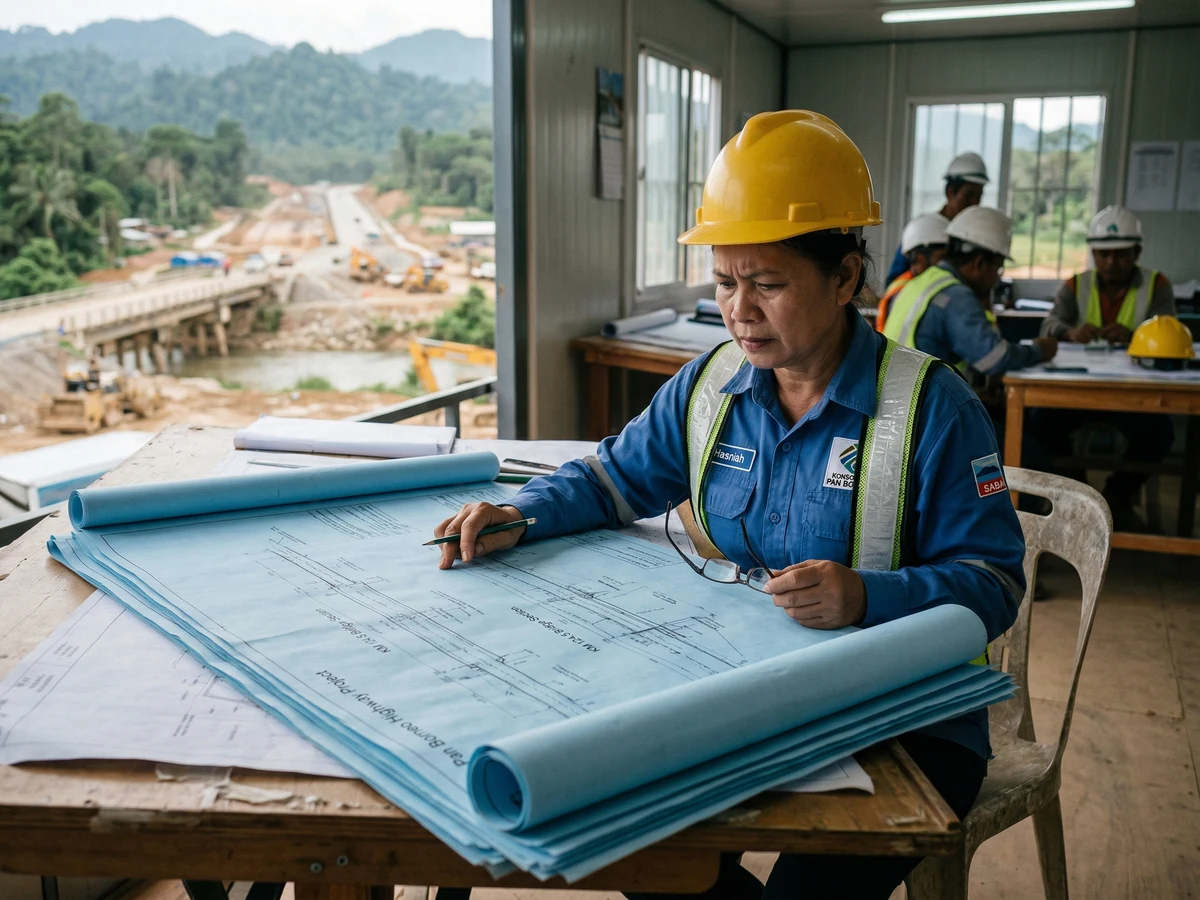
Delivery changed hands early in the project's life. Sabah's original project delivery partner, Borneo Highway PDP Sdn Bhd, was appointed in April 2016 and terminated in September 2019, with only a small share of the work complete. The Ministry of Works now implements the project directly, with JKR Sabah as Superintending Officer. That switch is the single biggest reason the cost roughly doubled.
Phase 1A: 318 km, 16 work packages
Phase 1A carries the west coast trunk — Sindumin, Sipitang, Beaufort, Bongawan, Papar, Putatan, Kota Kinabalu, Inanam, Sepanggar and on towards Rampayan Laut — plus three detached packages on the east coast: the Tawau–Semporna junction, the Lahad Datu Bypass, and the Sandakan–Telupid stretch. It is not one continuous road, and it does not run "Kota Kinabalu to Kimanis": Kimanis is not a Phase 1A boundary at all.
Phase 1A costs RM10.9 billion. It stood at 86.6% against a scheduled 97.55% in February 2026, and at 87.86% in July 2026 — a gain of about 1.3 points in five months. The completion target has now moved three times: October 2026, then the first quarter of 2027, and in July 2026 the Deputy Works Minister told the Dewan Negara it is expected in mid-2028. Nine further packages were due to open by the end of 2026.
Note that official statements have put the package count at both 15 and 16, apparently reflecting the award of the Serusop–Pituru package. Sixteen is the figure used by the Works Minister and in the ministry's own cost breakdown.
Each point is a figure stated publicly by a minister or in a parliamentary answer on that date. Progress has flattened noticeably through 2026.
Source: Bernama, Dewan Rakyat answers and KKR statements, 2024–2026
Phase 1B: 388 km, 19 work packages
Phase 1B is the larger and later phase, covering four separate corridors rather than a single stretch:
- North-west: Kota Belud to Kudat
- Central: Telupid to Ranau
- North-east: Lahad Datu to Sandakan
- South-east: Tawau to Lahad Datu
Letters of acceptance went to 13 contractors in October 2024, with construction periods of 36 to 48 months. The allocation is RM13.989 billion, fully federally funded. As at 26 February 2026 the phase stood at 13.56% against a scheduled 19.6%. The Works Ministry now targets the fourth quarter of 2030 for Phase 1B together with Phase 1A, replacing the fourth quarter of 2028 given in February.
Three of the central packages — running from Kampung Lumou Baru through Kampung Toupos and Kampung Nabutan to Ranau, some 70.2 km in total — were reported underway in April 2025.
Phases 2 and 3: still at planning stage
Beyond Phase 1, two further phases exist on paper only. Answering the State Assembly in November 2024, Deputy Chief Minister Shahelmey Yahya set out:
- Phase 2 — the Tamparuli–Ranau alignment, around 98 km
- Phase 3 — Kimanis–Keningau–Kalabakan–Tawau, around 432 km
Both are at planning stage, with implementation dependent on government approval and financial capacity. No cost estimate, contract award or start date has been published for either. Anyone quoting a budget or a completion year for these phases is guessing.
What has actually opened
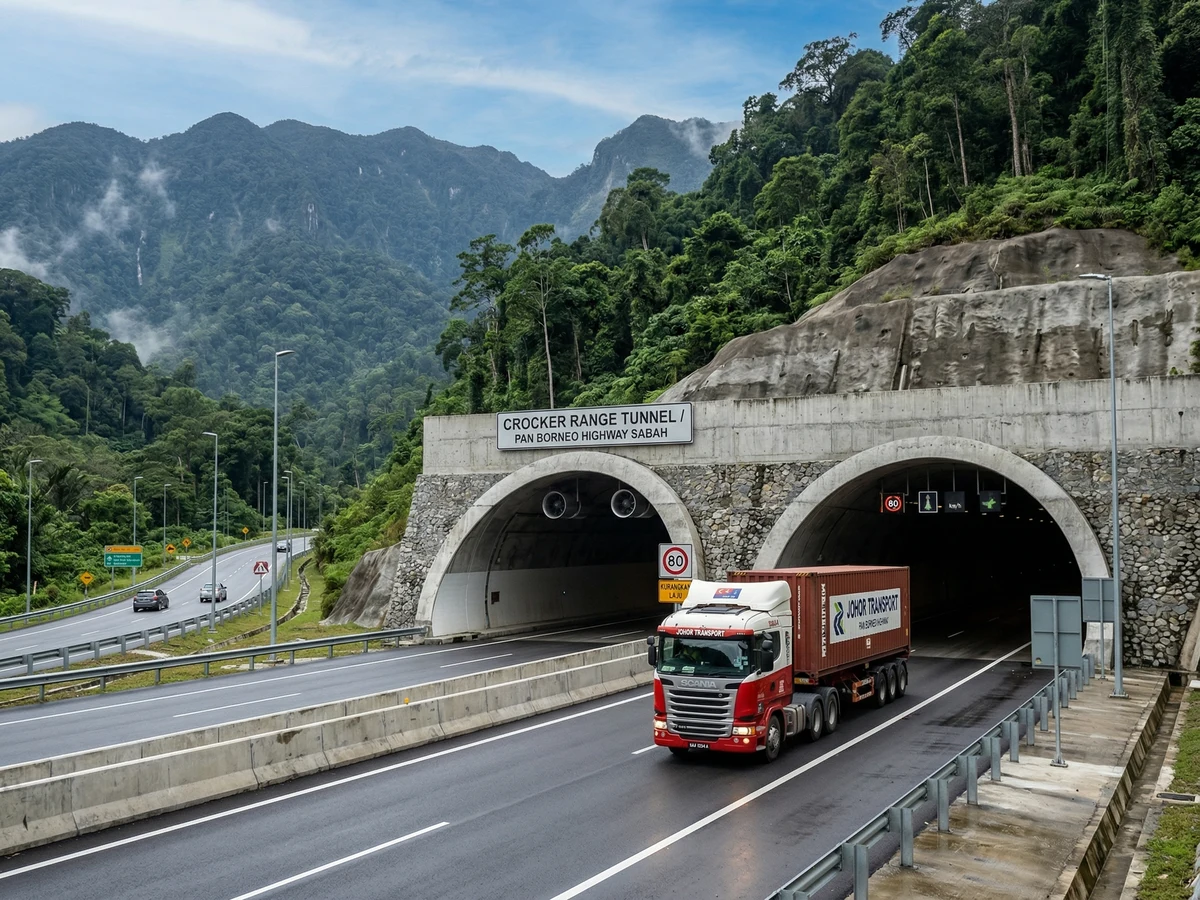
The highway opens in pieces. Four packages opened between 2022 and 2023:
- Donggongon–Papar — opened August 2022
- Mile 32 to Kampung Lot M, Sandakan — opened November 2022
- Tawau to the Semporna junction — opened August 2023
- Lahad Datu Bypass — opened October 2023
Nine further packages were scheduled to open during 2026. Among them, the Putatan–Menggatal section opened in July 2026, giving traffic a route around Kota Kinabalu city centre. Several more are slated for 2027, with the remainder staged out towards 2030.
Why it has run late
The causes cited officially are consistent across parliamentary answers and ministry statements:
- Land acquisition — disputes and compensation have held up work fronts. Land acquisition for Phase 1 is budgeted at RM2.53 billion, of which about RM1.2 billion had been paid by mid-2026.
- Utility relocation — SESB power lines, water mains and telecoms sit within the road reserve and must be moved, in sequence, without cutting off nearby communities.
- Worker and material shortages — securing labour and machinery has been difficult, particularly in the period after COVID.
- Terrain and soil — stretches through the interior cross soft ground and hilly terrain, complicating foundations, drainage and embankments.
Underlying all of it is the 2019 termination of the project delivery partner model, which required the remaining scope to be reassessed five years after the original estimate and re-procured under conventional federal contracting.
Cost and funding
Phase 1 was estimated at RM12.86 billion in 2015. It now stands at RM24.889 billion — RM10.9 billion for Phase 1A and RM13.989 billion for Phase 1B.
The Works Ministry attributes the increase to the change in delivery model, changes in scope and design, geotechnical structures and soil treatment, large-scale utility relocation, and inflation in the price of steel, bitumen, cement, machinery and labour.
The project is fully federally funded. There is no state cost-share, no private concession and no toll. Phases 2 and 3 have no allocation.
The Pan Borneo Highway is toll-free, and has been a stated federal commitment since 2015. The reasoning given by the Works Minister is that unlike expressways in Peninsular Malaysia, Pan Borneo is the main route across Sabah and Sarawak with no alternative road alongside it, so there is no basis for charging. There is no concessionaire and no toll operator appointed.
Frequently asked questions
Q When will the Pan Borneo Highway be fully completed?
Q What is the total cost of the Pan Borneo Highway in Sabah?
Q Will tolls apply on the Pan Borneo Highway?
Q Can I drive the Pan Borneo Highway now (2026)?
Q What are the Phase 2 and Phase 3 details?
Q Why is the project running late?
Q Who is building the Pan Borneo Highway in Sabah?
Sources & References 8 sources
Last verified: 20 August 2026
Project Management
Official Statements
- Dewan Rakyat — cost breakdown, 14 July 2026 Deputy Works Minister on the RM12.86b to RM24.889b increase and land compensation
- Sabah State Assembly — Phases 2 and 3, 19 November 2024 Shahelmey Yahya on the Tamparuli–Ranau and Kimanis–Tawau alignments
- Phase 1 completion target, April 2025 Head of State policy address, Phase 1 by 2029. Superseded: the Works Ministry gave Q4 2030 in July 2026.
- Toll-free commitment, August 2025 Works Minister confirms no tolls on Pan Borneo
- Package openings, May 2026 Nine work packages scheduled to open during 2026