Sabah Ports 2026 — Sepanggar Container & Cargo Data

We are working through the statistics in this section against their original sources. The headline figures above were re-checked on 17 August 2026. Detailed figures further down the page have not yet been individually verified, and some may be out of date or wrong.
If you spot something that looks wrong, please tell us — it genuinely helps.
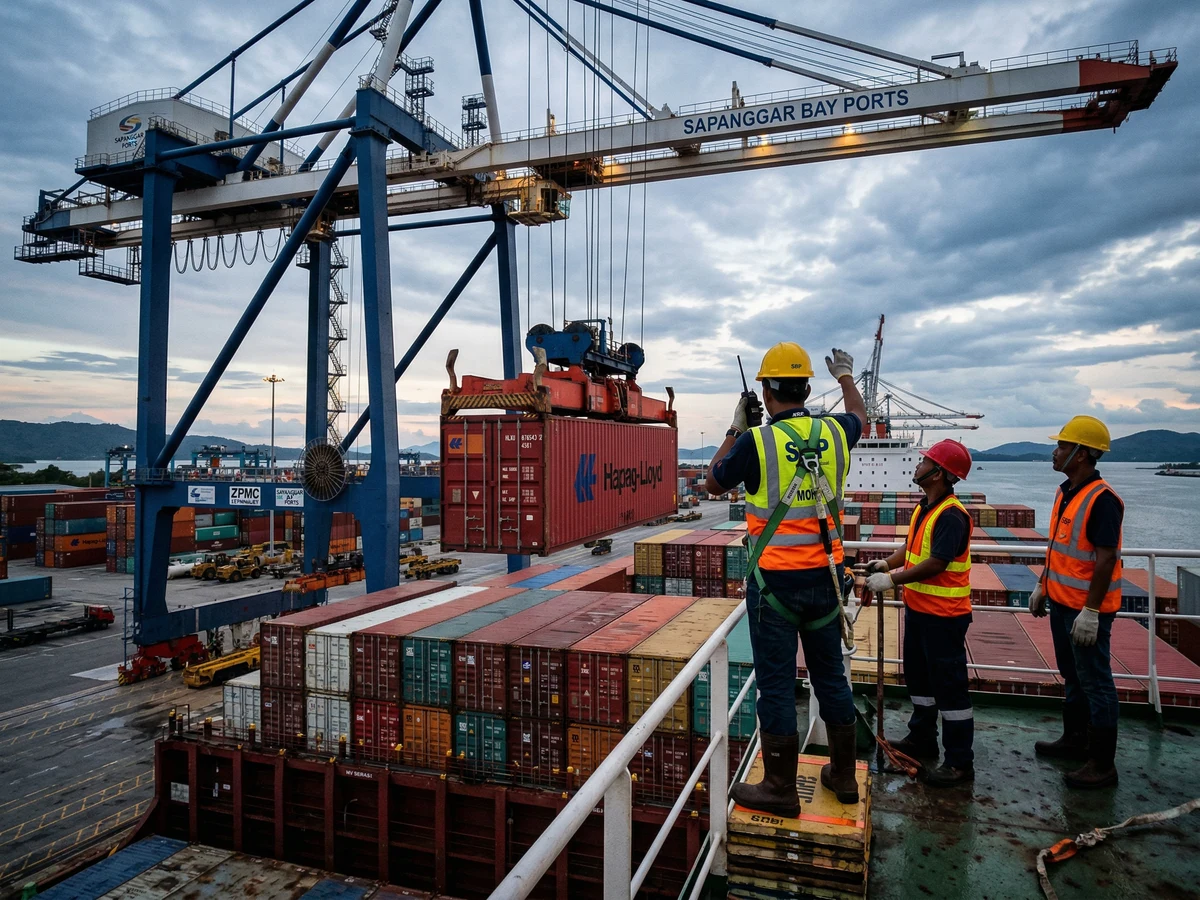
Sabah Ports operates eight ports, of which three handle containers. Sapangar Bay Container Port (SBCP) is the flagship, handling 396,694 TEUs in 2025 — about three quarters of the Sabah Ports network total of 532,391 TEUs, with Tawau and Sandakan making up most of the rest. SBCP's current capacity is around 500,000 TEU a year and an expansion now under way is raising it towards 1.25 million. Cruise traffic across Sabah was 24,634 passengers from 23 calls in 2025.
Sapangar Bay alone, not the Sabah Ports network total. Growth has been steady rather than dramatic: the 2020 pandemic year dipped only about 5%, and 2023 fell back before recovering strongly in 2024 and 2025.
Source: SuriaGroup Berhad (formerly Suria Capital Holdings): Annual Reports 2022, 2023 and Integrated Annual Report 2025; Sabah Ports Sdn Bhd BIMP-EAGA presentation 2022 for 2017–2021
Sapangar Bay Container Port (SBCP)
SBCP is Sabah’s largest port and its only international container gateway, serving the BIMP-EAGA region (Brunei, Indonesia, Malaysia, Philippines East ASEAN Growth Area). It handled 396,694 TEUs in 2025, up 9.4% on the 362,449 TEUs of 2024, according to SuriaGroup's annual report. Current annual capacity is around 500,000 TEU.
A distinction worth making: Sapangar Bay's throughput is often overstated elsewhere by quoting the Sabah Ports network total in its place. That total covers all three of Sabah's container-handling ports together. The 2024 split was Sapangar Bay 362,449, Tawau 83,285 and Sandakan 56,210 TEUs, which together make up the network total quoted for that year. For 2025 the network total was 532,391.
SuriaGroup's own documents do not fully agree on Sapangar Bay's 2025 volume. Its annual report states 396,694 TEUs twice, and that is the figure used here because it is the only one the company attaches to Sapangar Bay by name. Its fourth-quarter Bursa filing gives 396,964 for what it calls total volume handled, and that version is the one that reconciles against the published network total. The gap is 270 containers — immaterial in practice, but we would rather show the disagreement than pretend it away.
The port is operated by DPW Sabah Sdn Bhd, a joint venture between DP World (51%) and Sabah Ports Sdn Bhd (49%), which took over day-to-day operations in September 2024. Sabah Ports remains the concessionaire, and the Sabah Ports Authority owns the facility.
A separate expansion is under way, delivered in two stages: the first lifts capacity to about 850,000 TEU a year, and the full 1.25 million TEU is the two-stage target. It is a federal project managed by SEDIA, with RM1.03 billion approved and a construction contract of RM899.8 million held by a WCT–CCCC joint venture. Progress reported for June 2026 differs by source — about 60% according to SuriaGroup, 62.75% according to Bernama — with completion now expected in October 2027, having missed an original target of early 2025 because of difficulty sourcing reclamation sand to specification.
Cruise and passenger traffic
Sabah received 24,634 cruise passengers from 23 ship calls in 2025 — 19 calls at Kota Kinabalu Port and 4 at Sandakan Port. That is a clear recovery on 2024 (16,727 passengers from 14 calls) but still short of 2019, when 30 calls brought 36,183 passengers. Sabah Tourism Board has indicated 25 confirmed calls for 2026.
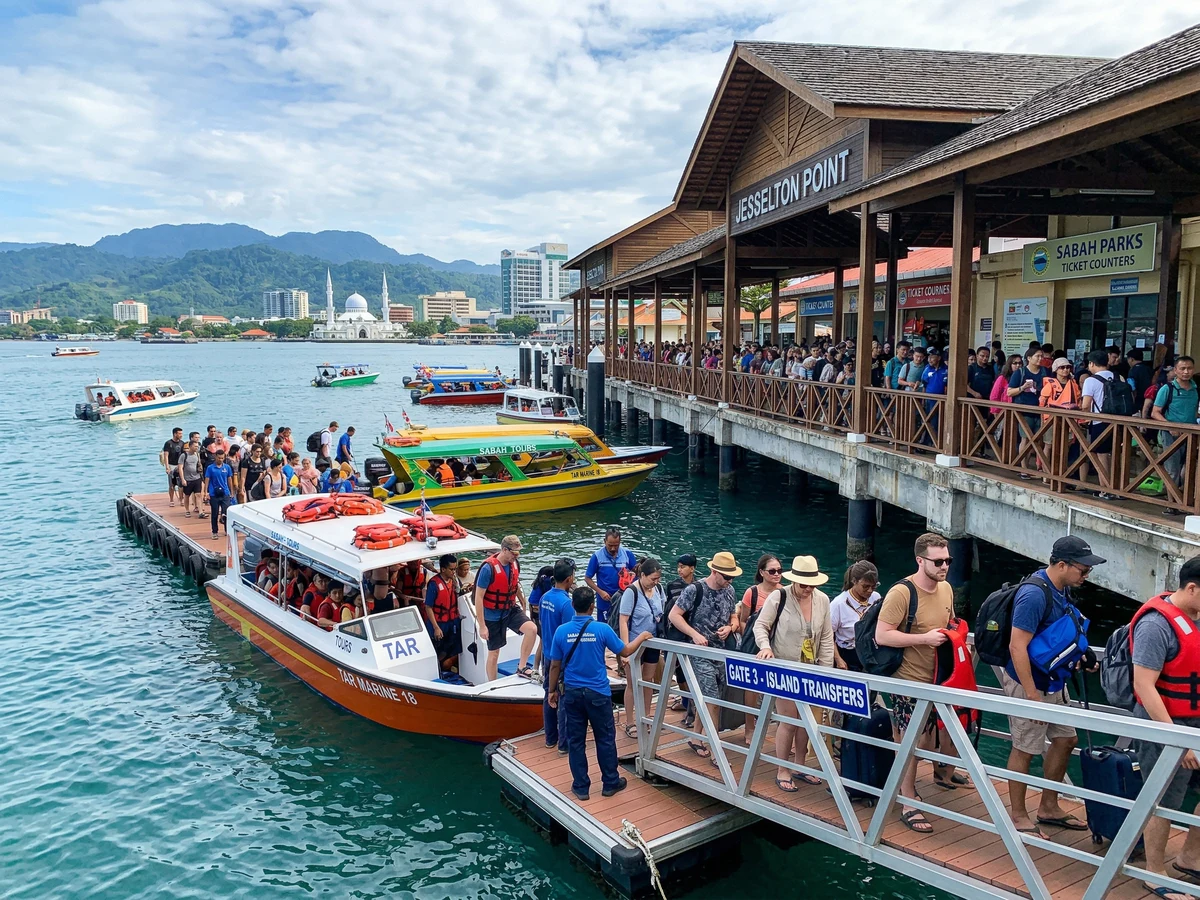
Cruise ships berth at Kota Kinabalu Port's conventional wharf, one vessel at a time. That is a different facility from the ferry jetty: since 1 March 2026 the Jesselton Point ferry terminal has operated from South Jetty, also inside Kota Kinabalu Port, having moved off its original waterfront site. The operator describes South Jetty as a temporary base while the original site is redeveloped. Island boats to Tunku Abdul Rahman Park run from South Jetty. The direct Kota Kinabalu to Labuan ferry has been suspended since 1 April 2026.
The port provides the usual ground services for arriving passengers — immigration, customs and onward transport connections. A dedicated international cruise terminal has been discussed but is not built.
Sandakan & Tawau Ports
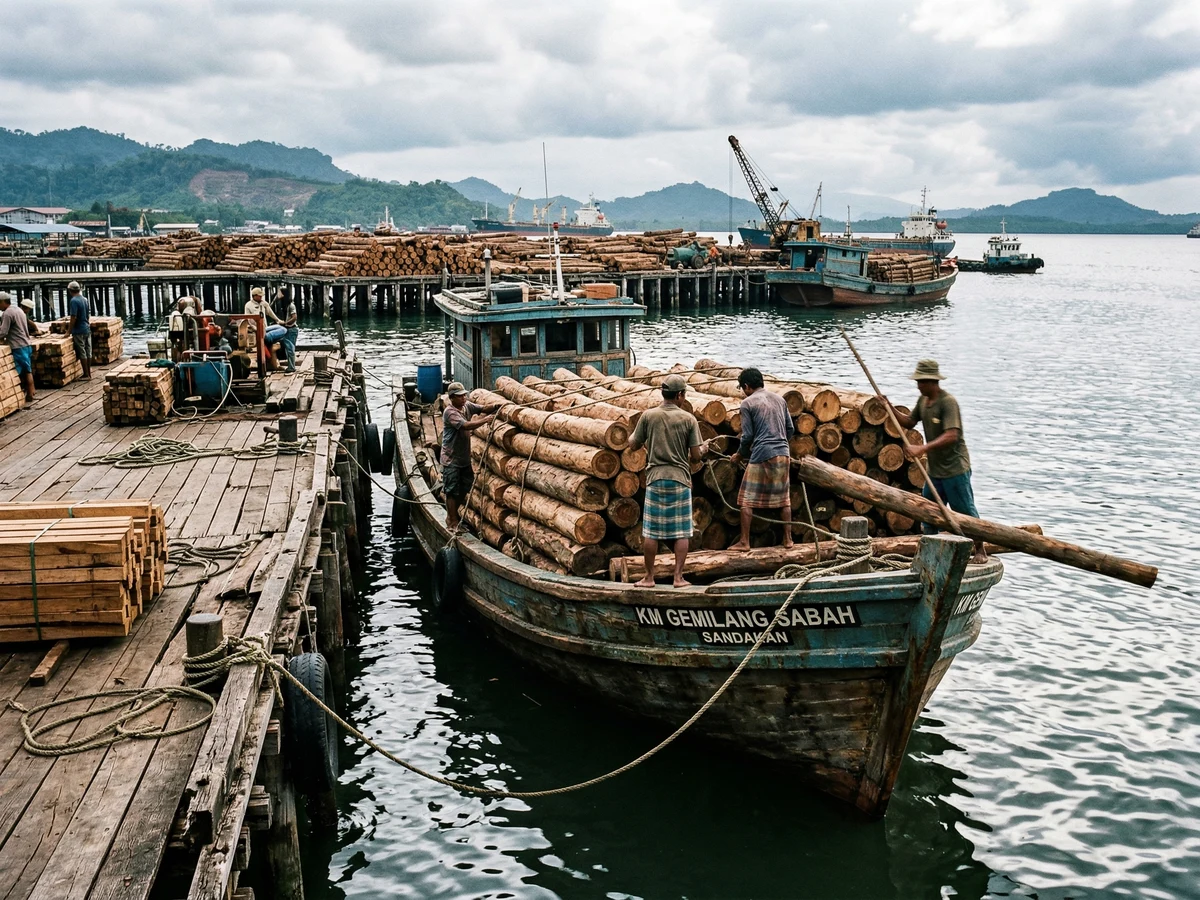
Sandakan Port: Handles containers alongside regional cargo, forest products, fish and general cargo. It moved 56,210 TEUs in 2024, up from 47,722 in 2023. Sabah Ports stopped publishing a separate Sandakan figure after 2024, reporting it only in combination with Tawau, so no 2025 number is available for the port on its own. No audited annual cargo tonnage for Sandakan alone is published either.
Tawau Port: Sabah's second-busiest container port and its primary outlet for palm oil, with dedicated bulk liquid loading facilities. It moved 83,285 TEUs in 2024, up from 73,508 in 2023. It also handles timber, general cargo and limited border trade with Indonesia. As with Sandakan, Sabah Ports reported no separate Tawau figure for 2025, and publishes no audited cargo tonnage for the port alone.
Regional Trade Role
Sabah’s ports are gateways for intra-regional ASEAN trade, particularly between Malaysia, Brunei, Indonesia, and the Philippines. Sabah is also a transhipment point for goods destined for Peninsular Malaysia and beyond.
Key export commodities: palm oil, timber, cocoa, seafood, and petroleum products. Key import commodities: machinery, vehicles, construction materials, chemicals, and consumer goods.
Frequently asked questions
Q Does Sabah have cruise ship terminals?
Q Is there a ferry from Sabah to the Philippines?
Q Is there a ferry from Kota Kinabalu to Labuan?
Q How does Sapangar Bay compare to Westports (Port Klang)?
Q How does Sabah export palm oil?
Q Is there a ferry from Tawau to Tarakan (Indonesia)?
Sources & References 9 sources
Last verified: 17 August 2026
Port Data
- SuriaGroup Berhad — 42nd AGM press release (FY2024) Source of the 2024 per-port split: Sapangar Bay 362,449, Tawau 83,285, Sandakan 56,210 TEUs.
- SuriaGroup Berhad — 4th quarter FY2025 Bursa filing Reports 135,427 TEUs for the group's ports excluding Sapangar Bay, which is now equity-accounted. Its combined figure of 396,964 conflicts with the 396,694 stated for Sapangar Bay in the annual report - see the note on this page.
- Sabah Ports Sdn Bhd Operator of Sabah's eight ports. Port list, facilities and berth specifications.
- DPW Sabah Sdn Bhd — terminal operator The DP World 51% / Sabah Ports 49% joint venture that has operated Sapangar Bay Container Port since September 2024.