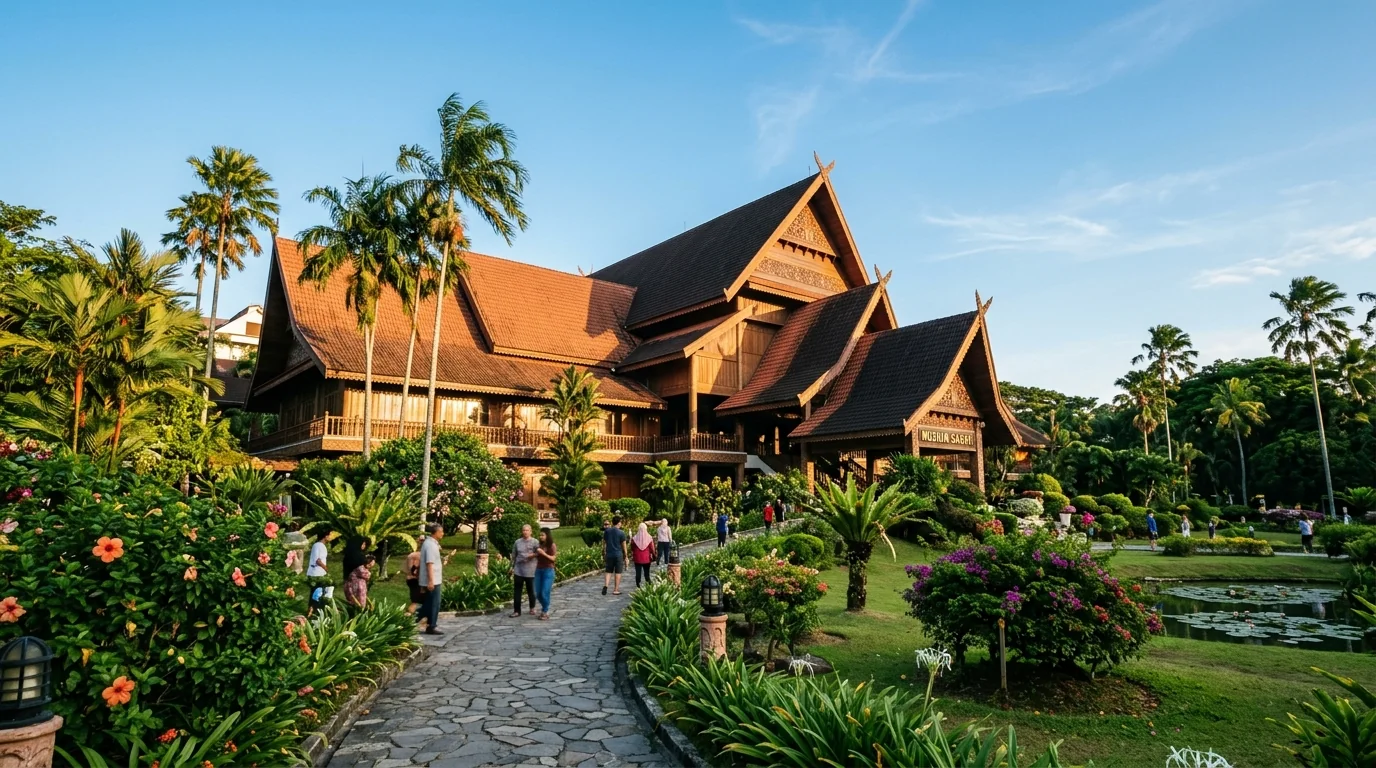
Sabah State Museum — Kota Kinabalu's Heritage Museum and Village
What is the Sabah State Museum?
The Sabah State Museum (Muzium Sabah) is Kota Kinabalu's premier museum and the official repository of Sabah's cultural, natural, and historical heritage. Located in the Bukit Istana Lama area of the city, the museum opened in 1984 and has grown into a comprehensive cultural institution managed by the Sabah Museum Department under the state government.
The museum complex comprises several interconnected buildings and outdoor exhibits spread across landscaped grounds. The main museum building is a four-storey structure housing extensive galleries covering natural history, ethnography, colonial history, ceramics, and Islamic civilization. Alongside the main building is the Heritage Village—an outdoor living history exhibit showcasing traditional houses from Sabah's major ethnic groups, built to original specifications and offering visitors a tangible connection to indigenous architecture and lifestyle.
The Sabah State Museum is not merely a static repository of objects behind glass; it is an immersive experience where visitors encounter Sabah's story at multiple levels—from the natural environment to the diverse indigenous cultures to the colonial period and modern independence. For anyone seeking to understand Sabah's identity, history, and cultural diversity, the museum is an essential starting point.
The museum serves both tourists and local schoolchildren. School groups regularly visit for field trips, making the museum a key educational institution. The gift shop carries books, local crafts, and souvenirs, allowing visitors to take home knowledge and memories of their visit.
What can I see in the main museum building?
The main museum building spans four floors, each with a specific thematic focus. The galleries are arranged to guide visitors through layers of Sabah's story—from the natural world to human culture and history.
| Floor/Section | Content | Time Needed | Highlight |
|---|---|---|---|
| Floor 1: Natural History | Sabah's flora, fauna, geology, marine life | 30–45 mins | Giant leatherback turtle display and endemic bird collection |
| Floor 2: Ethnography | Indigenous cultures, traditional costumes, instruments, tools | 45–60 mins | Full Kadazan-Dusun wedding costume and Bajau maritime implements |
| Floor 3: History | Colonial era, WWII, MA63, political history | 30–45 mins | Mat Salleh rebellion display and original colonial documents |
| Floor 4: Ceramics & Trade | Chinese ceramics from trade era, ancient trade routes | 20–30 mins | Ming Dynasty ceramics recovered from Sabah archaeological sites |
Floor 1: Natural History
The ground floor introduces visitors to Sabah's extraordinary biodiversity. Exhibits showcase the state's diverse ecosystems—from coastal mangroves to rainforest to highland meadows—and the wildlife within them. The centrepiece is often a giant leatherback turtle display (these massive sea turtles nest on Sabah's beaches). The bird collection showcases endemic species like the Kinabalu serpent eagle and various hornbills. Displays on Sabah's geology explain the state's position on the Pacific Ring of Fire and its volcanic history. A marine life section highlights Sabah's coral reefs and marine biodiversity.
Floor 2: Ethnography & Indigenous Cultures
This floor is devoted to Sabah's indigenous peoples—the Kadazan-Dusun, Bajau, Murut, Rungus, and other communities that form the foundation of Sabah's cultural identity. Exhibits display traditional costumes, jewellery, ceremonial dress, musical instruments, and household tools. A highlight is the full Kadazan-Dusun wedding costume, showing the intricate embroidered jacket, sarong, and ornaments. The Bajau section displays maritime instruments and implements reflecting centuries of seafaring tradition. Traditional tools—fishing hooks, agricultural implements, weapons—tell the story of how these communities adapted to and utilized Sabah's environment. Videos and photographs provide context on festivals, ceremonies, and daily life in traditional communities.
Floor 3: Colonial History & Independence
This gallery covers Sabah's experience under British colonial rule, the impact of World War II, and the journey to independence. Exhibits include original colonial documents, photographs of colonial-era Kota Kinabalu, and displays on the British North Borneo Chartered Company. The Mat Salleh rebellion display is particularly significant, documenting the indigenous resistance movement against colonial expansion. A section on WWII covers Sabah's occupation and the subsequent liberation. The Malaysia Agreement (MA63) section explains how Sabah came to join the Federation of Malaysia in 1963 with special constitutional protections. The gallery traces Sabah's political development from colonialism to modern statehood.
Floor 4: Ceramics, Porcelain & Trade Routes
The top floor is dedicated to ceramics and trade goods, reflecting Sabah's historical role in regional maritime trade. Chinese porcelain and ceramics from various dynastic periods—Tang, Song, Ming, Qing—have been recovered from archaeological sites in Sabah, evidence of ancient trade networks connecting Sabah to China. Displays explain these trade routes, showing how merchants and traders moved goods, ideas, and cultures across the South China Sea. The exhibits provide tangible evidence that Sabah was not isolated but was part of broader regional commerce and cultural exchange for centuries.
What is the Heritage Village and what houses are there?
The Heritage Village is an outdoor living history exhibit showcasing traditional houses from Sabah's major ethnic groups. Constructed on the museum grounds, each house is built according to traditional design and construction methods—often by master craftspeople from the respective communities. Walking through the Heritage Village is like stepping through time, experiencing how different indigenous communities lived before modern development.
Houses and structures in the Heritage Village
The village includes traditional houses from the following communities:
- Kadazan-Dusun Longhouse (Rumah Panggal): A large communal dwelling showcasing the traditional longhouse architecture of the Kadazan-Dusun people of the interior highlands. The structure features a covered communal verandah and individual family quarters arranged in a line.
- Bajau Traditional House (Rumah Bajau): Built on stilts above ground, reflecting the Bajau seafaring heritage and adaptation to both coastal and riverside environments. The elevated design provides protection from flooding and allows air circulation in tropical heat.
- Murut House: A traditional dwelling of the Murut people from the interior regions, featuring distinctive architectural elements adapted to highland terrain and climate.
- Rungus Longhouse: The Rungus people of northern Sabah traditionally lived in longhouses. This reconstruction shows their living arrangements and cultural space.
- Traditional agricultural buildings: Storage structures, granaries, and other functional buildings demonstrating how communities managed food storage and agricultural activities.
- Craft workshops: Some areas may feature artisans demonstrating traditional crafts—weaving, wood carving, or basket-making—depending on scheduling.
Visitors are usually welcome to enter the houses (remove shoes if required) and see the interior layout, sleeping areas, hearth, and storage spaces. Informational placards at each structure explain the construction methods, cultural significance, and daily life of the residents. In some cases, guides are available to share oral history and answer questions about the structures and cultural practices.
What other buildings and galleries are on the museum grounds?
Beyond the main museum building and Heritage Village, the Sabah State Museum complex includes several complementary facilities:
Science and Technology Centre
Located adjacent to the main museum, the Science and Technology Centre features interactive exhibits on physics, natural sciences, and technology. Hands-on displays allow visitors—particularly children—to explore concepts through experimentation and play. This facility serves both tourists and school groups.
Art Gallery
The museum maintains a dedicated art gallery featuring rotating exhibitions of contemporary and traditional art by local and regional artists. The gallery supports Sabah's artistic community and provides a space for cultural expression beyond the historical and ethnographic focus of the main galleries.
Islamic Civilisation Park
An outdoor area adjacent to the museum grounds dedicated to Islamic heritage and architecture. Exhibits and structures explore the contributions of Islamic civilization to Sabah and the broader region, reflecting the Sabah's diverse religious communities.
Landscaped gardens and outdoor sculpture
The museum grounds include extensive landscaping with native plants, walking paths, and outdoor sculptures reflecting Sabah's cultural themes. These gardens provide pleasant spaces to rest and reflect between galleries.
Gift shop and café
A well-stocked gift shop sells books on Sabah's history and culture, local crafts, postcards, and souvenirs. A small café offers refreshments, though eating options are limited—bring water and snacks if you plan a 3-hour visit.
How do I get to the Sabah State Museum?
Location and address
The Sabah State Museum is located at Jalan Muzium, Bukit Istana Lama (Signal Hill area), Kota Kinabalu. It is about 2–3 kilometers from the city centre, uphill from the waterfront.
By taxi or ride-share
The easiest option for most visitors. Use Grab (Southeast Asia's ride-hailing app) or a local taxi. The drive from the city centre takes about 10 minutes. Provide the driver with the address: Jalan Muzium, Bukit Istana Lama, Kota Kinabalu. Cost is typically RM10–15 from the city centre.
By car (self-drive)
If renting a car, follow directions to Bukit Istana Lama/Signal Hill. The museum has a small parking lot. The drive from most downtown hotels takes 10–15 minutes.
By public bus
Some local buses serve the Signal Hill area, but frequency and routes are limited. This option is less convenient than taxi/Grab. Ask your hotel for current bus routes.
From major hotels
Most hotels in Kota Kinabalu can arrange taxi pickups to the museum. Some organize group tours that include hotel transport and museum entry.
Operating hours
Tuesday–Sunday, 9:00am–5:00pm. Closed Mondays and on public holidays in Sabah. Last entry is typically 30 minutes before closing. Plan to arrive before 4:00pm to have adequate time to explore.
What should I know before visiting?
Dress code and comfort
Dress in light, breathable clothing. The museum is air-conditioned, but the Heritage Village is outdoors and can be hot. Wear comfortable walking shoes with good support. The outdoor sections involve uneven ground and potentially muddy paths after rain. Bring a hat or umbrella for sun protection.
What to bring
- Water bottle (stay hydrated, especially in the outdoor sections)
- Camera or smartphone for photos
- Light snacks (café options are limited)
- Sunscreen for outdoor areas
Timing your visit
Morning visits (9:00am–12:00pm) offer cooler temperatures and smaller crowds. Avoid peak hours at midday. Weekday visits are quieter than weekends. Saturday and Sunday mornings see school groups and families.
Photography and research
Photography is generally permitted. The Heritage Village is particularly photogenic in late afternoon light. If you are a researcher or serious student of Sabah's history, contact the museum in advance; staff may provide access to archive materials and research libraries not open to casual visitors.
Accessibility
The main museum building is accessible by staircase and lift. However, the Heritage Village outdoor grounds are uneven and not fully wheelchair accessible. Visitors with mobility issues may find the outdoor section challenging.
Guides and information
Individual walk-around visits do not include a guide, but signage and placards at each exhibit provide context and information. For deeper engagement, book a guided tour in advance. The museum's informational materials are primarily in Malay and English.
Weather
Sabah is tropical and receives rain year-round, particularly during monsoon seasons. Check weather forecasts before visiting. Light rain is common but usually brief. The outdoor Heritage Village is challenging in heavy rain.
Frequently asked questions
Q How long should I spend at the Sabah State Museum?
Q Is there parking at the Sabah State Museum?
Q Can I photograph inside the museum?
Q Is the Heritage Village the same as the museum or a separate admission?
Q Are there guided tours available at the Sabah State Museum?
Resources
- Sabah Museum official website — Hours, entry fees, current exhibits, contact information
- Sabah Tourism Board: Sabah Museum — Tourist information and travel tips
- Wikipedia: Sabah State Museum — Detailed history and institutional information
- Google Maps: Sabah State Museum — Directions and location