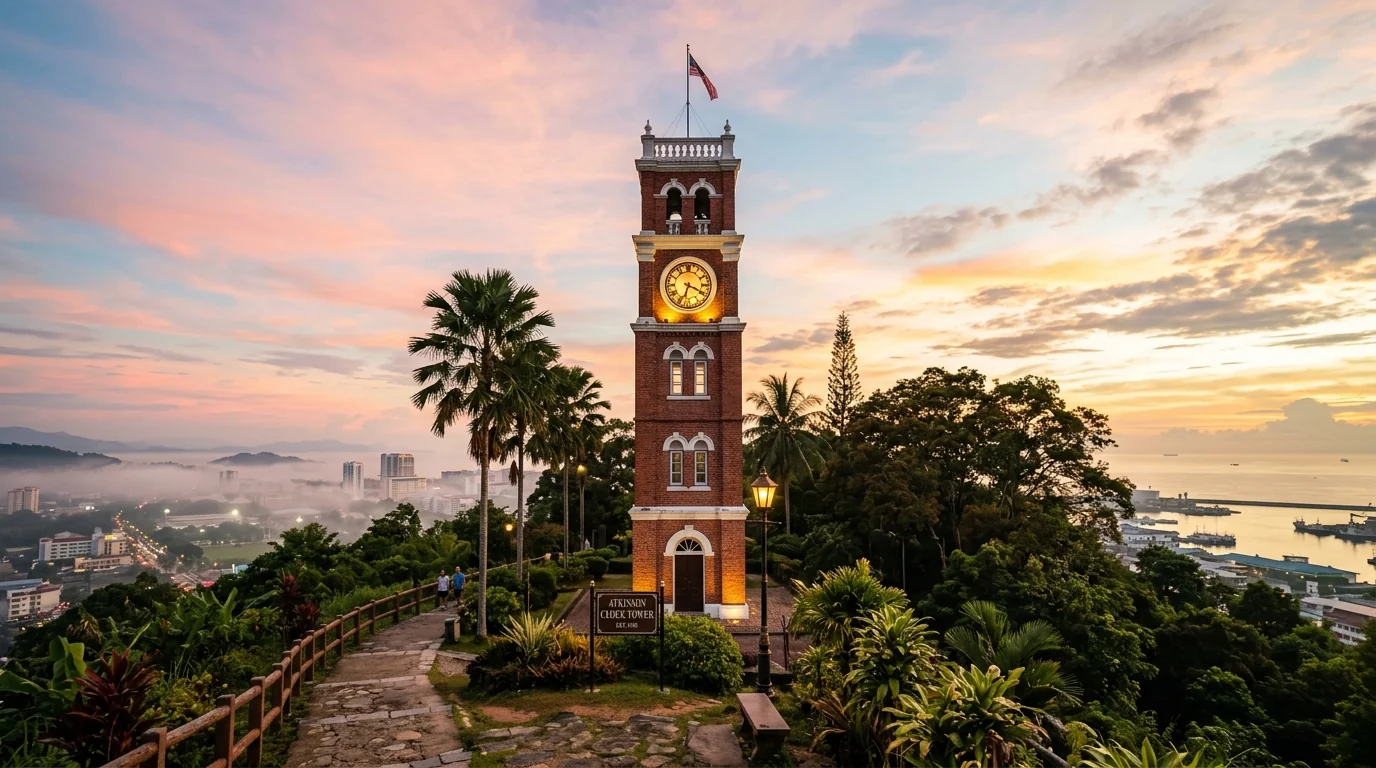
Atkinson Clock Tower — Kota Kinabalu's Oldest Surviving Building
What is the Atkinson Clock Tower?
The Atkinson Clock Tower is a 15.7-metre-tall colonial monument standing on Signal Hill (Bukit Bendera) in Kota Kinabalu. Commissioned on 20 April 1905, it is the oldest surviving building in the city and one of only three structures to survive World War II bombing and occupation. Originally built from Mirabau wood, a local hardwood prized for its durability, the tower housed a two-faced clock donated to the town and served a dual purpose: commemorating Jesselton's first District Officer, Francis George Atkinson, and functioning as a critical navigation landmark for ships entering the harbour.
For decades, the clock tower was illuminated at night as a shipping beacon, guiding vessels safely into port. Mariners relied on its distinctive silhouette and the regular chiming of its bells to mark time and navigation checkpoints. The structure became an iconic symbol of Jesselton's colonial administration and the town's growing importance as a trading and administrative centre in British North Borneo.
In 2018, the Sabah Heritage Council gazetted the Atkinson Clock Tower as an official heritage site, recognizing its architectural and historical significance. Today, the tower remains a free, publicly accessible landmark open 24 hours. The surrounding area has been developed into "Atkinson Clock Tower Square," a pleasant public park with landscaping, benches, and pathways that honour the site's heritage.
Who was Francis George Atkinson?
Francis George Atkinson was the first District Officer of Jesselton (the colonial name for what is now Kota Kinabalu), appointed to administer the newly established settlement. Born in England and posted to British North Borneo during the height of colonial expansion in Southeast Asia, Atkinson played a key role in establishing the town's administrative structures and mediating between the colonial company (the British North Borneo Chartered Company) and local communities.
Tragically, Atkinson died on 8 December 1902 at just 28 years old from malaria, locally known as "Borneo Fever" — a disease that claimed the lives of many British colonial officers posted to tropical regions. His death was mourned throughout Jesselton, as he had earned respect for his fair dealing and commitment to the settlement's growth. Recognizing his contributions and wanting to preserve his memory, Atkinson's mother, Mrs Mary Edith Atkinson, donated funds and a high-quality two-faced clock mechanism to the town. The clock tower was constructed to house this mechanism and to serve as a permanent memorial to her son's service.
The tower stands as a tribute not only to Francis Atkinson himself but to the many colonial administrators who gave their lives to the development of Sabah during the British North Borneo era. His name remains inseparable from Kota Kinabalu's earliest history.
How did the clock tower survive World War II?
When Japan invaded British North Borneo in December 1941, Jesselton was one of the first targets. The town was heavily bombed by the Imperial Japanese Navy and Army, and most of the colonial administration buildings were deliberately destroyed or flattened during the fighting. The Japanese occupation lasted until 1945 and resulted in severe damage to Jesselton's infrastructure and population.
Despite the intense bombardment, the Atkinson Clock Tower endured—though not without scars. Japanese machine-gun fire during the occupation damaged the clock's dial and internal cog mechanism, rendering it non-functional. For years after the war, the tower stood as a silent testament to the town's trauma, its broken clock face a visible reminder of conflict and loss.
The post-war restoration of the clock mechanism was undertaken by Yick Ming Watch Dealers, a local horological business in Kota Kinabalu. The Yick Ming family took on the responsibility of repairing and maintaining the clock, a commitment that has been passed down through generations. To this day, the same family continues to service and maintain the Atkinson Clock Tower's mechanisms, ensuring that it keeps accurate time and its bells continue to chime—a remarkable continuity of stewardship spanning over 75 years.
In 1959, the tower underwent extensive renovation in celebration of Jesselton's Diamond Jubilee. Defective timber from the original 1905 construction was replaced with hardwoods, roof timbers were replaced, and the structure was comprehensively renewed to ensure its longevity. This mid-century restoration is why the tower remains in such good condition today.
What does the clock tower look like?
The Atkinson Clock Tower stands 15.7 metres (approximately 51.5 feet) tall, making it a prominent landmark visible from much of Signal Hill and parts of the Kota Kinabalu waterfront. Its architecture reflects the practical colonial style of early 20th-century British North Borneo — straightforward, functional, and built to last in a challenging tropical climate.
The tower's primary structural material is timber. The original 1905 construction used Mirabau wood, a local hardwood highly valued for its natural resistance to rot and insect damage—critical qualities in humid tropical environments. After the 1959 renovation, sections of weakened timber were replaced with a mix of other hardwoods selected for durability. The exterior is finished simply, without excessive ornamentation, reflecting the pragmatic architectural philosophy of the era.
The two-faced clock mechanism, donated by Francis Atkinson's mother, is housed in the tower's upper section. Each clock face is clearly visible from different angles around the structure, allowing the time to be read from multiple directions. The clock mechanism is mechanical (not electric), which is why ongoing maintenance by trained horologists is essential. Bells inside the tower mark the hours and half-hours with traditional chiming.
The tower's distinctive shape—a tall, narrow timber structure with a pyramidal or tapered roof—makes it recognizable from a distance and explains why it served effectively as a navigation landmark for maritime traffic. Its silhouette would have been especially distinctive to ship captains approaching Jesselton Harbour in daylight or guided by its nighttime illumination.
| Fact | Detail |
|---|---|
| Year Built | 1905 (commissioned 20 April 1905) |
| Height | 15.7 metres (51.5 feet) |
| Primary Material | Mirabau wood (original); mixed hardwoods (post-1959 renovation) |
| Purpose | Memorial to Francis George Atkinson; navigation landmark; public timekeeper |
| District Officer Commemorated | Francis George Atkinson (d. 1902, age 28) |
| Clock Faces | Two-faced mechanical clock mechanism |
| WWII Damage | Japanese machine-gun fire damaged clock dial and cog mechanism |
| Heritage Status | Gazetted by Sabah Heritage Council (2018) |
| Entry Fee | Free |
How do I visit the Atkinson Clock Tower?
Location and Access: The Atkinson Clock Tower is located on Signal Hill (Bukit Bendera) in the heart of Kota Kinabalu's city centre. It is approximately 5–10 minutes on foot from Padang Merdeka (the ceremonial ground), making it easily accessible from downtown. The tower is situated at the top of a gentle hill; sturdy shoes are recommended for the uphill walk, but the climb is manageable for visitors of most fitness levels.
Hours: The tower is open 24 hours as an outdoor landmark. There is no gate or restricted access, so you can visit at any time of day or night. Many visitors choose early morning (before 8:00am) to avoid heat and crowds, or sunset (around 6:00–7:00pm, depending on season) to photograph the tower in golden light.
Entry Fee: Admission is completely free. There are no tickets, no guided tours, and no restrictions on photography or personal use.
What to Bring: Bring plenty of water, especially if visiting during midday heat (11:00am–3:00pm temperatures can exceed 30°C). Sunscreen and a hat are essential. A camera or smartphone is recommended for photography. Insect repellent can be useful in early morning or evening.
Signal Hill Observatory Platform: Just a short walk from the clock tower, the Signal Hill Observatory Platform offers panoramic views of Kota Kinabalu's waterfront, the South China Sea, and distant islands. This viewpoint pairs well with a clock tower visit and takes an additional 15 minutes to enjoy.
Getting There by Transportation: If coming from Kota Kinabalu International Airport (approximately 7km away), a taxi or ride-share (Grab) costs RM25–35 and takes 15–20 minutes depending on traffic. From central KK hotels, it is usually a 5–10 minute ride. Street parking is available near the base of Signal Hill, though it can be limited during peak hours (10:00am–4:00pm weekends).
Nearby Amenities: The Atkinson Clock Tower Square area includes benches and rest areas. Nearby restaurants, cafés, and shops are located in central Kota Kinabalu, less than a 10-minute walk downhill. Public restrooms are available in the adjacent Padang Merdeka area.
What else is near the Atkinson Clock Tower?
Padang Merdeka: Just downhill from the clock tower, Padang Merdeka (Independence Square) is Kota Kinabalu's ceremonial and civic heart. This large open ground is where Malaysian independence celebrations are held, and it offers open space, monuments, and historical markers. The walk between the clock tower and Padang Merdeka takes about 10 minutes and is an easy descent.
Kota Kinabalu Waterfront: Below Signal Hill, the KK waterfront is a lively area with night markets (weekend evenings), seafood restaurants, and views across the bay to offshore islands. The walk down takes 15–20 minutes and is downhill the entire way.
Sabah Museum (City Branch): Located near the city centre, this museum houses exhibits on Sabah's natural history, indigenous cultures, and colonial period. It is approximately 1km from the clock tower and is open Tuesday–Sunday 9:00am–5:00pm. Admission is RM10 for locals, RM20 for foreigners.
St. Michael's Church: One of the oldest standing churches in East Malaysia (though originally built in the 1880s and rebuilt several times), St. Michael's is a peaceful colonial-era place of worship visible from various points in central KK. It is located approximately 2km from the clock tower.
Tun Fuad Stephen Monument: A monument to Sabah's first Chief Minister, located in the city centre near Padang Merdeka. This is a short walk from the clock tower and is part of KK's colonial heritage cluster.
Night Market (Pasar Malam): If visiting on a weekend, the Kota Kinabalu night market near the waterfront offers street food, local crafts, and a authentic glimpse of contemporary local life. It operates Friday–Sunday from around 5:00pm–10:00pm and is a 15-minute walk from Signal Hill.
Frequently asked questions
Q Is the Atkinson Clock Tower still functioning?
Q Can I go inside the clock tower?
Q How long does it take to visit?
Q What is the Atkinson Clock Tower Square?
Q Why is the Atkinson Clock Tower historically significant?
Resources and further reading
- Wikipedia: Atkinson Clock Tower — Detailed history and architectural information
- Sabah Tourism Board — Official tourism information for Kota Kinabalu attractions
- CLL Adventure Borneo — Detailed heritage guide and visitor tips
- MySabah — Local perspective on the clock tower and its significance
- Google Maps — Navigation and directions to Signal Hill