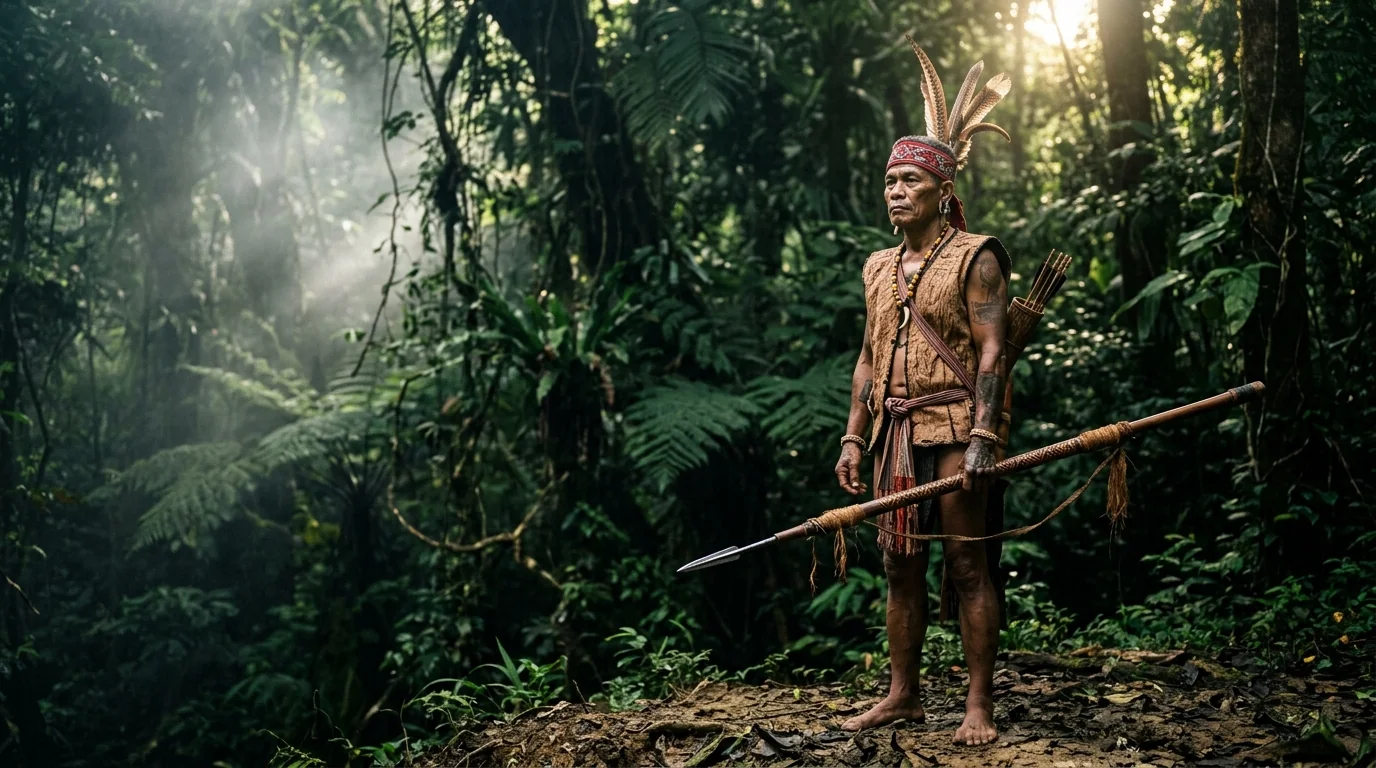
Ontoros Antanom — Murut Warrior and Leader of the Rundum Rebellion
Who was Ontoros Antanom?
Ontoros Antanom was a Murut chief who lived in the early 20th century and became one of Sabah's most significant indigenous resistance leaders. He rose to prominence during the Rundum Rebellion (1915–1916), a Murut uprising against British colonial rule in the interior of Sipitang district. Unlike Mat Salleh, the better-known Bajau rebel of an earlier era, Ontoros Antanom and the Murut resistance have received less international attention, but their struggle is equally central to Sabah's story of indigenous defiance against colonial domination.
Ontoros came from the Murut heartland of interior Sabah, where his people had maintained traditional customs, governance structures, and spiritual practices for centuries. He was respected within his community and gradually consolidated support among neighbouring Murut groups, laying the groundwork for the coordinated rebellion that would challenge British authority. His leadership during the Rundum Rebellion demonstrated exceptional military strategy and an ability to unite disparate Murut clans against a common enemy.
Historical documentation of Ontoros Antanom is less extensive than that of Mat Salleh, partly because the rebellion took place in remote interior regions and involved fewer direct engagements with colonial forces stationed in coastal towns. However, the impact of the Rundum Rebellion on Murut society and British colonial policy was profound, and Ontoros legacy remains a cornerstone of Murut cultural identity and Sabah resistance history.
The Murut people under British rule
The Murut (also spelled Murut or Modot) are an indigenous hill people of Sabah, historically concentrated in the interior uplands of what is now the Tenom and Sipitang districts. Before British colonisation, the Murut maintained autonomous societies, governed by clan leaders and headmen, with strong traditions of headhunting, agriculture, and spiritual practices. They lived in small settlements scattered across the forested highlands, largely isolated from the coastal Bajau and Bruneian sultanate influences.
When the British North Borneo Chartered Company (BNCC) began asserting control over the interior in the late 1800s and early 1900s, the Murut found themselves increasingly subjected to foreign laws, taxation, and administrative intrusion. The British established district offices and appointed headmen loyal to colonial interests, gradually eroding traditional authority structures. Young Murut men were pressed into forced labour for colonial infrastructure projects, particularly logging and road-building expeditions that depleted villages of able-bodied workers.
The Murut way of life centred on swidden agriculture (shifting cultivation), hunting, and ritual headhunting, which served both spiritual and social purposes. Headhunting was not merely violence but a formalised cultural practice tied to warrior status, marriage prospects, and spiritual appeasement. When the British banned headhunting as part of their "civilising mission," they struck at the heart of Murut social structure and identity. Traditional leaders lost prestige when they could no longer authorise raids and rituals; young men lost paths to adulthood and status. This cultural suppression, combined with taxation and forced labour, created the conditions for widespread Murut resentment and resistance.
What drove the Rundum Rebellion?
The Rundum Rebellion was not a spontaneous outburst but rather the culmination of years of tension between Murut communities and British colonial policies. Several specific grievances converged in the early 1910s to ignite the uprising:
Headhunting ban. The British prohibition on headhunting, enforced from the 1890s onwards, fundamentally destabilised Murut society. Without the ability to conduct ritual headhunting raids, Murut men could not achieve the status and recognition necessary for leadership and marriage. The ban was experienced not as a moral reform but as cultural annihilation.
Taxation. The BNCC imposed taxes on Murut communities, which had no tradition of monetary exchange and lived primarily through subsistence farming and hunting. These taxes were often payable in money, forcing Murut to engage with colonial markets or face punishment and confiscation. Tax collectors were sometimes abusive, adding to grievances.
Forced labour. Young Murut men were conscripted or coerced into labour gangs for colonial projects. These men were taken from their communities for extended periods, disrupting agricultural cycles and village social life. Working conditions were often harsh, and compensation was minimal or non-existent.
Loss of autonomy. Traditional Murut leaders found their authority diminished as British administrators appointed compliant headmen and bypassed indigenous governance. Local decision-making was replaced by remote colonial decrees that made little sense in the context of Murut life.
Religious and spiritual pressure. Christian missionaries, supported by the colonial government, sought to convert the Murut, which threatened their animistic beliefs and the shamans (datus) who held significant spiritual authority.
By 1915, these cumulative pressures had reached a breaking point. Ontoros Antanom and other Murut leaders began secretly organising resistance, planning to expel the British from the interior and restore Murut sovereignty.
How did Ontoros organise the resistance?
Ontoros Antanom was a skilful political organiser who understood that success required unity among the traditionally independent Murut clans. He spent months travelling through the interior, meeting with clan leaders and elders, articulating the shared grievances that affected all Murut communities. His message was clear: the British were eroding Murut culture, autonomy, and prosperity. Only a united uprising could drive them out.
Ontoros did not rush into open rebellion. Instead, he built a clandestine network, securing commitments from disparate Murut groups to act in concert when the signal was given. He selected Rundum, a settlement deep in the Sipitang interior, as the operational centre of the rebellion. Rundum was remote enough to avoid constant colonial surveillance yet central enough to coordinate with other Murut settlements across the interior.
Ontoros also understood the importance of spiritual legitimacy. He consulted with Murut spiritual leaders and shamans, framing the rebellion not merely as a political act but as a sacred defence of Murut identity. This religious sanction helped convince communities that the ancestors and spirits supported their cause.
Strategically, Ontoros planned to attack British outposts and administrative centres in the interior, destroy government records (which documented taxation and labour obligations), and reassert Murut control over their territories. He mobilised warriors and stockpiled what arms and ammunition were available in the interior. By early 1915, the preparations were complete, and Ontoros made the decision to launch the rebellion.
The rebellion events 1915-1916
The Rundum Rebellion erupted in early 1915 when Murut warriors launched coordinated attacks on British posts and colonial officials in the Sipitang district. The initial strikes were swift and violent. Murut forces attacked administrative centres and killed several British colonial officers and sympathetic local headmen. The rebellion quickly spread across Murut-inhabited areas of the interior, with warriors rallying to Ontoros's leadership.
The British were caught off guard by the scale and coordination of the uprising. Colonial authorities in Sandakan, the capital, rapidly mobilised military reinforcements and organised a counter-offensive. The response was swift and overwhelming: British soldiers, armed with rifles, machine guns, and artillery, advanced into the interior to crush the rebellion.
Ontoros and his warriors fought valiantly, using their intimate knowledge of the terrain and traditional guerrilla tactics. However, they were vastly outgunned. The British deployed artillery and used scorched-earth tactics, burning villages and crops to destroy the rebellion's supply lines and civilian support. Hundreds of Murut were killed or displaced. The rebellion, though fiercely fought, was militarily unequal.
By mid-1916, the British had suppressed the open rebellion, though pockets of Murut resistance lingered. Ontoros Antanom died during this suppression—killed in combat or during the aftermath—and his death marked the effective end of the organised uprising. The survivors fled deeper into the forest or surrendered to colonial authorities.
British suppression and the end
The British response to the Rundum Rebellion was characterised by overwhelming military force and collective punishment. Once the rebellion was deemed "crushed," the British implemented retaliatory measures designed to prevent future uprisings. These included destruction of villages, confiscation of lands, fines imposed on Murut clans, and forced displacement.
The British narrative of the rebellion emphasised their military superiority and portrayed Ontoros Antanom and the Murut as "primitive insurgents" incapable of civilised governance. Colonial reports downplayed the legitimate grievances that had sparked the uprising and instead highlighted the rebellion as an example of why strict colonial control and "civilisation" were necessary.
For the Murut, the suppression of the rebellion was a traumatic blow. Ontoros, their leader and the symbol of resistance, was gone. The British presence was now entrenched and militarily unchallengeable. The Murut had no choice but to accommodate colonial rule, though they never fully accepted British authority. Headhunting disappeared, but cultural practices and oral traditions preserved the memory of Ontoros and the rebellion.
The British implemented stricter control over the interior, appointed more colonial administrators to remote areas, and gradually co-opted the Murut leadership structure through the headman system. By the 1920s, overt resistance had ended, but Murut resentment of colonial rule simmered beneath the surface for decades.
Ontoros legacy and recognition today
Unlike Mat Salleh, whose rebellion occurred earlier and has been more extensively documented and monumentalised, Ontoros Antanom and the Rundum Rebellion have received less public recognition in modern Sabah. However, within Murut communities and among Sabah historians, Ontoros is deeply respected as a symbol of indigenous resistance and cultural preservation.
Ontoros represents the Murut struggle for sovereignty and cultural dignity. He refused to accept foreign domination without a fight and organised his people across traditional clan divisions to mount a unified resistance. For Murut descendants today, Ontoros is a hero who defended their way of life against colonialism, even though the rebellion ultimately failed. His legacy affirms Murut identity as distinct and autonomous, not merely a footnote in British North Borneo history.
In recent years, Sabah scholars and cultural organisations have worked to elevate Ontoros Antanom's profile. He is studied in history curricula, featured in academic works on Sabah resistance, and increasingly recognised in official narratives of Sabah's pre-independence history. Cultural institutes and museums have begun displaying artefacts and accounts related to the Rundum Rebellion. Murut cultural festivals and gatherings often reference Ontoros as a symbol of ancestral strength and resilience.
| Aspect | Ontoros Antanom | Mat Salleh |
|---|---|---|
| Ethnic group | Murut | Bajau |
| Period of rebellion | 1915–1916 | 1894–1900 |
| Primary cause | Taxation, forced labour, headhunting ban, cultural suppression | Opposition to BNCC authority and sultanate circumvention |
| Geographic centre | Rundum (Sipitang interior) | Tambunan plateau |
| Scale | Regional (interior Murut clans) | Wider (Bajau and allied groups) |
| Outcome | Suppressed by 1916; death of Ontoros | Killed in combat 1900 |
| Modern recognition | Growing (academia, Murut communities) | Prominent (public monument, widely known) |
| Historical documentation | Limited colonial records; oral tradition | Extensive British colonial accounts |
The absence of a major public monument to Ontoros Antanom (unlike Mat Salleh's memorial in Tambunan) reflects both the geographic remoteness of the Rundum Rebellion and historical gaps in documentation. However, efforts are underway to redress this imbalance. Some propose establishing a memorial or cultural centre in Sipitang or the interior to honour Ontoros and educate future generations about the Rundum Rebellion.