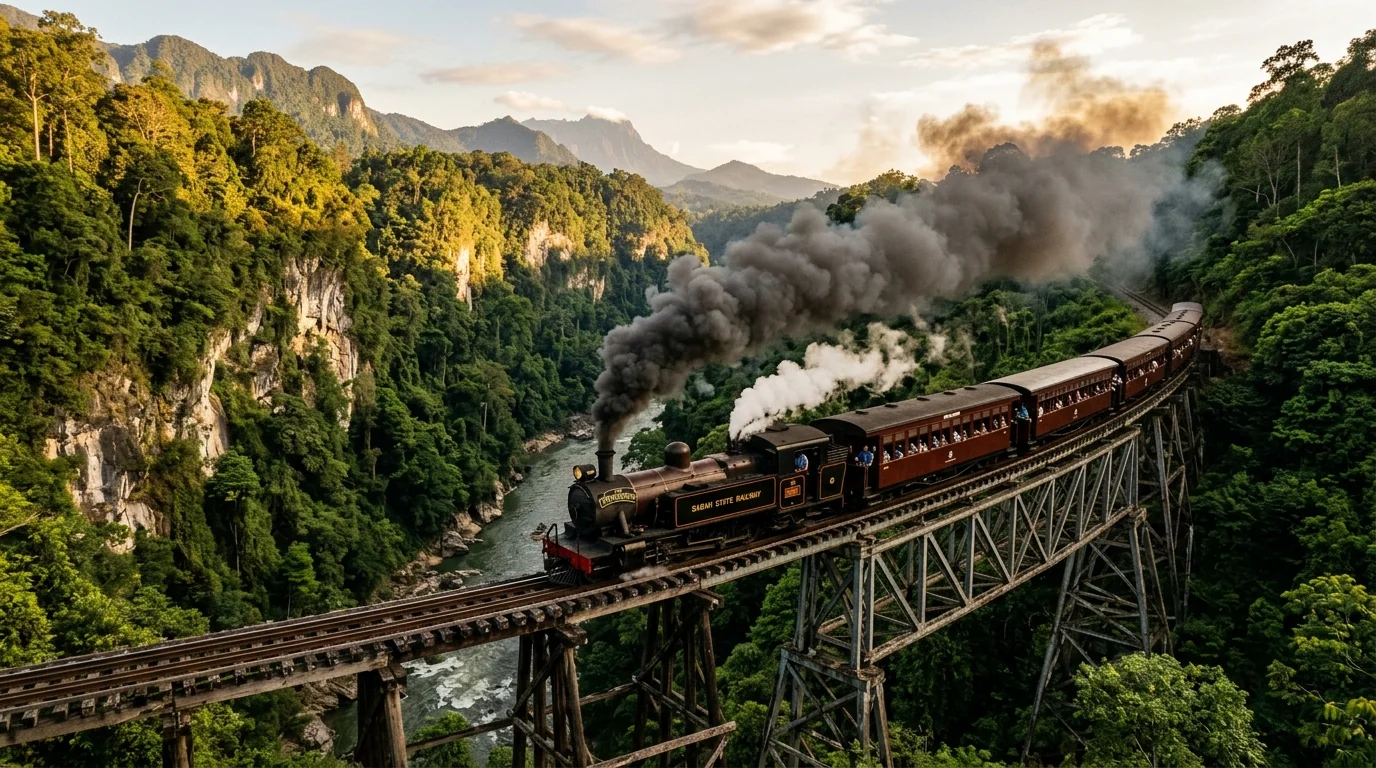
North Borneo Railway — Sabah's Heritage Steam Train Journey
What is the North Borneo Railway?
The North Borneo Railway, now operated as the Sabah State Railway (Kereta Api Sabah), is a 134-kilometre narrow-gauge railway that stretches from Kota Kinabalu's Tanjung Aru station to the interior town of Tenom. Built over a century ago by the British North Borneo Chartered Company, the railway remains one of Sabah's most iconic heritage landmarks and a window into the colonial era.
The railway's gauge is just 762mm (2 feet 6 inches)—a narrow gauge designed for cost-effective construction through Sabah's terrain. Today, the main attraction is the heritage steam train experience: a vintage 1950s-era steam locomotive pulling beautifully restored wooden carriages, operated on selected days each week. The journey is as much a celebration of railway history as it is a scenic adventure through Sabah's interior, from coastal settlements to jungle-clad mountains and the dramatic Padas Gorge.
For visitors and history enthusiasts, the heritage steam train is one of Sabah's most memorable day trips. The journey combines outdoor adventure, cultural history, and the romance of heritage railway travel—a living museum on wheels moving through some of Sabah's most beautiful landscapes.
How was the railway built under colonial rule?
Construction of the North Borneo Railway began in 1896 under the British North Borneo Chartered Company (BNBCC), a commercial enterprise that governed the territory before it became a British protectorate. The railway was built in stages, with the section from Jesselton (modern-day Kota Kinabalu) to Papar completed first, followed by extensions to Beaufort and eventually Tenom around 1905.
The primary purpose was economic: to transport agricultural products—tobacco, rubber, and timber—from the fertile interior down to the coast for export. The railway also helped establish Beaufort as an interior trading hub and connected remote communities to coastal markets. For the BNBCC, the railway was essential infrastructure to maximize profitability from Sabah's natural resources.
Construction was difficult and costly. Workers faced dense jungle, steep terrain, and tropical diseases. The narrow-gauge design was chosen to reduce costs compared to standard-gauge railways. Local labour was employed alongside imported engineers and supervisors. The Padas Gorge section was particularly challenging, requiring careful surveying and engineering to lay track safely alongside the river.
By the early 1900s, the railway was operational, and it transformed Sabah's interior economy. The line operated continuously through the colonial period, carrying both passengers and freight. However, during World War II, the railway was damaged by Allied bombing and disrupted by Japanese occupation. Post-independence, the railway continued to serve local communities and freight, though gradually declining as roads and motor transport developed.
What route does the heritage steam train take?
The heritage steam train journey covers the full 134km line from Kota Kinabalu to Tenom, stopping at several significant stations along the way. The route descends gradually from sea level at Tanjung Aru to the interior highlands, passing through diverse landscapes and communities.
| Station | Distance from KK | Notable Feature | Time from Previous |
|---|---|---|---|
| Tanjung Aru | 0km | Main terminus, KK city limits | Starting point |
| Papar | 45km | Coastal town, paddy fields and agriculture | ~1.5 hours |
| Beaufort | 78km | Colonial-era trading town, interior hub | ~1.5 hours |
| Halogilat | 110km | Small station in gorge region, jungle setting | ~1 hour |
| Tenom | 134km | End station, highland town, agricultural region | ~1.5 hours |
Departure from Tanjung Aru is at 10:00am sharp. The train moves slowly, allowing passengers to enjoy the scenery. The section from Papar to Beaufort passes through agricultural land and small settlements. The Beaufort to Tenom section is where the journey becomes truly spectacular, entering the Padas Gorge with increasingly dramatic views.
What is the Padas Gorge and why is it special?
The Padas Gorge is a deep, narrow canyon carved by the Padas River through Sabah's interior highlands. The gorge stretches approximately 24 kilometres, with steep jungle-clad walls rising hundreds of metres above the river. It represents some of Sabah's most dramatic natural scenery—a pristine wilderness area where dense rainforest, limestone cliffs, and white water rapids create an almost primordial landscape.
The railway track clings to the gorge wall, winding alongside the Padas River for much of the Beaufort-to-Tenom section. This engineering feat was extraordinary for its time: workers had to hand-cut sections of track into the cliff face, and in some places, the track actually runs below the level of the river during rainy season. Sitting on the heritage train passing through the gorge, passengers are just metres away from the river, able to see the white water rapids and hear the roar of the water.
The Padas Gorge is special because it is relatively untouched—there are no roads paralleling the gorge, no settlements in the depths. The railway is the only access point, making the heritage steam train journey the most accessible way for most visitors to experience this wilderness. The gorge is home to indigenous communities in the surrounding highlands, and various bird and wildlife species thrive in the pristine rainforest environment.
The gorge is also famous among white water rafting enthusiasts: the Padas River offers Class III–IV rapids, and rafting expeditions run alongside the railway route. However, the railway passenger experience is unique—you travel through the gorge without getting wet, at a leisurely pace, with time to photograph and absorb the landscape.
How do I book and take the heritage steam train?
Booking the heritage steam train requires advance planning, as seats are limited and popular departure dates fill quickly. Here's a practical step-by-step guide:
Where to book
- Sabah State Railway official office: Contact directly through their website at http://www.railway.sabah.gov.my. They provide current schedules and accept bookings by phone or email.
- Licensed tour operators in Kota Kinabalu: Most hotels and travel agencies in KK can arrange bookings on your behalf, often bundling transport from your hotel and lunch on the train.
- Walk-ups are not recommended: The heritage train often runs at or near capacity, especially on weekends and public holidays.
When to book
Book at least one week in advance, ideally 2–3 weeks for weekend departures or public holiday periods. Cancellations do occur, so checking availability just before your trip can sometimes yield last-minute seats.
What to expect on the day
Arrive at Tanjung Aru station 30 minutes before departure. The heritage train departs at 10:00am sharp and arrives in Tenom around 3:30–4:00pm. Lunch is served on the train—typically a packed meal reflecting local tastes. Return journey (diesel rail car) departs Tenom around 4:30pm and arrives back in Tanjung Aru by 8:30pm.
Pricing
- RM80 for foreign visitors (includes lunch)
- RM35 for Malaysian citizens with MyKad (includes lunch)
- Children and group discounts available—inquire when booking
What else can I do along the railway route?
The railway journey itself is the main attraction, but there are several ways to extend your experience and explore the surrounding areas:
Tenom and the surrounding highlands
Tenom is Sabah's main highland agricultural town, famous for cocoa farming. If you arrive with several hours before the return train, visit a local cocoa farm or the Tenom Agricultural Park. The town has basic shops, cafes, and a modest hotel if you prefer to stay overnight.
Beaufort town exploration
If booking a full-day tour, some operators offer a short stop in Beaufort (1–2 hours). Beaufort is a historic colonial-era settlement with old colonial architecture, local shops, and traditional food. It's worth a brief walk-around if time permits.
Padas River white water rafting
For the adventurous, combine your railway trip with a separate Padas River rafting excursion. Rafting operators run trips in the same gorge that the train passes through—a thrilling contrast to the train experience. Rafting requires a separate booking with local operators in Kota Kinabalu.
Photography
The entire journey is a photographer's paradise, especially the Padas Gorge section. Bring a good camera and ensure you have window seats for unobstructed views. The golden hour at sunrise (if you were at the station) or late afternoon through the gorge offers excellent light.
Local guides
Some tour operators include a local guide who shares stories about the railway's history, the gorge's wildlife, and the communities along the route. This context enriches the experience significantly.
Frequently asked questions
Q Is the North Borneo Railway still operating?
Q How long does the heritage steam train journey take?
Q Can I do the full journey in one day?
Q Is the Padas Gorge the same as the Padas River white water rafting?
Q What is the best seat on the heritage train?
Resources
- Sabah State Railway (official website) — Schedules, booking, contact information
- Wikipedia: North Borneo Railway — Detailed historical information
- Sabah Tourism Board: North Borneo Railway — Tourist information and local insights
- TripAdvisor heritage train reviews — Real visitor reviews and photos