Save this interactive cheat sheet for quick reference. Click the "Copy" button to copy Malay phrases to your clipboard for messaging or translation apps.
Selamat datang
seh-LAH-mat dah-TAHNG
Welcome
Terima kasih
tuh-REE-muh KAH-sih
Thank you
Berapa harga?
buh-RAH-puh HAR-guh
How much?
Di mana...?
dee MAH-nuh
Where is...?
Ya/Tidak
yah / tee-DAHK
Yes/No
Maaf
mah-AHF
Sorry
Tolong
TOH-long
Please/Help
Sama-sama
SAH-muh-SAH-muh
You're welcome
Saya tak faham
suh-YUH tahk FAH-hum
I don't understand
Permisi
per-MEE-see
Excuse me
SabahGuidesabahguide.com
Click to copy • Pronunciation included • Use in any situation
Ordering at the Kopitiam
A "kopitiam" is a traditional coffee shop—a cultural institution in Sabah. Learning to order like a local makes for an authentic experience and endears you to locals instantly.
Common Orders
Kopi-O
Black coffee + sugar
RM 1.50–2
Kopi-O Kosong
Black, no sugar
RM 1.50–2
Kopi-C
With condensed milk
RM 1.50–2
Teh Tarik
Pulled tea (national drink!)
RM 2–3
Customization Phrases
"Kurang manis" — Less sweet
"Kurang pedas" — Less spicy
"Panas" — Hot (temperature)
"Sejuk" — Cold/iced
Tip: Kopitiam culture is quintessential Sabah. Arrive early for peak hours (7–9 AM), bring cash (many are cash-only), and enjoy the local vibe with breakfast pastries like "roti bakar" (grilled bread with butter and sugar).
SabahGuidesabahguide.com
Traditional coffee shop culture • Affordable breakfast experience
Larger numbers: Sebelas (11), dua puluh (20), seratus (100), seribu (1,000), sejuta (1 million)
Numbers follow a phonetic pattern, making them intuitive once you get the rhythm. Practice counting aloud to build confidence.
Directions & Transport
Navigating Sabah is easier with these essentials:
Jalan terus — Go straight
Belok kiri — Turn left
Belok kanan — Turn right
Berhenti di sini — Stop here (for taxis/Grab)
Berapa jauh? — How far?
💡Ride-Hailing Apps
Grab dominates Sabah's ride-hailing market. Use it for reliable transportation. Drivers often speak English, but sharing a location via WhatsApp is safest.
Food & Dining Phrases
Sabah's food scene is world-class. Communicate your preferences and dietary needs:
Kurang pedas — Less spicy
Tak nak gula — No sugar
Halal ka? — Is this halal?
Bungkus — Takeaway/to go
Kurang manis — Less sweet (for drinks)
ℹ️Must-Try Sabah Dishes
Hinava (raw fish in lime), Tuaran mee (handmade noodles), nasi lemak, roti canai, and fresh seafood. Food is deeply cultural here—asking for recommendations shows genuine interest.
Shopping & Bargaining
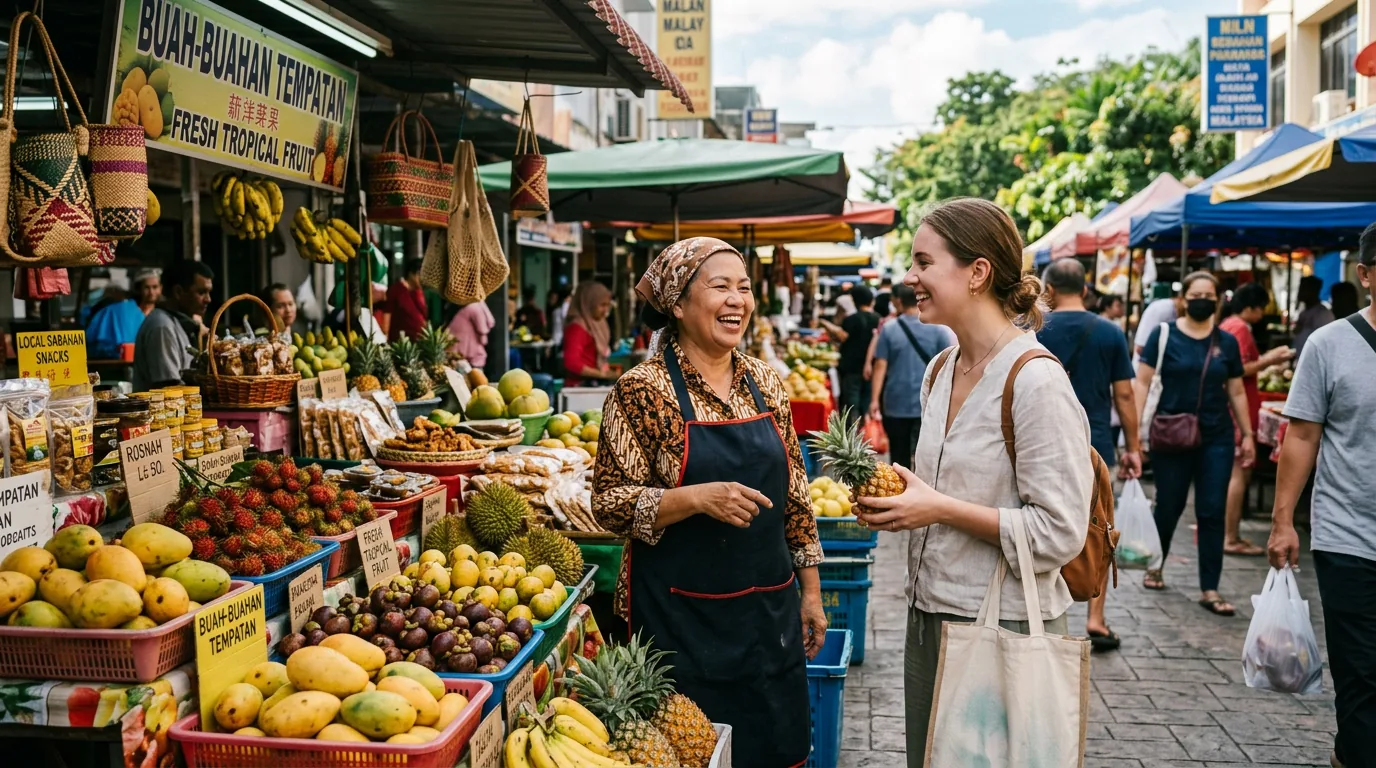
Markets and street vendors are the heart of Sabahan commerce. Light bargaining is normal and expected:
Berapa harga? — How much is this?
Mahal — Expensive
Murah — Cheap
Boleh kurang? — Can you reduce the price?
Ada diskaun? — Any discount?
Saya ambil ini — I'll take this
💡Bargaining Etiquette
Smile and be good-natured. Aggressive bargaining is considered rude. A 10–20% reduction is typical. In shops and restaurants, prices are fixed—don't bargain there.
The Sabah Signature: "Bah"
Sabah Malay replaces the peninsular Malaysian "lah" with "bah." It adds emphasis, agreement, and a friendly tone:
Bagus bah! — Good! (vs. standard "Bagus lah!")
Boleh bah — It's okay
Makan bah! — Let's eat!
Jalan bah — Let's go!
Using "bah" shows cultural awareness and locals will appreciate the effort. It's the ultimate phrase to fit in.
Sabah's Colourful Language: The Swear Words Guide
Every language has its spicy side, and Sabah—with its multilingual melting pot—has developed a spectacularly rich vocabulary of profanity. You will hear these in kopitiam, traffic jams, pasar malam, and construction sites. Understanding them is essential to truly understanding Sabah.
⚠️Read the Room
This section is educational, not an invitation to swear at aunties. Use these among friends who've already dropped a few bombs first. Never direct these at strangers, elders, or in formal settings. Sabahans have a great sense of humour—but respect still comes first.
Each phrase is rated by severity:
MILD Playground-level. Your grandma might use it.
MEDIUM Gets you a look from aunty. Normal among friends.
NUCLEAR Full-on verbal warfare. Use at your own risk.
Hakka Chinese — The Undisputed Champions
Sabah's Chinese community is predominantly Hakka, and Hakka has earned a legendary reputation across Malaysia for having the most creative, most brutal profanity of any Chinese dialect. Even non-Chinese Sabahans borrow Hakka swear words daily. If you've ever wondered why Malaysian swear words sound vaguely Chinese—it's Hakka.
Diao nia ma
dee-OW nee-ah mah
F*** your mother
The nuclear option. Shortened to "DNM" in texts. You'll hear this screamed in traffic, at football matches, and during heated mahjong games. The most recognisable Hakka phrase in all of Malaysia.
NUCLEAR
Lan jiao / Lin kun
lahn jee-OW / lin koon
Penis
The Swiss Army knife of Hakka profanity. Used as a noun, adjective, verb, and expression of disbelief. "Lan jiao lah!" = "Bullshit!" Can be inserted into almost any sentence for emphasis.
NUCLEAR
Chiu ci bet / Jipet
chew chee bet / jee-PET
Your vagina
Extremely vulgar. Usually directed at someone in rage. The "ci bet" / "jipet" part alone is commonly used as a standalone expletive, similar to the English C-word.
NUCLEAR
Thai lin ngong
tai lin NGONG
Big-dick crazy
Calling someone absolutely insane. "Thai" (big) + "lin" (penis) + "ngong" (crazy). One of Sabah's most iconic insults. Often shortened to just "lin ngong." You'll hear uncles yelling this at bad drivers.
MEDIUM
Ngai diao
ngai dee-OW
I f***
Expression of frustration or disbelief, not a literal statement. Like saying "f*** me" in English when something goes wrong. "Ngai diao, flat tyre again!"
MEDIUM
Ham ka chan
hum kah CHAN
Your whole family dies
A Cantonese curse that's crossed over into Sabah Hakka usage. Cursing someone's entire family lineage. Reserved for serious rage—you don't casually drop this one.
NUCLEAR
Puk kai
pook GUY
Fall dead on the street
Cantonese-origin curse wishing someone drops dead in public. Common across Malaysian Chinese. "That puk kai cut my queue!" Used both as a curse and a noun to describe a terrible person.
MEDIUM
Sei ngin
say NGIN
Dead person
Used like "damn" or to call someone useless. "Sei ngin, late again!" Not as harsh as it sounds—more exasperated than angry. Common between friends.
MEDIUM
Mau lin yong
mow lin YONG
No dick use / Useless
Calling something or someone completely useless. "This WiFi mau lin yong!" Despite the crude literal meaning, it's surprisingly mild in practice—used casually even around family.
MILD
Si chun
see CHOON
Stupid / Dumb
General-purpose insult for stupidity. Milder than most Hakka options. "Don't be so si chun lah." Safe to use among friends without escalating things.
MILD
Ham sap
hum SUP
Salty-wet / Perverted
Calling someone a pervert or dirty-minded. "Eh, don't be so ham sap lah!" Very commonly used, almost affectionately, when a friend makes a suggestive comment. Universal across all Malaysian Chinese dialects.
MILD
Diao ni si woo
dee-OW nee see WOO
F*** your ass
Even more graphic variation of "diao nia ma." Rarely heard in casual conversation—this is pure road-rage or bar-fight territory.
NUCLEAR
Makai lin
mah-KAI lin
Eat d***
Telling someone to perform a certain act. Used in frustration or as a dismissal. A classic Hakka move: take any normal verb and add "lin" to make it vulgar.
MEDIUM
Chau hai
chow HIGH
Smelly vagina
Cantonese crossover that's deeply embedded in Sabah Chinese vocabulary. Used as a general expletive or to describe a despicable person. "That chau hai cheated me!"
NUCLEAR
ℹ️The Hakka Modifier Trick
Hakka speakers have a legendary ability to make ANY word vulgar by inserting "lin" (penis) into the middle of a phrase. Normal sentence: "Makai" (eat). Vulgar version: "Makai lin." This works with almost any verb and is a core feature of Hakka creative profanity. Once you understand this pattern, you'll decode half the swearing you hear in Sabah.
Sabah Malay — Local Flavour Included
Sabah Malay has its own set of insults that don't exist in Peninsular Malaysia. The mild ones are used so casually they're practically terms of endearment. The nuclear ones... well, you'll know when someone means business.
Palui
pah-LOO-ee
Stupid / Foolish
THE quintessential Sabah insult. Used constantly, even affectionately. "Eh palui, wrong way lah!" It's so Sabahan that Peninsular Malaysians won't even know what it means. Almost a term of endearment among close friends.
MILD
Buduh / Budu
boo-DOO
Stupid
Sabah's version of "bodoh" (standard Malay for stupid). Used interchangeably with palui but slightly harsher. "Buduh betul kau ni!" (You're really stupid!) Common in everyday banter.
MILD
Bingai
bing-EYE
Slow / Dense
Specifically means someone is slow on the uptake—not just stupid, but painfully dense. "Bingai betul, sudah explain tiga kali!" (So dense, already explained three times!) A very Sabah-specific word.
MILD
Biul
bee-OOL
Crazy / Nuts
Sabah-specific word for crazy. "Kau biul ka?!" (Are you crazy?!) Less harsh than "gila" and used more playfully. You might hear it when someone does something unexpectedly wild or funny.
MILD
Tanga
TANG-ah
Clueless / Idiotic
Someone who's completely oblivious. "Tanga juga kau ni." (You're really clueless.) Often used when someone misses an obvious point. Mild enough for everyday use.
MILD
Sot
SOT
Crazy (short-circuit)
Derived from "short circuit"—implying someone's brain short-circuited. "Sot sudah dia ni." (He's gone crazy.) Used across all races in Sabah. Very common and relatively harmless.
MILD
Muhau
moo-HOW
Crazy / Mad
Another Sabah word for crazy, with indigenous roots. "Muhau betul!" (Truly crazy!) Interchangeable with biul and sot. Sabah really does have a lot of words for "crazy."
MILD
Babi
BAH-bee
Pig
Deeply offensive, especially to Muslim Malays and indigenous groups. Calling someone "babi" crosses a cultural and religious line. Among Chinese friends it's milder, but NEVER use this around Muslim Sabahans. Context matters enormously here.
MEDIUM
Sial
see-AHL
Damned / Cursed / Bad omen
General-purpose "damn." "Sial betul hari ni!" (What a damned day!) Also used as "that cursed person." Moderate intensity—acceptable among friends, inappropriate in formal settings.
MEDIUM
Celaka
cheh-LAH-kah
Damn it / Wretched
Slightly stronger than "sial." "Celaka punya kereta!" (Damn car!) Often used when things go wrong. Has a slightly old-school feel to it—your father's generation's go-to swear word.
MEDIUM
Bangang
BANG-ang
Idiot / Imbecile
Stronger than bodoh or palui—implies someone is truly, impressively stupid. "Bangang betul budak ni." (This kid is a real idiot.) More aggressive than the mild Sabah words above.
MEDIUM
Mangkuk
MANG-kook
Bowl (used as "dickhead")
Literally a bowl, but universally understood as calling someone a dickhead. "Mangkuk betul driver ni." (What a dickhead driver.) The beauty of this insult is you can say it in front of children and foreigners won't know.
MEDIUM
Kurang ajar
koo-RANG ah-JAR
Poorly raised / No manners
Insulting someone's upbringing and, by extension, their parents. "Kurang ajar betul!" (So ill-mannered!) This cuts deep in Asian culture where family honour matters. Often said by elders about younger people.
MEDIUM
Mampus / Pergi mampus
MUM-poos / per-GEE MUM-poos
Drop dead / Go die
Telling someone to go die. "Pergi mampus lah kau!" Harsh, but used more casually than it sounds—somewhat equivalent to "get lost" with extra venom. Still, don't say this to people you've just met.
MEDIUM
Gila babi
GEE-lah BAH-bee
Pig crazy
Combines "crazy" with "pig" for double impact. "Gila babi mahal!" (Insanely expensive!) Used for emphasis more than as a direct insult. Offensive to Muslims due to the pig reference. Mostly used by Chinese Sabahans.
MEDIUM
Pukimak
POO-kee-mak
Mother's vagina
THE most offensive word in Malay. Period. The absolute nuclear bomb of Malay profanity. Shortened to "kimak" in casual use. Using this in anger at someone is essentially declaring war. You will hear this in road rage and football matches. Never, ever direct this at a stranger.
NUCLEAR
Kimak
kee-MAK
Shortened "pukimak"
The clipped, rapid-fire version of pukimak. More common in everyday use because it's faster to yell. "Kimak! Late again!" Functions like the English F-word as a general exclamation of frustration.
NUCLEAR
Lancau
lan-CHOW
Penis
Borrowed from Chinese (lan jiao) into Malay. "Lancau lah kau!" Functions the same as the Hakka version but in Malay contexts. Shows how Sabah's multilingual environment creates cross-language profanity.
NUCLEAR
Sundal
SOON-dal
Prostitute / Whore
Extremely offensive. Calling someone (especially a woman) "sundal" is fighting words. "Anak sundal" (child of a prostitute) is even worse. This is serious—not used casually even among friends.
NUCLEAR
Anak haram
AH-nak hah-RAM
Illegitimate child / Bastard
Deeply offensive in Muslim culture. Implies the person's parents weren't married—a major taboo. "Haram" carries religious weight, making this far heavier than the English equivalent "bastard."
MEDIUM
Taik
TAH-eek
Shit / Excrement
The mildest of the crude words. "Taik lah!" (Shit!) Used exactly like the English equivalent. Can be combined: "Muka taik" (shit face), "Taik kucing" (cat shit = worthless). Acceptable in casual settings.
MILD
Kadazan-Dusun — The Indigenous Arsenal
Kadazan-Dusun is Sabah's largest indigenous language, spoken by about 40% of the population. The profanity is colourful, creative, and—because fewer outsiders know it—often deployed as "stealth swearing" that flies under the radar. Many Kadazan insults have crossed over into mainstream Sabah Malay.
Tongo / Bongo / Bongok
TONG-oh / BONG-oh / BONG-ok
Stupid
The classic trio of Kadazan stupidity insults. All mean roughly the same thing but with slightly different flavours—bongok being the harshest of the three. "Bongo betul kau ni!" Very widely used even by non-Kadazan Sabahans.
MILD
Thai lingong
tai ling-ONG
Extremely stupid / Beyond crazy
When "bongo" isn't strong enough. This is the "weapons-grade" version of calling someone stupid in Kadazan. Implies a level of stupidity that borders on clinical. The Kadazan equivalent of Hakka's "thai lin ngong."
MEDIUM
Tontolou
ton-toh-LOW
Penis / Male genitalia
The Kadazan word for male genitalia, used as a swear word. "Tontolou kau!" Functions similarly to how "lan jiao" works in Hakka—a versatile anatomical insult. Used among Kadazan speakers as an exclamation.
MEDIUM
Bobot
BOH-bot
Vagina
The Kadazan equivalent of the crude anatomical terms in other languages. Used as an expletive or insult. Less commonly heard in mixed company but alive and well in Kadazan-speaking households and kampungs.
MEDIUM
Balabak
bah-LAH-bak
Scrotum / Balls
"Balabak nu!" (Your balls!) Used as an exclamation of disbelief or as a direct insult. The Kadazan version of "bollocks." Mild enough that you'll hear it tossed around in kampung banter and tamu markets.
MILD
Taiih
TAH-eeh
Shit / Excrement
The Kadazan "shit." "Taiih lah!" Functions exactly like the Malay "taik" or English "shit." Universal and mild. You'll hear grandmothers say this when they step in something.
MILD
Bida
BEE-dah
Ugly
Not technically a swear word, but definitely an insult. "Bida betul muka dia." (His face is really ugly.) Used across Sabah by all races. Stings more than you'd expect—appearance-based insults hit hard in Asian culture.
MILD
Sakai
sah-KAI
Uncivilised / Backwards
Originally referred to the Orang Asli (indigenous people) of Peninsular Malaysia, now used across Sabah to mean "uncivilised" or "backwards." "Sakai betul perangai dia." (His behaviour is so uncivilised.) Considered derogatory—use with caution.
MILD
Logiut
loh-gee-OOT
F***er
A Dusun expletive directed at someone you're angry with. Less commonly known outside Kadazan-Dusun communities, making it effective "stealth" swearing in mixed company.
MEDIUM
💡Bonus: Cross-Language Power Combos
True Sabah veterans mix languages for maximum impact. You'll hear combinations like "Babi punya palui!" (Pig-stupid! — Malay combo), "Sei ngin, bongok betul" (Dead man, truly stupid — Hakka + Kadazan + Malay), or the legendary triple-language "Diao nia ma, palui, bongok betul kau ni!" These multilingual combos are uniquely Sabahan and reflect how deeply intertwined the cultures are here.
Emergency Phrases
⚠️Know These
Tolong! — Help!
Panggil polis! — Call the police!
Panggil ambulans! — Call an ambulance!
Di mana hospital? — Where's the hospital?
Emergency numbers: 999 or 112 (police/ambulance), 994 (fire). Save these in your phone.
Pronunciation Masterclass
Malay is beautifully phonetic—once you learn the rules, pronunciation is consistent:
Vowels: A=ah, E=eh/uh, I=ee, O=oh, U=oo
Consonants: C always "ch", G always hard, H always pronounced, R gently rolled
Combinations: Ng = single sound (like "sing"), Ny = "canyon"
Stress: Usually on the penultimate (second-to-last) syllable
ℹ️Practice Tip
Listen to native speakers on YouTube. The language has a melodic rhythm—getting the cadence right matters more than perfect pronunciation.
Indigenous Languages: Respect & Awareness
Sabah is home to diverse indigenous languages:
Kadazan-Dusun — Spoken by ~40% of Sabah's population, UNESCO-designated endangered language
Bajau "Sama" — Spoken by maritime communities on the west and east coasts
Chinese dialects — Hakka (dominant), Cantonese, Hokkien
Learning a simple phrase like "Aramaiti" (having a jolly time/celebration) shows respect for Kadazan culture. However, English and Malay are sufficient—locals value effort over fluency.
Frequently Asked Questions
QWhat's the difference between Sabah Malay and standard Malay?
Sabah Malay uses "bah" instead of "lah" for emphasis and sounds more casual. For example: "Bagus bah!" (Good!) vs standard "Bagus lah!" Both are understood, but using "bah" shows cultural awareness. Pronunciation is slightly different too—more relaxed and laid-back.
QHow important is it to learn Malay phrases?
Very helpful but not essential. About 72% of Sabahans speak English well, especially in tourism areas. However, locals deeply appreciate when visitors try Malay—it's seen as respectful and opens doors to better service and authentic interactions. Even basic phrases go a long way.
QWhat's the best way to order coffee in Sabah?
Visit a "kopitiam" (traditional coffee shop) and order: Kopi-O (black coffee with sugar), Kopi-O kosong (black, no sugar), Kopi-C (with condensed milk), or Teh tarik (pulled tea). Say "Kurang manis" for less sweet. It's a quintessential local experience and very affordable (RM1.50–3).
QAre there indigenous languages I should know about?
Kadazan-Dusun is the largest indigenous language with about 40% of Sabah's population speaking it. Learning simple greetings like "Aramaiti" (celebration/jolly time) is culturally meaningful. However, English and Malay are sufficient for tourists. Respect for local heritage is more important than fluency.
QWhat emergency phrases should I memorize?
Key ones: "Tolong!" (Help!), "Panggil polis!" (Call police!), "Panggil ambulans!" (Call ambulance!), "Di mana hospital?" (Where's the hospital?). Emergency numbers: 999 or 112 for police/ambulance, 994 for fire. Save these in your phone just in case.
QIs bargaining expected in Sabah?
In markets and with street vendors, light bargaining is normal and expected. Use phrases like "Berapa?" (How much?), "Mahal" (Expensive), "Boleh kurang?" (Can you reduce?), or "Ada diskaun?" (Any discount?). Smile and be friendly—aggressive bargaining is considered rude. In shops and restaurants, prices are fixed.
QWill I offend anyone if I use swear words from the guide?
Context is everything. Among friends at a kopitiam after a few beers? You'll get roaring laughter and instant respect. At a formal dinner or with elderly locals? Absolutely not. The rule of thumb: if someone swears at you first, you're cleared to respond in kind. Sabahans have thick skin and a great sense of humour—just read the room.
One short email a week on what's happening around Sabah — events, food, and local life. Free to join, and every subscriber is in the monthly RM50 Grab voucher draw.