Sabah Hotels 2026 — Accommodation Supply & Occupancy

We are working through the statistics in this section against their original sources. The headline figures above were re-checked on 18 August 2026. Detailed figures further down the page have not yet been individually verified, and some may be out of date or wrong.
If you spot something that looks wrong, please tell us — it genuinely helps.
Tourism Malaysia publishes the official count: 540 hotels with 27,208 rooms in 2024. Two wider counts also circulate — 685 properties and 26,822 rooms from the Chief Minister in October 2023, and 691 and 27,136 reported by Daily Express in January 2024 — because they include lodges and budget premises that fall outside Tourism Malaysia's ten-room survey frame. The room totals agree within about one percent.
On occupancy, Tourism Malaysia puts Sabah at 51.6% for 2024 and 54.4% for January to September 2025 — below the Malaysian average every year since 2021, and well below Sabah's own 65.8% in 2019, when it led the national figure. On those numbers the state leaves close to half its rooms empty on an average night.
Sabah led the national average in 2019 and has trailed it every year since. 2020 is not published. The 2024 figure of 51.6% is the most recent complete year.
Source: Tourism Malaysia, Key Performance Indicators
Accommodation Overview
Two different questions get muddled here, so it is worth separating them. How many rooms Sabah has depends entirely on what you count. How full they are is published every year by Tourism Malaysia, and it is the more useful number.
On supply, Tourism Malaysia counted 540 hotels with 27,208 rooms in Sabah for 2024. Its hotel survey covers hotels and serviced apartments with at least ten rooms, which is why two wider counts also circulate: 685 properties with 26,822 rooms, stated by the Chief Minister in October 2023, and 691 with 27,136 rooms, reported by Daily Express in January 2024. The room totals sit within about one percent of each other; the property counts differ by roughly 150 purely on definition. A figure quoted as "hotels in Sabah" is usually all paid accommodation.
On demand, Sabah recorded 51.6% average occupancy in 2024 and 54.4% for the first nine months of 2025. Both sit below the Malaysian average — as Sabah has every year since 2021 — and well below the 65.8% it reached in 2019, when it led the national figure. The state is not short of rooms on an average night — it is short of demand outside its four busiest months.
What the star ratings cover
The published star-rating breakdown is much smaller than it first appears. Of the 691 properties in that count, only the three-, four- and five-star tiers are broken out: 70 properties and 11,636 rooms, around 43% of the total. That is 10 five-star with 3,906 rooms, 16 four-star with 3,218 rooms, and 44 three-star with 4,512 rooms.
The source is silent on the one- and two-star tiers and on unrated premises — the other roughly 620 properties and 15,500 rooms. No published source breaks those down. Any chart showing a complete star-by-star split of all Sabah rooms is describing data that does not exist.
Only these 70 properties and 11,636 rooms are covered by the published star breakdown — about 43% of that count. The source does not break out one- and two-star or unrated premises.
Source: Daily Express, 5 January 2024
Established properties
Kota Kinabalu and around: Shangri-La Tanjung Aru on the beachfront; The Pacific Sutera (500 rooms and suites) and The Magellan Sutera (456) at Sutera Harbour; Nexus Resort and Spa Karambunai (485) on the Karambunai peninsula; Hilton Kota Kinabalu (304 rooms, trading since 2016) and Citadines Waterfront Kota Kinabalu (open since February 2024) in the city.
The resort remains open, but all Kinabalu Wing rooms and suites are closed for refurbishment from May 2026 until the second quarter of 2027, and the Horizon Lounge is closed from August 2026 to January 2027. Confirm which wing your booking is in. Source: the hotel's own guest notice, read 18 August 2026.
Rainforest and interior: Borneo Rainforest Lodge serves Danum Valley with around 30 chalets, alongside the more basic Danum Valley Field Centre. Sabah Tea Garden, which now trades as Sabah Tea Resort, in Ranau, is an organic tea plantation with agrotourism lodging — a bamboo longhouse, cabins and a campsite, not a luxury resort.
Dive coast: Semporna and the Tun Sakaran islands are served mostly by dive resorts and water-village properties booked as packages rather than as room nights. Note that Labuan is a Federal Territory, not part of Sabah, so its hotels do not appear in any Sabah count.
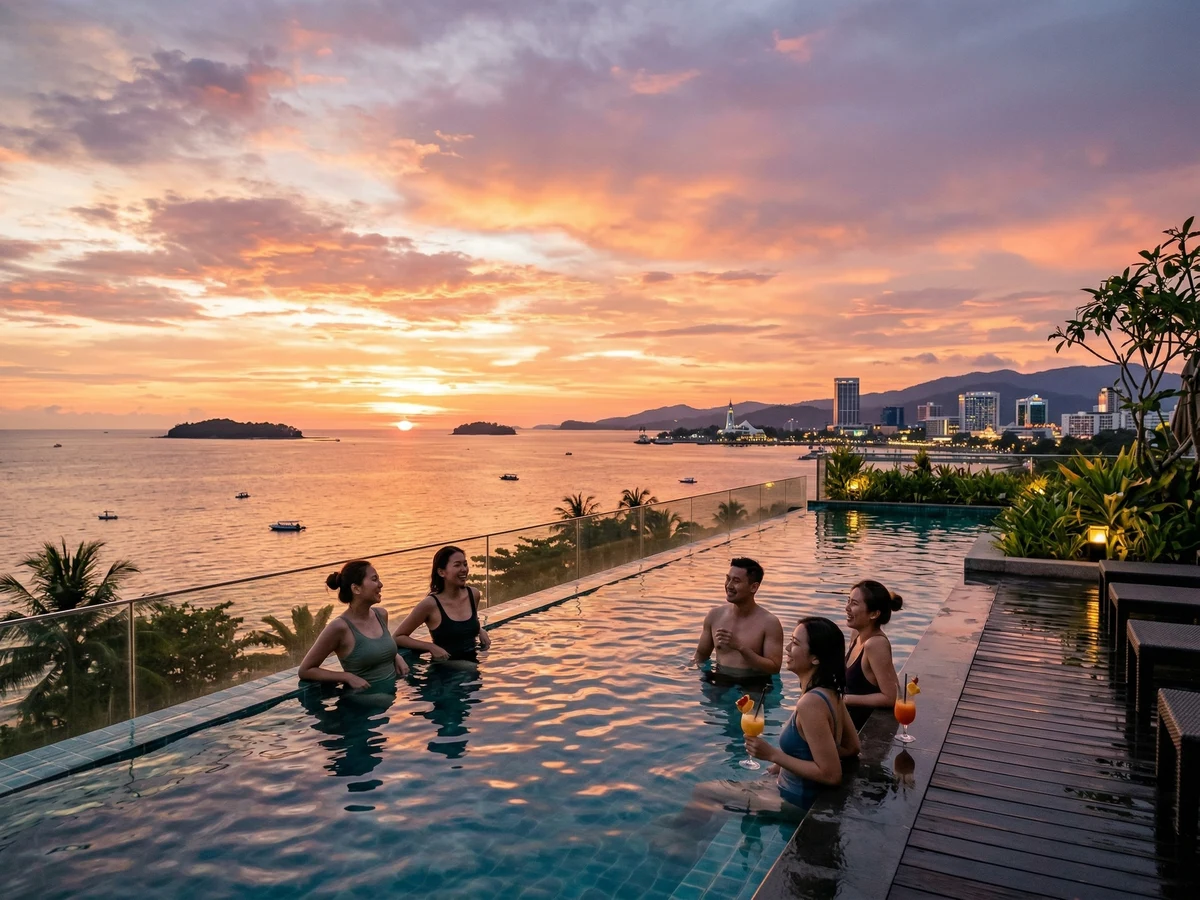
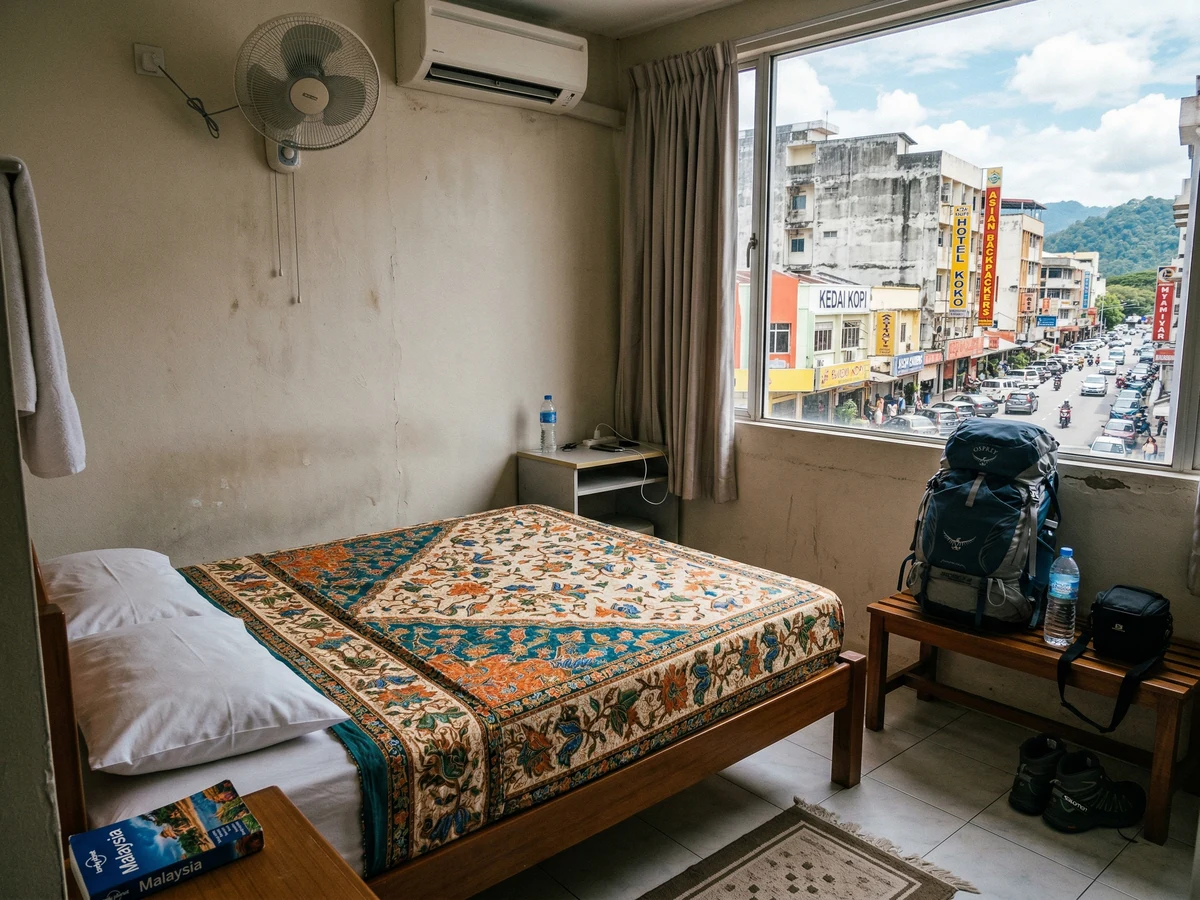
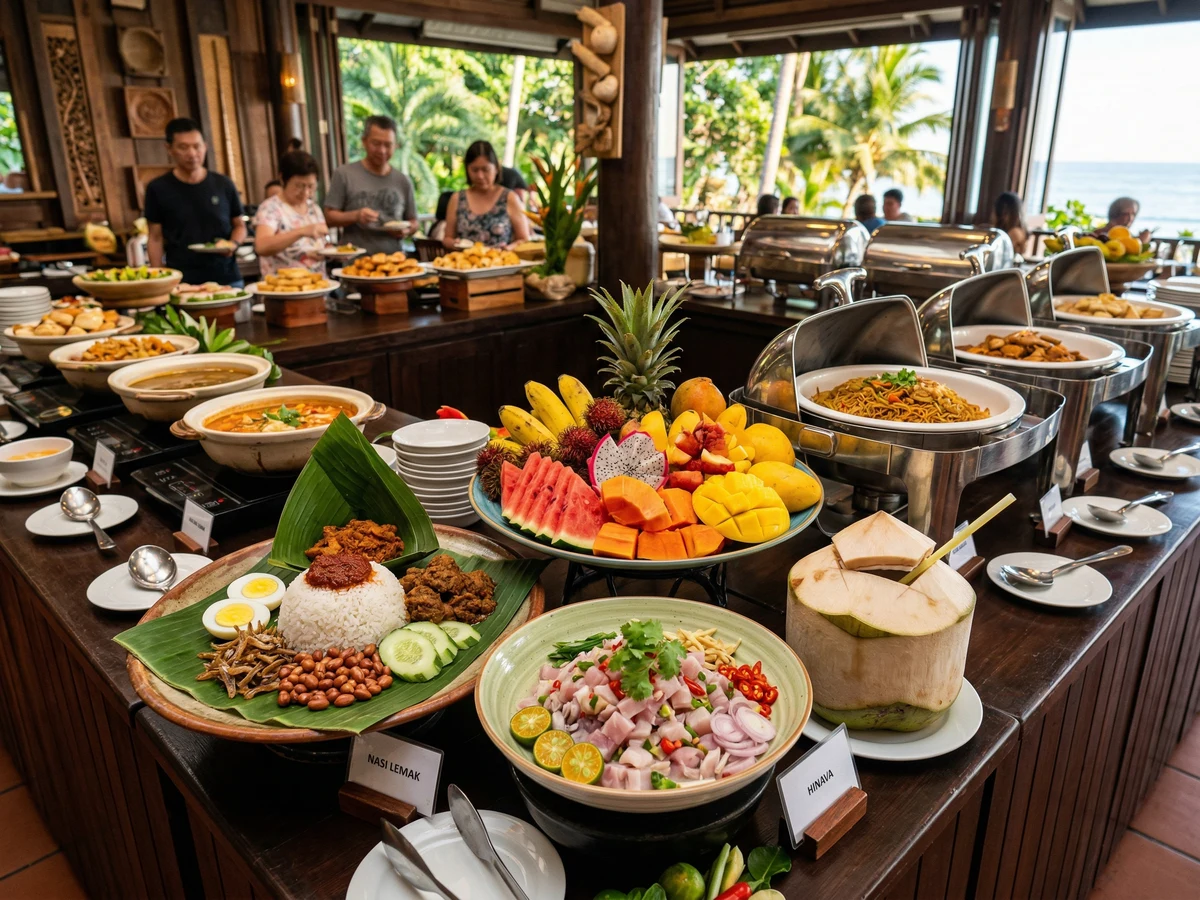
Where the rooms are
No published source breaks Sabah room stock down by district. District-share figures circulate online, but none of them traces to an official or attributable source, and this page no longer carries them.
What is published is a split by setting rather than district: 81.3% of rooms are in cities and towns, 15.2% are beachfront and 3.5% are hillside, reported by Daily Express in January 2024. Kota Kinabalu is plainly the largest market — it is the international gateway and holds every top-tier property — but the size of its share is not something anyone has published.
Seasonality
Because no monthly occupancy series exists for Sabah, the honest proxy for when the state is busy is recorded visitor arrivals. On 2025 arrivals the year divides cleanly into three, and these are the same bands used on our best time to visit guide.
December is the busiest month by a wide margin and September is second, ahead of both July and August. April is the quietest. This is arrivals, not occupancy — no monthly occupancy series is published for Sabah.
Source: Sabah Tourism Board, 2025
Peak — December, September, July, August. The four busiest months by arrivals. Highest rates, tightest availability, and the months where premium Kota Kinabalu stock genuinely fills. Book well ahead.
Shoulder — June, March, February, January. Arrivals close to the annual average. Rates and availability are reasonable, and February and March are the two driest months on the west coast.
Quiet — November, October, May, April. The four quietest months, and the cheapest. April and May are the quietest of all while still sitting in the west coast dry stretch, which makes them the best value of the year. October is the wettest month in Kota Kinabalu.
New supply
In January 2024 Zerin Properties put eight hotels under construction in Sabah, adding 2,248 rooms. Of the individually confirmed projects since:
Opened in 2026: Hilton Garden Inn Kota Kinabalu Tuaran, 167 rooms, opened 26 March 2026 — the brand debut in Tuaran, about thirty minutes from the city. Ormond Sandakan, 299 rooms and suites on the Sandakan Bay waterfront, announced for April 2026.
Announced for 2027: InterContinental Sabah Kota Kinabalu Resort at Melinsung in Papar, 450 rooms, signed in November 2023 as a RM1 billion development. This is a target date and has not been confirmed as opened.
Further out: a Kimpton in Kota Kinabalu, 350 keys, has been signed with a stated 2031 opening. It is not 2026 or 2027 supply.
Set against occupancy near 52%, new supply is not filling a shortage so much as competing for the same demand. The pressure it relieves is seasonal and concentrated at the top of the market.
Frequently asked questions
Q How many hotels are there in Sabah?
Q What is the average room rate in Sabah?
Q What is the average hotel occupancy rate in Sabah?
Q Which are the best luxury hotels in Sabah?
Q Is there a shortage of accommodation in Sabah?
Q What hotel expansion is planned for 2026 and 2027?
Q Are there homestays or alternative accommodations?
Sources & References 6 sources
Last verified: 18 August 2026
Occupancy (official)
- Tourism Malaysia — Key Performance Indicators Average occupancy rate by state. Source of the Sabah figures for 2019 and 2021 to 2024, and the Malaysian comparison
- Tourism Malaysia — Paid Accommodation Survey Quarterly and cumulative occupancy. Source of Sabah January to September 2025, Kota Kinabalu locality, and Q1 2026
Room and property counts
- Tourism Malaysia — Malaysia Tourism Statistics in Brief 2024 The official state count, page 17: Sabah 540 hotels and 27,208 rooms for 2024. Survey frame is hotels and serviced apartments with at least ten rooms
- Chief Minister of Sabah, reported by Malay Mail 685 accommodation properties and 26,822 rooms, spoken 9 October 2023 and reported the next day. A ministerial statement, not a statistical release
- Daily Express, 5 January 2024 691 properties, 27,136 rooms, the star-rated breakdown and the location split. The article is built around Zerin Properties, but the paper does not attribute each figure to them