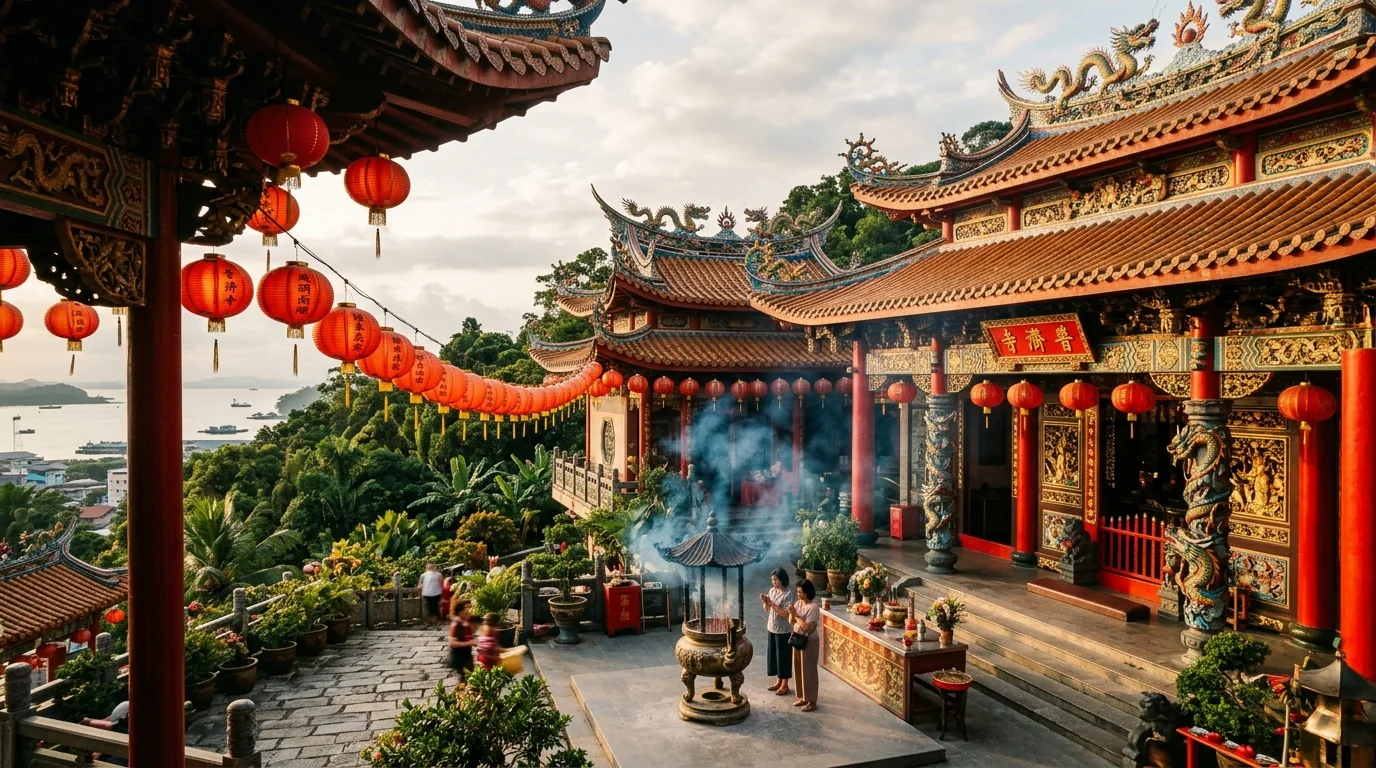
Sam Sim Kung Temple — One of the Oldest Chinese Temples in Sandakan
What is Sam Sim Kung Temple?
Sam Sim Kung Temple is one of Sandakan oldest religious buildings, established in the late 19th century during the early development of the town as a major trading port. It is a Chinese Taoist temple dedicated to Sam Sim Kung (Sam Sim Kong in Cantonese), a deity whose name translates loosely as "Three-Heart Lord" or "Three-Heart King." The temple serves both as a place of worship and as a living heritage site documenting Sandakan Chinese community history.
The temple structure reflects traditional southern Chinese temple architecture: a central altar housing the primary deity, side altars for subsidiary deities, incense stands for offerings, and decorative elements incorporating red lanterns, calligraphy, and wooden carvings. The interior is filled with the aroma of incense and the visual richness of gold-painted surfaces, symbolic animals, and religious iconography. Visitors are immediately immersed in an aesthetic and spiritual environment reflecting centuries of Chinese religious practice.
Unlike churches or mosques, which have regulated visiting hours, Sam Sim Kung Temple operates as a community religious space with flexible access. Worshippers come and go throughout the day. Early mornings and early evenings are typically busier, with devotees offering prayers and incense. Visitors can enter during open hours, observe respectfully, and participate in the temple atmosphere.
The temple is not merely a museum or historical artefact. It is a functioning place of worship where modern devotees, many of them descendants of the original Chinese settlers, continue to practice Taoist traditions. This ongoing religious life ensures that the temple remains culturally vital, not merely preserved.
Sam Sim Kung: the Three-Heart Lord
Sam Sim Kung is a Taoist deity with deep roots in southern Chinese culture, particularly in Cantonese-speaking regions. The name translates as "Three-Heart" (sam sim) and "Lord" or "King" (kung). Different interpretations exist, but the deity is generally understood as a guardian of community, a protector of moral order, and a patron of seafarers and traders.
In the context of early Sandakan, the relevance of Sam Sim Kung is clear. Sandakan was established as a trading port, and Chinese merchants arrived by sea from other parts of Asia. A deity associated with safe passage, commercial prosperity, and the protection of communities made spiritual and practical sense for these settlers. Building a temple to Sam Sim Kung was both a religious act—fulfilling spiritual obligations and seeking divine favour—and a social act of community institution-building.
Taoist theology incorporates elements of ancestor veneration, nature worship, and moral philosophy. Practitioners view Sam Sim Kung not as a supreme god (like monotheistic religions), but as one of many deities inhabiting a complex spiritual cosmology. Worshippers make offerings and prayers to Sam Sim Kung for specific purposes: safe travels, business success, protection from illness or misfortune, and guidance in moral conduct.
The altar in the temple houses a statue or icon of Sam Sim Kung, often depicted in traditional robes with symbolic attributes. Devotees light incense in honour of the deity, a practice called "burning incense" (sai heung in Cantonese). The incense serves as a vehicle for prayers—the rising smoke carries petitions to the deity. This ritualistic practice, repeated daily by countless worshippers over generations, has infused the temple space with spiritual significance.
Chinese settlement and commerce in Sandakan
Sandakan was founded by the British North Borneo Chartered Company (BNCC) in the 1870s as a trading and administrative centre. Its natural deep-water harbour made it ideal for commerce. European traders and administrators arrived first, but Chinese merchants quickly followed, recognising commercial opportunity.
Chinese settlement in Sandakan reflected broader patterns of Chinese diaspora across Southeast Asia. Chinese traders—often from Guangdong (Cantonese-speaking), Fujian (Hokkien-speaking), and Hakka-speaking regions of southern China—had long networks of commerce linking China to Southeast Asia. These networks moved goods (silk, tea, ceramics from China; spices, timber, rubber from Southeast Asia) and people.
In Sandakan, Chinese merchants established themselves as traders, merchants, shopkeepers, and eventually planters and labourers. They brought with them not just commercial expertise, but cultural and religious practices. The need for spiritual institutions—temples, clan associations, burial grounds—was immediate. Building Sam Sim Kung Temple was thus part of the broader Chinese community response to settlement: creating infrastructure, establishing networks, and maintaining cultural identity in a new land.
By the early 20th century, the Chinese community in Sandakan was substantial and influential. Chinese capital financed commerce, Chinese labour built infrastructure, and Chinese culture contributed to the town character. This demographic and economic reality is reflected in the temples, clan houses, and religious and social organisations that Chinese settlers established.
The temple as a cultural anchor for the Chinese community
For immigrant communities, temples serve functions far beyond the purely religious. Sam Sim Kung Temple was a cultural anchor—a space where Chinese settlers could practise their religion, celebrate festivals, teach children about cultural heritage, and maintain group cohesion in a foreign environment.
The temple was likely a gathering place where community decisions were made, where disputes were mediated, and where collective action was organised. Festival celebrations (Chinese New Year, Hungry Ghost Month) drew the community together, reinforcing shared identity and values. The temple also likely served as a gathering point for specific dialect or regional groups—Cantonese speakers, Hakka speakers, and Hokkien speakers may have maintained their own affiliated spaces or altar worship, reflecting the complex internal divisions within the broader Chinese community.
The temple also provided practical services. Chinese temples often housed community records, arranged burials for Chinese members (an important service in a foreign land), and administered clan charity or mutual aid systems. Over time, the temple became institutionalised into Sandakan civic and social life, recognised by the colonial administration as an important community institution.
This role explains why Sam Sim Kung Temple, despite being damaged during WWII and having faced many challenges over the past 150+ years, was maintained and restored. It was not merely a building, but a symbol of Chinese community presence and resilience in Sandakan. Keeping the temple alive was a way of keeping the community alive.
How Sam Sim Kung Temple survived WWII
Sandakan was heavily bombed during World War II. The Japanese occupied the town from 1942-1945, and the Allies (primarily Australia) conducted extensive bombing campaigns to dislodge the Japanese. Large areas of Sandakan were destroyed. Colonial and administrative buildings, commercial districts, and residential areas were levelled.
Sam Sim Kung Temple survived, though likely with significant damage. Why the temple was spared or restored is not fully documented, but several factors may be relevant. First, the temple may have been located in an area less targeted by bombing. Second, temples were often rebuilt quickly by communities as symbols of resilience and continuity. Third, the temple may have been restored under Australian military administration or post-war British colonial authority as a gesture of religious tolerance and community stabilisation.
The survival of Sam Sim Kung Temple makes it historically exceptional. Very few pre-war structures remain visible in modern Sandakan. The temple is thus one of the few physical connections to Sandakan pre-war character and Chinese community history. Walking into the temple today is, in a sense, stepping into one of the few spaces that Chinese settlers from the 1880s would recognise.
This historical continuity, despite war and destruction, carries profound symbolic weight for the Sandakan Chinese community. It represents cultural memory, community resilience, and the triumph of heritage preservation over historical erasure.
Architecture, festivals, and religious practices
Sam Sim Kung Temple reflects traditional Cantonese-style temple architecture adapted to a colonial-era building. The main altar is the spiritual focal point, housing the primary deity. Secondary altars for subsidiary deities and ancestors surround the central space. Wooden screens, carved decorations, and calligraphic inscriptions adorn the interior. Incense stands and offering tables facilitate daily worship.
Colour and symbolism permeate the space. Red and gold are predominant—red for good fortune and happiness, gold for prosperity and divine power. Dragons, phoenixes, and other auspicious creatures appear in carvings and paintings. Numbers and patterns carry meaning: the number eight signifies prosperity, nine represents longevity, and paired objects (lanterns, urns) represent balance and harmony.
Major festivals at Sam Sim Kung Temple include Chinese New Year (lunar new year), when the temple is decorated, incense burns heavily, and the community gathers for celebrations. Hungry Ghost Month (seventh lunar month) involves elaborate rituals to appease spirits and honour ancestors. Deity birthday celebrations (each deity has an assigned birthday in the lunar calendar) draw specific devotees.
Daily religious practice involves offerings and incense-burning. Devotees light incense sticks, place them in the incense stand, and make silent prayers or spoken petitions. Offerings of food (fruit, rice, meat), flowers, candles, and symbolic objects (paper money, prayer papers) are common. These acts connect the devotee to the deity, create a reciprocal relationship, and express gratitude or petition.
A heritage walk through Sandakan Chinese culture
Sam Sim Kung Temple is one stop on a broader Sandakan heritage journey. The town, despite WWII destruction, has retained or rebuilt enough historical landmarks to create a meaningful heritage itinerary. A Sandakan heritage walk might include:
- Sam Sim Kung Temple (Chinese Taoist heritage, community anchor)
- Other Chinese temples and clan associations (Hakka temple, Hokkien associations)
- Colonial administrative buildings and restored shophouses (representing BNCC-era commerce)
- St. Michael and All Angels Church (post-war Christian heritage)
- Japanese occupation sites and WWII memorials
- The harbour and coastal areas where Chinese merchants conducted trade
- Local museums documenting Sandakan recovery and East Coast history
A guided heritage walk, if available locally, provides context and anecdotes that unguided exploration cannot. Local historians and community members often serve as guides and can elaborate on family histories, community narratives, and the lived experience of pre- and post-war Sandakan.
The walk also contextualises Sam Sim Kung Temple within the broader narrative of Sandakan resilience. The temple, standing amid modern Sandakan, is a reminder that heritage preservation requires deliberate choice and community investment—the temple exists because people chose to maintain it.
| Chinese Temples & Heritage Sites in Sandakan | Type | Historical Period | Notes |
|---|---|---|---|
| Sam Sim Kung Temple | Taoist Temple | Late 1800s — pre-WWII, rebuilt post-war | One of oldest surviving religious buildings in Sandakan. Serves broader Sandakan Chinese community. |
| Hakka Association Temple | Clan Association / Temple | Early 1900s | Serves Hakka-speaking Chinese settlers. May include ancestral altar and community gathering space. |
| Hokkien Association / Temple | Clan Association / Temple | Early 1900s | Serves Hokkien-speaking Chinese settlers. Often includes opera hall or performance space. |
| Cantonese Association | Clan Association | Early 1900s | Serves Cantonese speakers. May have religious component alongside social/commercial functions. |
| Chinese Cemetery / Burial Grounds | Heritage Site | Late 1800s—modern | Traditional burial grounds for Chinese settlers, many graves predating WWII. Cultural and genealogical significance. |
| Old Chinese Shophouses (Sandakan heritage district) | Commercial Heritage | Late 1800s-early 1900s (some rebuilt post-war) | Remaining shophouses reflect Chinese merchant presence in pre-war commerce. Some now serve as shops, cafes, or galleries. |