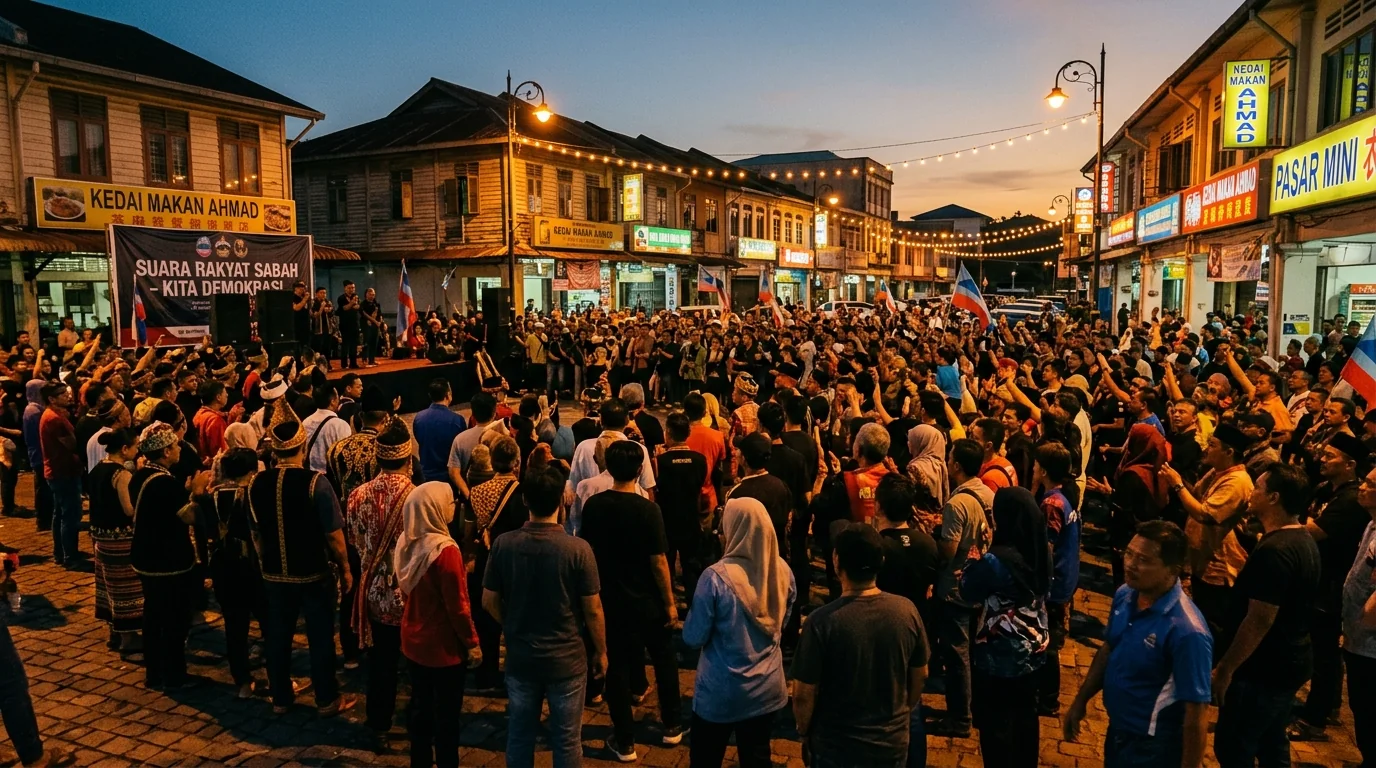
1985 Sabah State Election — The Night Pairin Waited to Be Chief Minister
What was the political situation in Sabah before 1985?
Sabah had been dominated by Berjaya and Chief Minister Harris Salleh since 1976. Harris had led the state for nine years and was allied with the federal Barisan Nasional coalition. By the early 1980s, Berjaya and Harris were becoming increasingly unpopular among Sabahans.
The central grievance was that Sabah remained poor despite being resource-rich. Oil was being extracted from Sabahan waters, but the revenue was going to the federal government and oil companies. Sabah received minimal returns on its natural resources. Schools, hospitals, and infrastructure were underfunded. Compare to other Malaysian states, Sabah was falling behind.
Sabahans felt their state was being exploited by the federal government and by local elites aligned with federal interests. Harris Salleh was seen as part of the problem—too accommodating to federal authority and not assertive enough in defending Sabah interests. The Berjaya party was aging and appeared disconnected from ordinary Sabahans, particularly from younger professionals and indigenous communities.
In 1983-1984, a new opposition party emerged: PBS, or Parti Bersatu Sabah (United Sabah Party). PBS was founded by Joseph Pairin Kitingan, a young lawyer and Christian Kadazan leader. PBS platform centered on restoring MA63 autonomy rights, fighting for more equitable oil revenue sharing, and developing Sabah more assertively. The message resonated with Sabahans who felt their state was being taken for granted.
There was also the death of Tun Fuad Stephens in August 1985. Fuad was Sabah first Chief Minister and was viewed by many as a symbol of Sabah political autonomy and dignity. His death, in a plane crash known as the Double Six Disaster, created a symbolic opening for new leadership to assume the mantle of defending Sabah interests.
How was the 1985 election campaign?
The 1985 election campaign was vigorous and competitive. Berjaya, as the governing party, used state resources and media to support its campaign. Harris Salleh was the Berjaya chief campaigner, arguing for continuity and stability under proven leadership.
PBS ran a grassroots campaign emphasizing change and pro-Sabah policies. Pairin was the charismatic face of the campaign. He promised to restore MA63 rights, fight for higher oil royalties, and accelerate development in neglected rural areas. PBS message appealed particularly to indigenous communities (Kadazan, Dusun, Murut), Christian voters, and younger professionals.
The campaign became increasingly competitive as PBS momentum grew. Polls showed PBS gaining ground. Berjaya attempted to suppress PBS campaign activities in some areas, and there were reports of some intimidation of PBS supporters. However, the federal government did not overtly manipulate the election process, suggesting confidence that Berjaya would win—or at least willingness to accept some electoral risk.
By August 1985, PBS was running strong. The party had organized well and had genuine grassroots support. Sabahans were frustrated with Berjaya and wanted change. The election was set for August 24, 1985.
Who won the 1985 election?
The election results were decisive. PBS won 25 out of 48 state assembly seats. Berjaya won only 16 seats. Other parties won 7. PBS had a clear majority and the right to form government.
The results shocked Berjaya and the federal authorities. Despite 13 years in power and control of state resources, Berjaya had been defeated. Sabahans had voted for change. PBS had won on a pro-Sabah, anti-federal autonomy platform. The election was a repudiation of Berjaya.
Joseph Pairin emerged as the clear victor and the Prime Minister was expected to call on him to form a government and become Chief Minister. By electoral convention, Pairin would be sworn in as Chief Minister within days of the election.
However, the transition would not be smooth.
What happened after voting ended?
After voting ended and results became clear, Pairin and PBS expected to be sworn in quickly. Harris Salleh and Berjaya were preparing to hand over power. But then something unusual happened: the Governor of Sabah, Tun Fuad Stephens (Fuad had been appointed Governor in May 1985 after his retirement as Chief Minister), did not immediately call Pairin for swearing in.
Pairin had won the election and had the numbers to form government. By constitutional convention, he should be sworn in within 24-48 hours. But the Governor delayed. Pairin waited at a hotel with his supporters. Time passed. The swearing in did not happen.
Rumors circulated about what was happening behind the scenes. Some said the federal government was trying to convince PBS assembly members to defect. Some said Berjaya was proposing a coalition government to deny PBS power. Some said the Governor was reluctant to see Harris Salleh replaced. The overnight delay seemed designed to give opponents of PBS time to organize resistance.
Why did the Governor delay the swearing in?
The exact reasons for the Governor delay have never been fully explained, but several factors likely played a role. First, the Governor may have been genuinely surprised by the PBS victory. Like others, he may have expected Berjaya to retain power. The unexpected result may have created uncertainty about how to proceed.
Second, federal authorities may have instructed or suggested to the Governor that he delay. The federal government may have hoped that overnight, circumstances would change—PBS assembly members might defect, a coalition might be arranged, or some other mechanism might arise to prevent Pairin from becoming Chief Minister. The delay gave federal agents time to work behind scenes.
Third, the Governor may have had personal or political reasons to delay. Tun Fuad Stephens was related to Harris Salleh and may have sympathized with Berjaya. Additionally, the Governor as Sabah constitutional head of state may have wanted to ensure smooth transition and may have felt uncertainty about Pairin ability to govern.
Fourth, there may have been genuine procedural questions. The Governor may have wanted legal advice on whether all election procedures had been completed and whether all seats had been properly determined before swearing in a Chief Minister.
Ultimately, the overnight delay was extraordinary and looked politically motivated. It appeared to be an attempt to undermine the electoral result through procedural delay. However, it did not work. PBS remained unified. Federal authorities apparently decided not to escalate the situation further. By the next day, pressure forced the Governor to proceed with swearing in.
What did Pairin and PBS do when they took power?
When Pairin was finally sworn in as Chief Minister on August 25, 1985, PBS began implementing its campaign platform. The government made MA63 restoration and oil revenue renegotiation top priorities. Pairin appointed a cabinet of PBS leaders representing different ethnic and geographic constituencies.
PBS immediately began arguing with the federal government about oil royalties. The state demanded higher payments and restoration of MA63 rights. The federal government was reluctant to concede. These negotiations dragged on for years with limited success.
PBS invested in rural infrastructure and education, targeting areas that had been neglected under Berjaya. Development accelerated in rural Sabah. Schools and clinics were built. Roads improved. PBS attempted to show it was delivering on its promise to develop the state more rapidly than Berjaya.
PBS also changed the character of Sabah politics. Under Berjaya, the state had been relatively accommodating to federal authority. Pairin and PBS were more assertively pro-Sabah. PBS questioned federal policies that affected Sabah and demanded that state interests be respected. This created more tension with federal authorities but resonated with Sabahans seeking greater autonomy.
Pairin also championed state unity across ethnic and religious lines. While PBS was ethnically rooted (strong among Kadazan-Dusun), the party attempted to build support among other Sabah communities. The message was that all Sabahans, regardless of ethnicity or religion, shared common interests in fighting for state autonomy and development.
| Year | Sabah Chief Minister | Party | Notes |
|---|---|---|---|
| 1963-1964 | Tun Fuad Stephens | USNO | Sabah first Chief Minister, negotiated MA63 |
| 1964-1965 | Stephens Kalong Ningkan | USNO | Second Chief Minister |
| 1965-1967 | Tun Fuad Stephens | USNO | Returned as Chief Minister |
| 1967-1976 | Tun Mustapha Harun | USNO | USNO joined BN coalition, strong federal alignment |
| 1976-1985 | Harris Salleh | Berjaya | 13 years, widespread dissatisfaction, exploitative oil deals |
| 1985-1994 | Joseph Pairin Kitingan | PBS | Won 1985 election, pro-Sabah autonomy platform |
| 1994-1996 | Salleh Said Keruak | BN | PBS defections allowed BN to form government despite losing election |
| 1996-2002 | Pairin Kitingan | PBS | PBS returned to power after switching to BN coalition |
What happened to PBS after 1985?
PBS held power until 1994. During this period, Pairin and PBS became identified with pro-Sabah politics and MA63 restoration efforts. However, they had limited success in extracting concessions from the federal government on oil revenue or other key issues.
In 1994, a dramatic reversal occurred. Despite winning the election again, multiple PBS assembly members defected to BN parties (Umno, MCA, and others). This mass defection was coordinated by federal authorities and offered financial and political incentives to PBS members. The defections reduced PBS to a minority. BN formed a new government under Salleh Said Keruak, despite having lost the election.
This 1994 defection crisis was deeply controversial. Sabahans and democratic observers condemned the overturning of electoral results through post-election member defections. It showed that even where elections could be contested, Malaysia political system allowed ruling authorities to overturn results through institutional mechanisms. The 1994 crisis became a defining moment in Malaysian democratic history and symbol of the limitations of electoral competition in Malaysia.
PBS never recovered its strength after 1994. The party continued to exist but was marginalized in Sabah politics. In the late 1990s and 2000s, other parties rose to prominence. However, the legacy of PBS and Pairin remained important in Sabah political culture. Pairin himself remained an influential figure, and PBS continued to champion MA63 restoration, even if it no longer held power.
The 1985 election remained symbolic of a moment when Sabahans voted for change and asserted political autonomy. Even though PBS was subsequently undermined, the 1985 victory remained a testament to Sabah democratic spirit and desire for pro-Sabah governance.