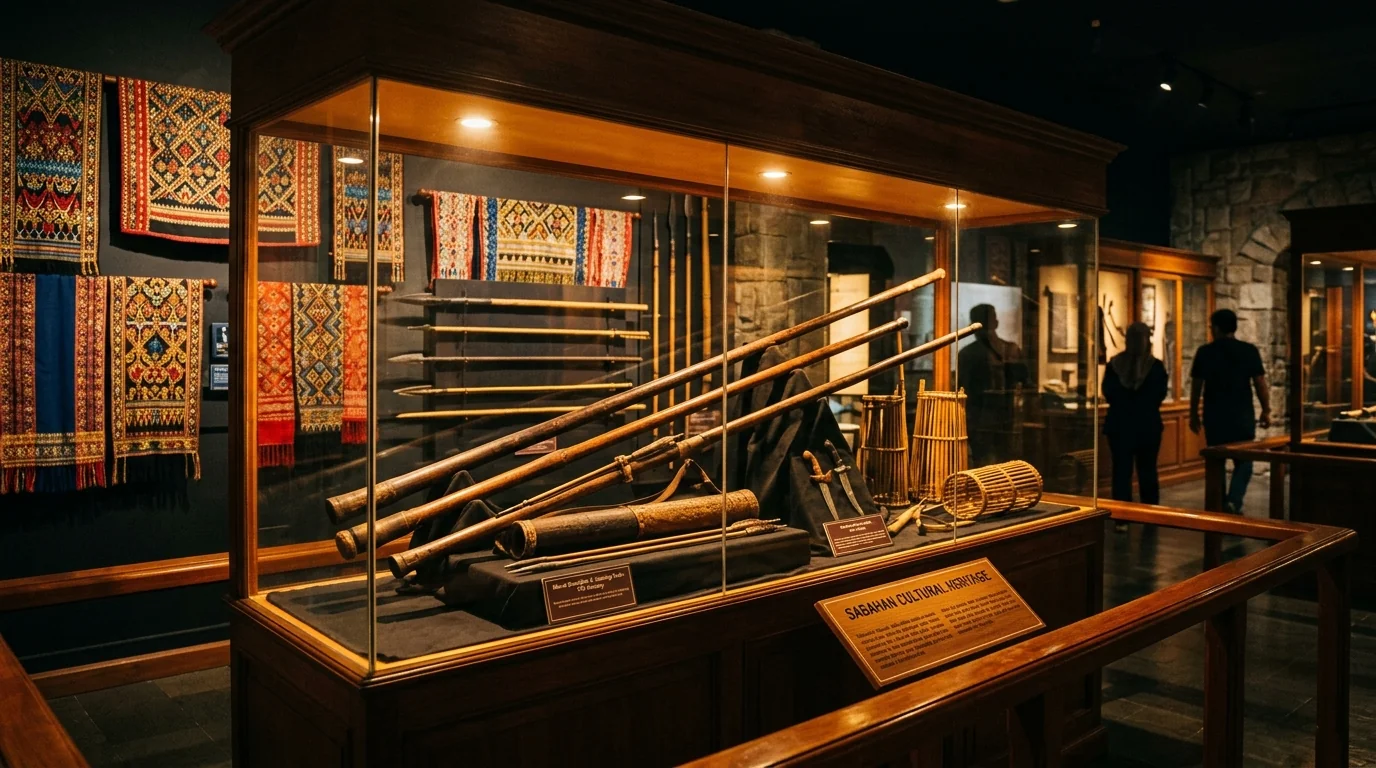
Muzium Warisan Keningau — Interior Sabah Heritage Museum
What is Muzium Warisan Keningau?
Muzium Warisan Keningau (Keningau Heritage Museum) is a branch of the Sabah State Museum system, established in the 1990s to document and preserve the history and culture of interior Sabah. While the flagship Sabah State Museum in Kota Kinabalu houses broader state collections, Muzium Warisan Keningau focuses specifically on the interior divisions: the Murut, Kadazan-Dusun, and Chinese communities who have shaped the region for centuries.
The museum is housed in a colonial-era building in Keningau town, a choice that itself carries historical weight. The building reflects the architectural heritage of the interior administration during the British period. Keningau, as a frontier town and gateway to the deep interior, was a strategic administrative centre, and the museum building is a relic of that colonial infrastructure.
Admission is free, making it an accessible cultural resource for residents and visitors alike. The museum is open Tuesday through Sunday, 9:00am to 5:00pm, closed Mondays and public holidays. Unlike large state museums, Muzium Warisan Keningau is intimate in scale—allowing visitors to explore collections at a personal pace without the overwhelming size of flagship institutions.
The museum serves both as a historical record and as a living cultural institution. Local school groups visit for cultural education, and heritage enthusiasts use it as a research resource. For many Murut, Kadazan-Dusun, and Chinese residents of the interior, it is a place where their ancestral heritage is formally recognised and preserved.
The Murut collections: blowpipes and cultural legacy
Keningau is located in the Murut heartland, and the museum reflects this regional identity strongly. The Murut—historically known as headhunters in colonial literature, though this characterisation is contested and oversimplified—developed a rich culture centred on hunting, agriculture, and warrior traditions. The museum houses significant artefacts documenting Murut life.
The most iconic Murut artefact is the sumpit (blowpipe). These are long, slender wooden tubes used for hunting small game and, historically, in inter-tribal conflicts. The museum holds several examples of traditional sumpit, some dating back over a century. The craftsmanship is evident: each blowpipe is hand-carved from specific wood species, weighted for accuracy, and often decorated with traditional motifs.
Accompanying the blowpipes are explanations of the poisoned darts (tepid) used with them. The Murut traditionally prepared a plant-based poison for hunting darts—a sophisticated ecological knowledge system. The museum documents this practice, though modern conservation regulations and cultural shifts mean traditional poison-dart hunting is now rare or non-existent among younger generations.
Beyond weapons, the Murut section includes traditional clothing, agricultural tools, and household items. Visitors can see traditional loincloth (lidi) worn by Murut men, women weavings, and the practical tools of upland agriculture—rice farming, fruit cultivation, and forest management. The overall picture is of a sophisticated society adapted to interior topography, not the stereotyped wild warriors of colonial propaganda.
The museum also contextualises Murut headhunting within its historical framework: inter-tribal territorial conflicts, spiritual beliefs about the nature of souls and warfare, and the role of headhunting as a coming-of-age practice and status symbol within Murut society. Modern ethical perspectives are presented alongside historical context, avoiding glorification while maintaining honesty about cultural practices.
Kadazan-Dusun heritage in the interior
While Kadazan-Dusun populations are more densely concentrated in coastal and lower-elevation areas, significant Kadazan-Dusun communities live in the interior divisions. The museum preserves this heritage, documenting Kadazan-Dusun language, agriculture, festivals, and spiritual beliefs as they manifest in the uplands.
Kadazan-Dusun agricultural tradition centres on rice cultivation, and the museum exhibits traditional rice farming tools, granary structures, and the annual harvest festival (Kaamatan). Exhibits explain the spiritual significance of rice in Kadazan-Dusun culture and the role of the rice goddess (Bambazon) in traditional beliefs. Though most Kadazan-Dusun today are Christian, these cultural and spiritual practices remain important to community identity.
The museum also features Kadazan-Dusun weaving, traditional clothing, and domestic crafts. Visitors can see intricate beadwork, traditional weavings (such as the lembayung cloth), and the practical items of rural Kadazan-Dusun life. This section contextualises Kadazan-Dusun presence in the interior as a major demographic and cultural force, not subordinate to the Murut narrative.
Chinese settler history and trade networks
A less visible but historically crucial community in interior Sabah are the Chinese. From the late 19th century onwards, Chinese traders, merchants, and eventually farmers settled in the interior, establishing trade networks and commercial enterprises. Keningau became a hub for this commerce, and the museum documents this historical presence.
The Chinese section of the museum includes trade documentation, photographs of early Chinese merchants and their shops, religious artefacts from Chinese temples and associations, and household items from Chinese settler families. Exhibits explain how Chinese networks connected interior Sabah to coastal trading posts, to British colonial administrators, and to broader Asian trade routes.
Chinese-language exhibits (often in traditional Chinese characters) honour the linguistic heritage of settlers, many of whom came from Guangdong (Cantonese), Fujian (Hokkien), and Hakka-speaking regions. Some exhibits include correspondence, business records, and photographs that illuminate Chinese-Murut or Chinese-Kadazan-Dusun cultural and economic interactions.
The Chinese community in interior Sabah, while smaller than coastal populations, played a disproportionately important role in commerce and infrastructure development. The museum recognises this contribution while also documenting the complex relationships—sometimes collaborative, sometimes competitive—between Chinese settlers and indigenous populations.
Why Keningau was the gateway to the interior
Geographically, Keningau sits at the crossroads between coastal Sabah and the deep interior highlands. It is accessible by road from Kota Kinabalu (approximately 100km inland), but it is also the jumping-off point for deeper interior regions like Tenom, Nabawan, and the upland zones.
During the British colonial period, Keningau was established as an administrative centre and military outpost. The British needed to administer interior populations and, more practically, to suppress piracy and headhunting that threatened trade. Keningau served as the administrative hub from which British officers could reach interior communities, make treaties, and enforce colonial authority.
The colonial-era building housing the museum is itself a reminder of this infrastructure. It represents the physical manifestation of British bureaucracy and control in a frontier region. Over time, as colonial rule solidified and inter-community conflicts decreased, Keningau transitioned from a military outpost to a trading and administrative centre.
The location of Muzium Warisan Keningau in the town thus makes sense: Keningau is the regional hub, and the museum serves interior communities and visitors as a repository of regional identity. The town continues to serve as a gateway—today, tourists and researchers heading to Tenom, Nabawan, or other interior sites often pass through Keningau and can access the museum.
How Muzium Warisan compares to the Sabah State Museum
The Sabah State Museum in Kota Kinabalu is the flagship institution, with larger collections covering the entire state: geology, archaeology, maritime history, natural history, and broad ethnographic exhibits. It serves a general audience and educational mandate.
Muzium Warisan Keningau is the inverse: smaller, regionally focused, and deeply specialised in interior communities. The comparison is not hierarchy (one bigger/better than the other), but complementarity. A visitor wanting comprehensive Sabah overview should visit the State Museum. A visitor interested in depth on Murut culture, interior heritage, or a specific region should visit Muzium Warisan Keningau.
The smaller scale of Muzium Warisan Keningau is an asset, not a limitation. It allows closer engagement with artefacts, more detailed contextual explanations, and often a more personal interaction with staff who are themselves from or deeply connected to interior communities. Many regional museums worldwide follow this model: smaller, locally-rooted institutions that complement larger state museums.
Visiting Keningau: combining heritage sites
A visit to Muzium Warisan Keningau is best combined with other interior Sabah attractions. Keningau town is small, and the museum visit takes 1.5 to 2 hours. To justify a day trip or overnight stay, consider pairing it with nearby sites.
Batu Sumpah (the Oath Stone) is located just outside Keningau town and is easily visited in the same day. The stone is a geographical and cultural landmark with a legend tied to Murut-British colonial relations. Combining the museum (cultural/educational context) with Batu Sumpah (experiential/legendary context) provides a rich interior heritage experience.
Tenom, approximately 30km from Keningau, is another natural pairing. Tenom is home to the Tenom Agricultural Park and serves as a gateway to deeper interior zones. A two-day interior itinerary might be: Day 1 — Keningau (museum + Batu Sumpah); Day 2 — Tenom (agricultural park + landscape exploration).
Visiting the interior divisions requires a vehicle (rental car, tour, or local transport). From Kota Kinabalu, drive inland for approximately 2-3 hours to reach Keningau. Road conditions are good, and the drive itself offers views of Sabah interior landscape—lowland forest transitioning to upland terrain, rivers, and agricultural zones.
| Interior Sabah Cultural Group | Language Family | Traditional Homeland | Key Cultural Traits |
|---|---|---|---|
| Murut | Austronesian (Murutic branch) | Upland interior (Keningau, Tenom, Nabawan) | Blowpipe hunting, headhunting tradition, upland rice farming, warrior culture |
| Kadazan-Dusun | Austronesian (Dusumic branch) | Highland and interior zones | Rice cultivation, Kaamatan festival, traditional weavings, Christian and traditional beliefs |
| Sungai (also called Lun Dayeh) | Austronesian | Upland Keningau and Tenom regions | Longhouse settlements, rice agriculture, weaving, shamanic traditions |
| Chinese settlers (Hakka, Cantonese, Hokkien) | Sino-Tibetan | Interior towns (Keningau, Tenom) and trading posts | Merchant trade, agriculture, temple associations, Chinese cultural festivals |
| Malay Muslims | Austronesian | Interior towns, administrative centres | Islamic faith, administration, commerce, integration into Malaysian state structures |