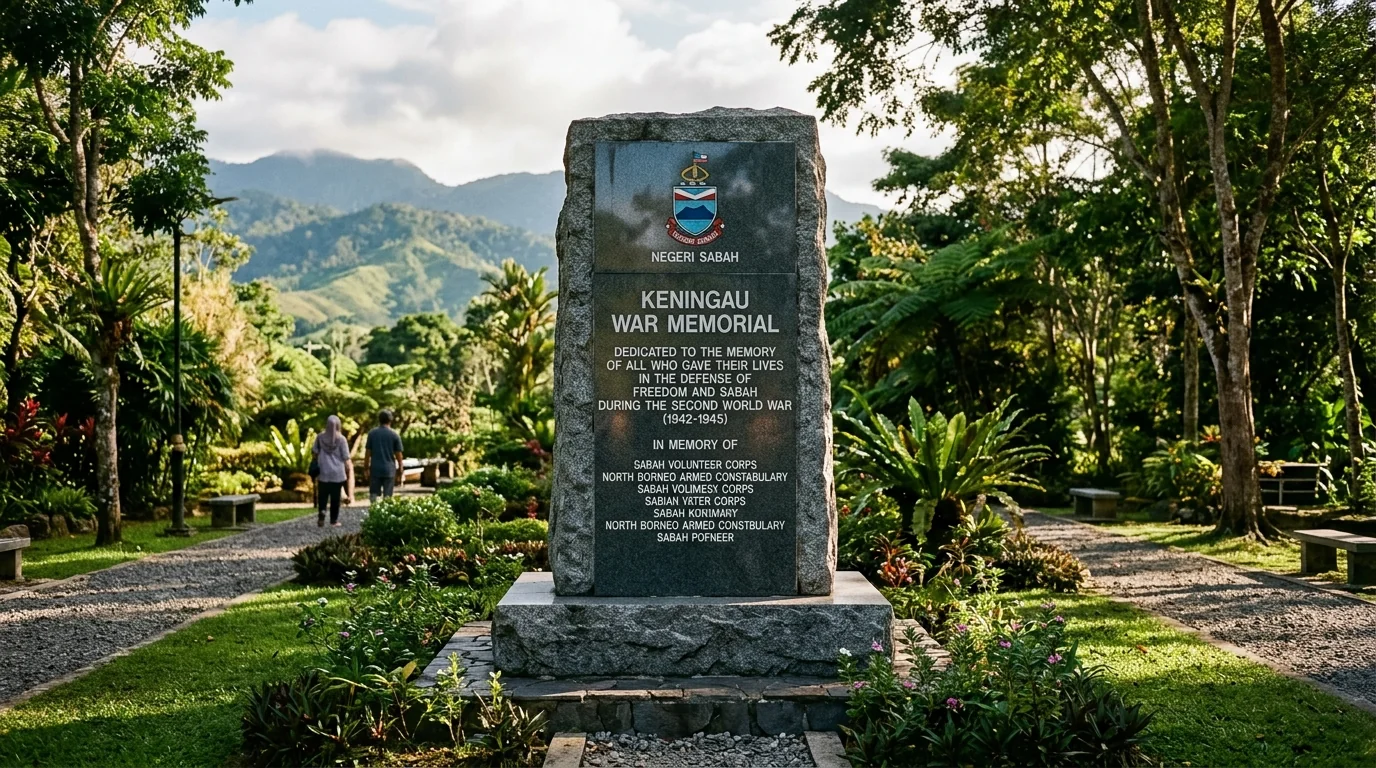
Keningau Oath Stone (Batu Sumpah) — Where Sabah's Leaders Swore to Join Malaysia
What is the Keningau Oath Stone?
The Keningau Oath Stone (Batu Sumpah) is a historical monument located in Keningau town square that marks the site where community and indigenous leaders from the interior of Sabah took a solemn oath in 1963 pledging support for the formation of Malaysia. The stone is one of Sabah's most politically and culturally significant monuments.
Keningau is in the interior of Sabah, the heartland of indigenous Sabahan peoples — the Murut, Dusun, and other groups. The oath was taken by village chiefs, community leaders, and local elders representing these communities. Their public commitment to Malaysia was symbolically important because it demonstrated that the grassroots populations of the interior — not just the colonial administration or coastal traders — supported Sabah joining the new federation.
The monument stands as a permanent physical reminder of this commitment. It is maintained as a state historical monument and is a point of pride for Keningau residents. The site is accessible to the public and is often visited by school groups, tourists, and historians interested in Sabah's path to independence and federation.
The Oath Stone is particularly significant in contemporary Sabah because it is invoked in political debates about Sabah autonomy and the rights guaranteed under the Malaysia Agreement 1963 (MA63). The stone is physical evidence that communities across Sabah consented to joining Malaysia, and this historical record is relevant to discussions about provincial rights and federal-state relationships.
What oath was taken and why?
In 1963, the British were preparing to grant independence to several colonial territories in Southeast Asia — Malaya had already gained independence in 1957, and now Sabah (then North Borneo), Sarawak, and Singapore were being prepared for self-government. The plan was to merge these territories into a new federation called Malaysia, with the Malay peninsula's Federation of Malaya as the core.
However, this merger was not a foregone conclusion. There was debate within Sabah about whether joining Malaysia was in the territory's best interests. Some leaders favored independence for Sabah alone, while others saw federation with Malaya as the path to security and economic development. The British colonial administration supported the Malaysia plan.
To demonstrate public consent for Malaysia among Sabah's diverse population, community leaders were asked to formally pledge their support. The oath taken at Keningau was one of these public commitments. Leaders swore that their communities supported the formation of Malaysia and would stand by this union.
The oath was symbolically important because Keningau was chosen as a location in the indigenous heartland. By having interior leaders take the oath, it demonstrated that Malaysia was not just a coastal or colonial project, but had the backing of interior indigenous communities — the Murut, Dusun, and other groups who had historically maintained independence and autonomy in the interior regions.
Why was Keningau chosen for this oath?
Keningau was chosen because of its symbolic and geographic importance. The town is located in the interior of Sabah, in the heartland of indigenous Sabahan populations. Keningau sits among communities of the Murut people, as well as other indigenous groups, making it a natural gathering place for interior leaders.
During the colonial period, interior Sabah had maintained a degree of autonomy and self-governance that coastal areas had lost to colonial administration. The interior peoples had their own leaders, their own customs, and their own systems of governance. By holding the oath ceremony in Keningau, the British and pro-Malaysia leaders were seeking validation from these autonomous communities.
Keningau was also chosen because it represented the diversity of Sabah. It was far enough inland to demonstrate support from truly interior populations, yet it was accessible enough for colonial officials and journalists to reach. The choice of location made a political statement: Malaysia was being formed not just by coastal elites, but with the consent of the interior peoples who had historically been most independent.
Additionally, Keningau was an established administrative center with infrastructure for hosting public gatherings. The town already had government buildings, schools, and meeting spaces that could accommodate the ceremony and the gathering of leaders from surrounding communities.
What was the Cobbold Commission?
The Cobbold Commission was a British inquiry led by Lord Cobbold that was sent to Sabah and Sarawak in 1962 to assess whether the population of these territories genuinely supported joining Malaysia. The Commission was meant to gauge public opinion and determine whether the Malaysia plan had sufficient support among the people.
The Cobbold Commission conducted surveys, held public meetings, and gathered testimony from leaders and community members across Sabah and Sarawak. The Commission's findings concluded that there was substantial public support for Malaysia, though this conclusion was debated at the time and has remained controversial among some Sabah historians and political figures.
The Oath Stone at Keningau can be understood as part of this broader process of demonstrating public support. The oath ceremony provided additional evidence that interior Sabah communities backed the Malaysia plan. The physical monument preserves this evidence for posterity.
The Cobbold Commission report was used by the British and Malaysian governments as justification for proceeding with the Malaysia formation. However, some argue that the Commission did not adequately canvas opposition voices or address concerns about Sabah autonomy and rights. These debates continue in Sabah political discourse today.
How does the oath stone fit into Malaysia's history?
Malaysia was formed on September 16, 1963, when Sabah, Sarawak, and Singapore joined the Federation of Malaya to create the new nation of Malaysia. This is now celebrated annually on Malaysia Day (September 16). The formation of Malaysia was a major geopolitical event that reshaped Southeast Asia.
The oath ceremony at Keningau was part of the run-up to Malaysia Day. It provided documentary and symbolic evidence that Sabah communities supported the federation. This was important in the context of Cold War geopolitics — British, Malaysian, and American officials wanted to demonstrate that Malaysia was formed through legitimate consent, not imposed by colonial fiat.
For Sabah itself, joining Malaysia meant the end of British colonial rule and the establishment of Sabah as a state within a larger federation. This was celebrated as a step toward self-determination and independence, though Sabah's relationship with Malaysia has remained contested in some quarters, particularly regarding the interpretation of the Malaysia Agreement and Sabah autonomy rights.
The Oath Stone preserves a record of how ordinary Sabahans participated in this historical moment. Rather than being a decision made only by elites in Kuala Lumpur or Jesselton, the oath ceremony at Keningau shows that grassroots communities across Sabah were engaged and voiced their support for the federation.
What is the stone significance in modern Sabah politics?
The Keningau Oath Stone has become a symbol in contemporary debates about Sabah autonomy and Sabah rights within the Malaysian federation. The Malaysia Agreement 1963 (MA63) granted certain powers to Sabah and Sarawak that are distinct from the powers held by other Malaysian states. These include control over immigration, land, and certain resource rights.
Political figures, historians, and civil society groups in Sabah sometimes invoke the Oath Stone as evidence of the social contract that was made in 1963. The argument is that Sabah communities, represented by their leaders at Keningau and elsewhere, agreed to join Malaysia on specific terms and with specific protections — the terms codified in MA63. The stone thus serves as a reminder that this agreement was made with the consent of the people.
When disputes arise about federal-state relations or the interpretation of MA63, the Oath Stone may be referenced as a symbol of Sabah commitment to Malaysia, but also as a marker of the negotiated terms under which that commitment was made. Some political voices argue that federal authorities have not always honored the spirit or letter of MA63, and the stone thus becomes a symbol of those grievances as well.
The stone is particularly invoked during Malaysia Day celebrations in Sabah, where political leaders and civil society figures reaffirm commitment to Malaysia while also calling for greater respect for MA63 and Sabah rights. The monument thus carries both cooperative and assertive meanings in contemporary politics.
How do you visit Keningau and the Oath Stone?
Keningau is located in the interior of Sabah, approximately 90 kilometers from Kota Kinabalu by road. The drive takes about 90 minutes from KK via the Tambunan road, passing through rural and agricultural areas. The landscape becomes increasingly mountainous as you move into the interior.
You can reach Keningau by rental car, taxi, or minibus from Kota Kinabalu. Several minibus services operate between KK and Keningau daily. The journey is scenic, passing through Sabah's agricultural heartland and offering views of interior mountains and landscapes.
The Oath Stone monument is located in Keningau town square area, in the central part of town. It is accessible 24 hours and there is no entry fee. The site is maintained by local authorities and is easily found if you ask locals for Batu Sumpah or the Oath Stone.
Plan to spend 30 minutes to an hour at the stone itself. To make the most of a Keningau visit, combine it with the Muzium Warisan Keningau (Heritage Museum), which houses exhibits on local indigenous history and culture. The museum provides context for understanding the oath stone and Keningau's significance in Sabah's history.
Other nearby attractions include Tenom (about an hour away) with its tea plantations, heritage railway, and scenic views. Beaufort, another historical town, is about 90 minutes away and is worth a visit for its colonial history and Beaufort-Tenom Railway heritage.
Accommodations in Keningau range from budget guesthouses to mid-range hotels. The town has restaurants serving local and Malaysian cuisine. Local guides are available if you want deeper context on Keningau history and indigenous culture.
| Date | Event | Location | Significance |
|---|---|---|---|
| 1962 | Cobbold Commission visits Sabah and Sarawak | Multiple locations including Sabah interior | British inquiry to assess public support for Malaysia |
| 1963 (before Sept 16) | Oath taken at Keningau by community leaders | Keningau town square area | Grassroots community pledge of support for Malaysia formation |
| September 16, 1963 | Malaysia is formed | Federation of Malaya, Sabah, Sarawak, Singapore unite | Sabah formally joins Malaysia — end of British colonial rule |
| 1963 | Oath Stone monument erected | Keningau | Permanent memorial to the 1963 oath ceremony |
| August 9, 1965 | Singapore leaves Malaysia | Federation of Malaya | Malaysia becomes federation of 13 states (down from 14) |