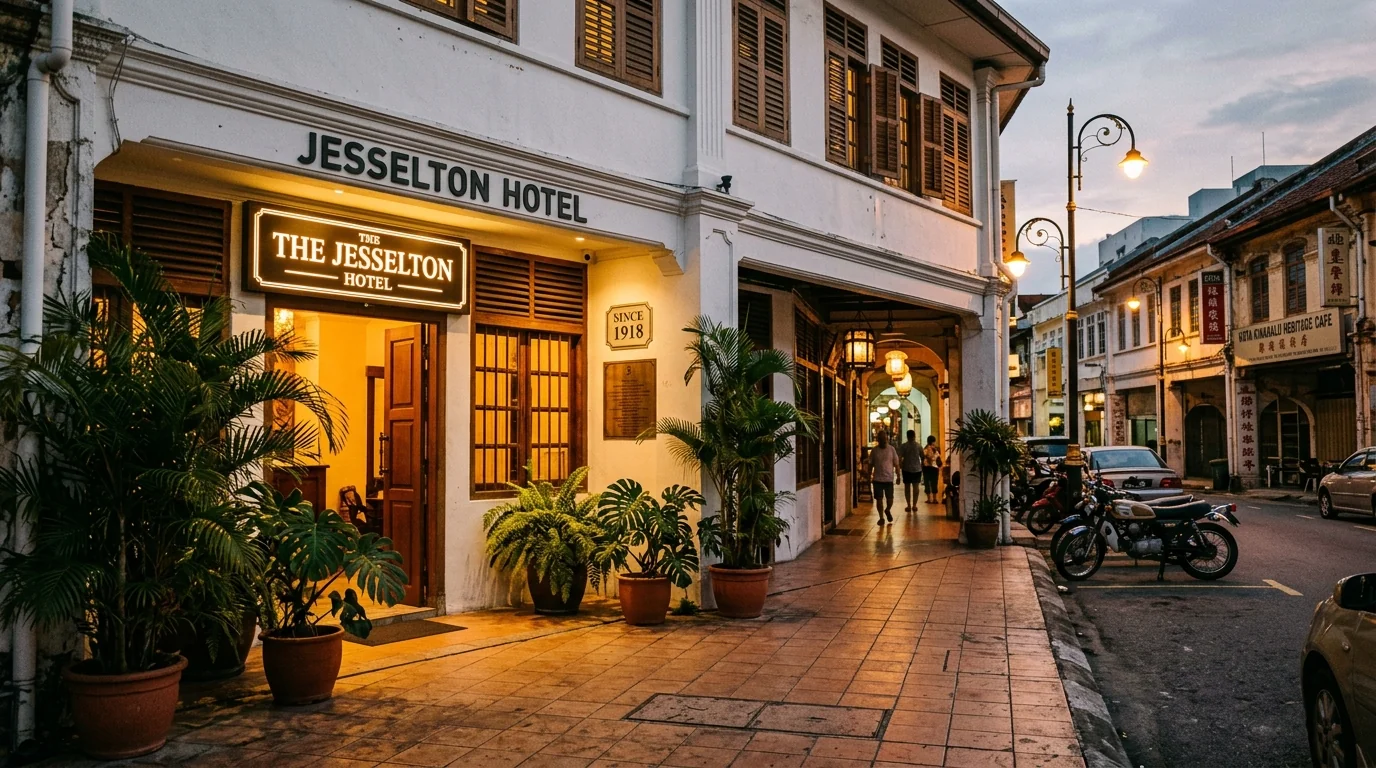
Jesselton Hotel — Kota Kinabalu's Oldest Operating Heritage Hotel (Est. 1954)
What is the Jesselton Hotel?
The Jesselton Hotel is a boutique heritage hotel located at 69 Jalan Gaya in central Kota Kinabalu. Established in 1954, it is the oldest continually operating hotel in Sabah and one of the few buildings that evoke the colonial and immediate post-war era of Kota Kinabalu. Unlike modern high-rise hotels with hundreds of rooms, the Jesselton Hotel maintains an intimate scale with around 30 rooms, colonial-era design, and a strong emphasis on personalised service and historical authenticity.
The hotel sits at the heart of the Jalan Gaya heritage precinct, a street lined with restored 19th- and early 20th-century shophouses. This positioning makes it not just a place to stay, but a living connection to Kota Kinabalu heritage. The ground floor hosts a restaurant and cafe serving Malaysian, Asian, and Western cuisine, and the lobby itself is filled with period furnishings, photographs, and memorabilia documenting KK's transformation from post-war backwater to modern capital.
For visitors, staying at or dining in the Jesselton Hotel is a deliberate choice to experience Kota Kinabalu through a historical lens rather than a contemporary one. It appeals to heritage enthusiasts, writers, diplomats, historians, and travellers seeking atmosphere over amenity.
Why the name Jesselton?
Kota Kinabalu was known as Jesselton during the British colonial period. The name was given by the British North Borneo Chartered Company (BNCC), which ruled the territory from 1881 onwards. Jesselton is believed to be derived from Sir George Jesselton, a financier and administrator associated with the BNCC, though historical sources on the exact etymology vary.
Under BNCC rule, the settlement grew from a small trading post into a formal colonial town with administrative buildings, a harbour, and merchant operations. The BNCC named it Jesselton as a way to formalise the emerging capital. From the 1880s until 1968, Jesselton was the official name of the town.
In 1968, just years after Malaysian independence, the town was renamed Kota Kinabalu—a name referencing Mount Kinabalu, Sabah's most iconic natural landmark. Kota means fort or city in Malay, so the new name translates loosely to Fort Kinabalu or City of Kinabalu. The name change reflected a post-colonial assertion of local and Malaysian identity.
The hotel retained the historical name Jesselton as a deliberate tribute to that colonial heritage. Today, calling it the Jesselton Hotel anchors visitors in Sabah history and signals the proprietors' commitment to preservation and memory.
A century of colonial and post-war heritage
The Jesselton Hotel was built in 1954, not long after World War II. This timing is crucial to understanding its historical significance. During WWII, Kota Kinabalu (then Jesselton) was bombed extensively by the Allies. Japanese occupation from 1942-1945 left the town in ruins. Most colonial-era buildings were destroyed, and the survivors were damaged beyond immediate use.
The post-war period, from 1945 onwards, was marked by reconstruction. The British returned, and Sabah was re-established as a British territory. A new generation of traders, administrators, and settlers arrived to rebuild. Into this optimistic reconstruction era, the Jesselton Hotel was founded in 1954. It represented confidence in Sabah growth, a desire to welcome visitors and businesses, and a statement that Kota Kinabalu was becoming a modern colonial administrative centre once again.
The hotel thus carries the memory of two eras: the pre-war colonial period (through its name and architectural reference) and the post-war reconstruction period (through its founding and operation). It serves as a bridge between these chapters of Sabah history.
As the years progressed through the 1960s and 1970s, the Jesselton Hotel remained a hub for government officials, visiting dignitaries, and business travellers. It witnessed Sabah transition from a British territory to an independent state (1963) and then to a component of Malaysia. This makes the hotel not merely a commercial enterprise, but a historical witness to Sabah sovereignty and identity-building.
How did the hotel survive modernisation?
Many heritage buildings in Sabah were demolished to make way for modern high-rises, shopping malls, and contemporary infrastructure. Between the 1980s and 2010s, Kota Kinabalu experienced rapid urban development. Land values on Jalan Gaya skyrocketed, and developers eyed heritage properties as prime real estate for modern redevelopment.
The Jesselton Hotel survived for several reasons. First, its proprietors—who have stewarded the hotel as a family or long-term business—chose heritage preservation over short-term profit from land sale. This decision prioritised cultural and historical value over commercial maximisation. Second, the Sabah state government and heritage advocates began recognising the cultural significance of Jalan Gaya and its shophouses. This created community and official pressure to preserve rather than demolish. Third, the hotel itself remains profitable as a boutique heritage property, catering to a niche but dedicated market of heritage-conscious travellers.
While the hotel has undergone maintenance and modernisation of utilities (electrical, plumbing, safety systems), it has resisted wholesale architectural overhaul. The facades, interior layouts, and period design remain largely faithful to the original mid-century colonial aesthetic. This balance—maintaining heritage authenticity while meeting modern hospitality standards—is what distinguishes the Jesselton Hotel.
In recent years, there has been renewed interest in heritage preservation across Sabah. The Jalan Gaya Heritage Precinct is now actively protected, and the Jesselton Hotel is widely acknowledged as a flagship heritage property. This cultural shift has reinforced the hotel proprietors' original commitment to preservation.
The restaurant and colonial ambience
The Jesselton Hotel restaurant and cafe are open to the public and serve as an extension of the hotel heritage experience. The dining spaces retain colonial-era decor: wooden beams, period lighting, vintage photographs documenting Sabah history, and antique furnishings. The atmosphere evokes 1950s-1970s colonial hospitality—unhurried, personal, and steeped in place.
The menu reflects Kota Kinabalu culinary tradition, blending Malay, Chinese, and Western dishes. Afternoon tea service is a particular highlight, invoking British colonial traditions of the era when Jesselton was the administrative capital. Visitors can sit in the restaurant or cafe, order a meal or beverage, and absorb the historical ambience without commitment to an overnight stay.
The restaurant also serves as a gathering place for locals—government workers, heritage enthusiasts, historians, and long-time KK residents who return for nostalgia and a sense of connection to their city past. This local usage is important; it prevents the hotel from becoming merely a tourist attraction and keeps it embedded in genuine community life.
For many visitors, a meal at the Jesselton Hotel is less about the cuisine (though the food is good) and more about the sensory and emotional experience of inhabiting a space that feels authentically rooted in Sabah history.
Jalan Gaya and the heritage precinct
Jalan Gaya is not just a street; it is a corridor of Kota Kinabalu history. Named after Thomas Gaya, an early colonial administrator, the street is lined with shophouses built in the late 19th and early 20th centuries. These shophouses originally housed merchants, traders, and service providers who formed the commercial spine of colonial Jesselton. Chinese merchants were particularly prominent on Jalan Gaya, dealing in rubber, timber, and general trade goods.
Many of these shophouses were damaged or destroyed during WWII bombing. Those that survived were restored after the war. In recent decades, heritage advocates and the Sabah state government have invested in systematic restoration of Jalan Gaya shophouses, turning the street into a living museum of colonial-era architecture.
Today, Jalan Gaya hosts a Sunday Market—a weekend phenomenon where the street transforms into a bazaar of craft vendors, food stalls, antique dealers, and artisans. This weekly activation reinforces Jalan Gaya not as a museum piece, but as a functioning, vital part of Kota Kinabalu culture. The Jesselton Hotel sits within this precinct, and guests or visitors benefit from proximity to this cultural ecosystem.
Walking distance from the hotel are other heritage landmarks: Padang Merdeka (the independence square where Sabah declared alignment with Malaysia in 1963), the Atkinson Clock Tower (built 1905), and various heritage shophouses now converted to art galleries, cafes, and boutiques. This concentration of historical sites makes Jalan Gaya the most heritage-dense area of Kota Kinabalu.
How does Jesselton Hotel compare to modern KK hotels?
Kota Kinabalu today hosts dozens of hotels, from international chains to contemporary budget options. The Jesselton Hotel occupies a niche—not by accident, but by design. The table below contrasts the Jesselton Hotel with typical modern KK hotels:
| Category | Jesselton Hotel | Modern KK Hotels (Chain / Contemporary) |
|---|---|---|
| Rooms | ~30, colonial-style, small-to-medium | 150-500+, standardised, spacious |
| Architecture | Mid-century colonial, heritage shophouse | Modern concrete, glass, steel high-rise |
| Price Range | RM150-300/night (approximate) | RM100-400+/night depending on tier |
| Atmosphere | Personal, quiet, time-displaced, intimate | Professional, busy, contemporary, efficient |
| Service Model | Personal, concierge-style, staff know guests | Professional but transactional |
| Heritage Value | High—building is a historical document | None—contemporary build |
| Location Appeal | City heritage precinct (Jalan Gaya) | Waterfront, business district, airport corridor |
| Target Guest | Heritage seekers, historians, writers, seekers of authenticity | Business travellers, convenience-focused tourists |
| Dining | On-site restaurant with heritage ambience | Multiple on-site options or nearby chains |
| Fitness / Modern Amenities | Limited—no gym, basic facilities | Full—gym, pool, spa, business centre |
Neither is objectively superior; they serve different traveller profiles. The Jesselton Hotel competes not on luxury or amenity, but on authenticity and cultural immersion. A guest choosing the Jesselton Hotel is making a statement: "I want to understand Kota Kinabalu through its past, not escape into contemporary convenience."