Fall of Jesselton 1941 — How Japan Conquered British North Borneo in Days
What was Jesselton like before the war?
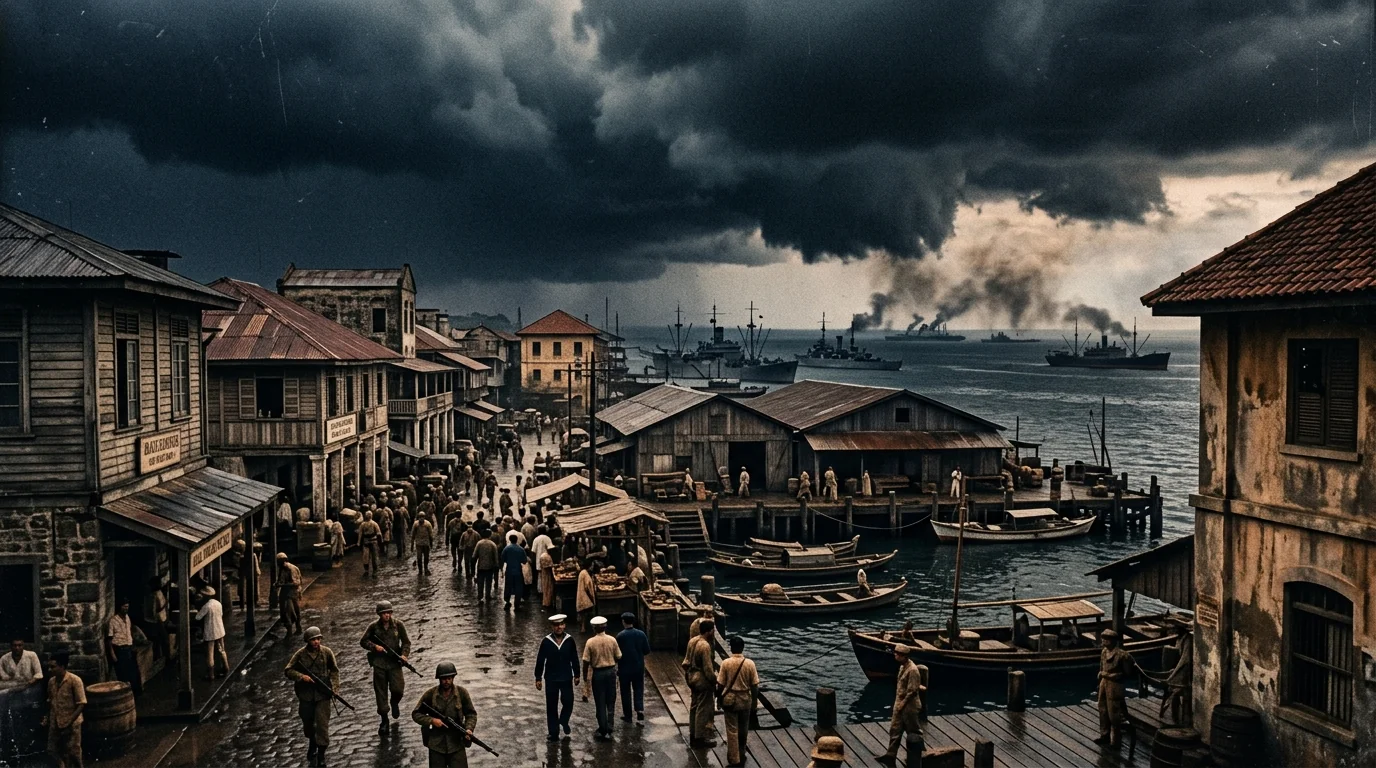
Jesselton in 1941 was a sleepy colonial town of a few thousand people. It was the capital of British North Borneo, administered by the British North Borneo Chartered Company. The town had a small port where trading ships and government vessels anchored. A few colonial buildings—government offices, the residence of the BNCC Governor, a church—gave the town administrative importance despite its small size.
Life in Jesselton was quiet and colonial. European administrators and their families lived comfortable lives, attended by servants. Chinese and indigenous traders conducted commerce through the port. A small garrison of British soldiers and BNCC police maintained order. Schools, hospitals, and other institutions were minimal.
Jesselton was geographically isolated. Ships provided the only reliable transportation. No roads connected Jesselton to other major towns. No railway existed. Communication with the rest of the world was by radio or courier. This isolation meant Jesselton was strategically vulnerable—if a maritime power attacked, the town could not easily receive reinforcements or supplies.
The town was not militarized. There were no military barracks, no munitions factories, no strategic installations. The small Volunteer Force garrison was lightly armed. There were no coastal defence batteries, no anti-ship guns, no naval vessels stationed permanently in port. Jesselton existed as a civilian colonial administrative center with minimal military presence.
In late 1941, with war raging in Europe and Japanese expansion occurring in Asia, Jesselton residents were aware of distant threats. However, the town felt remote and safe. Some officials and residents discussed evacuating, but evacuation was difficult and many chose to stay. Few anticipated that Japanese forces would arrive within days of the attack on Pearl Harbour.
Why was British North Borneo unprepared for war?
British North Borneo was unprepared for war for several reasons. First, North Borneo was seen as a minor and remote territory. The British Empire focused military resources on defending strategic areas—India, Egypt, Singapore, Malaya. North Borneo was peripheral. The Colonial Office did not allocate significant resources for military infrastructure.
Second, the BNCC was a commercial company with limited military capacity. While the BNCC maintained a small armed force for maintaining internal order, this force was not trained or equipped for warfare against a professional military. The BNCC could not sustain military operations against Japan.
Third, Britain was focused on the European theatre in late 1941. Hitler was attacking the Soviet Union. Britain was fighting in North Africa. Military resources were stretched thin. The Far East, including North Borneo, was considered a secondary theatre.
Fourth, some British leaders believed Japan would not attack European colonial territories or did not anticipate how quickly Japan would move. When Japan did attack, the speed and scale of operations exceeded British expectations.
Fifth, Singapore, which was supposed to be the bastion of British power in the Far East, was poorly defended and fell to Japanese forces within days. This meant that North Borneo could not rely on Singapore for protection. Once Singapore fell, North Borneo was isolated.
How did Japan attack British Borneo?
Japan attack on the Far East began on December 7, 1941, with the bombing of Pearl Harbour. On the same day, Japanese forces also attacked British Malaya, Thailand, and other targets across Southeast Asia. The attacks were coordinated and overwhelming.
In Borneo, Japanese forces launched air raids on oil fields and ports in Sarawak starting December 8. The oil fields at Miri and Seria in Sarawak were targets of Japanese bombing. These raids destroyed oil infrastructure and made clear that Japan was not merely striking at American or British military targets but was attempting to seize territorial control of Borneo.
Japanese military forces began amphibious landings at Miri and Seria in Sarawak in early December. Local British forces offered minimal resistance. Within days, Japanese forces had secured these positions. The Japanese then moved on to Labuan Island and prepared to advance into North Borneo.
By early January 1942, Japanese forces were approaching Jesselton. The British North Borneo Volunteer Force received orders to prepare defensive positions but was hopelessly outnumbered. Evacuation plans were made for some civilians and officials, but evacuation was difficult and incomplete.
What happened when Japanese forces reached Jesselton?
Japanese military forces landed at Jesselton on January 10, 1942. The landing was not opposed by any significant military force. The British North Borneo Volunteer Force, numbering perhaps a few hundred, could not meaningfully resist thousands of Japanese troops with air and naval support.
British officials decided that resistance would be futile and would only result in unnecessary deaths and destruction. Governor Frank Bevan and the British military commander authorized surrender. White flags were raised. Japanese forces entered the town without fierce fighting.
However, there was not a formal ceremony of surrender. Instead, Japanese military forces simply took control. British officials and soldiers were captured. The town was placed under Japanese military administration. Civilians were told to remain in their homes.
The fall of Jesselton was surprisingly quick. From initial Japanese landings to Japanese control of the town took only a few days. There was no heroic last stand, no prolonged siege. Jesselton fell to superior force with minimal military resistance.
Once in control of Jesselton, Japanese forces began consolidating power. The port was put to military use. Government buildings were converted to military administration. Prisoners were placed in internment camps. The Japanese military declared martial law and established a military government in North Borneo.
What did Japanese occupation mean for Sabah?
Japanese occupation of North Borneo lasted from 1942 to 1945. The occupation was administered by the Japanese military. Civilian authority was suspended. Japanese military courts administered justice. The economy was controlled by the Japanese military.
Occupation meant severe hardship for civilians. Food was rationed and often scarce. Rice and other staples were requisitioned for the military. Civilians were sometimes impressed into forced labour to build military installations or work in mines and quarries. Disease spread due to malnutrition and poor living conditions. Mortality rates, particularly among children, increased.
The Japanese established a harsh system of censorship and control. Free speech was prohibited. Gatherings were restricted. Suspected opponents of Japanese rule were imprisoned, tortured, or executed. The Thought Police (Kempeitai) conducted surveillance and suppressed dissent.
The Japanese also recruited some Sabahans for military service and labour. Some Sabahans collaborated with the Japanese occupation, either by necessity or choice. Others resisted covertly or participated in armed rebellion.
For the small European population in North Borneo—perhaps a few thousand—occupation meant internment. British officials, missionaries, traders, and their families were placed in internment camps. Conditions were harsh. Some died from mistreatment, disease, or malnutrition.
The occupation disrupted normal commerce and agriculture. Traditional trade routes were severed. Markets were closed or controlled. Farming was disrupted. The economy collapsed. Sabahans subsisted at near-starvation levels.
| Date | Event | Location |
|---|---|---|
| December 7, 1941 | Japan attacks Pearl Harbour; war begins in Far East | Pacific / Asia |
| December 8, 1941 | Japanese bombing of Sarawak oil fields begins | Miri, Seria |
| December 10-15, 1941 | Japanese landings in Sarawak, British forces retreat | Miri, Seria, Sarawak |
| January 1942 | Japanese forces move toward Labuan and Jesselton | Northern Borneo |
| January 10, 1942 | Japanese forces land at Jesselton; British surrender | Jesselton (Kota Kinabalu) |
| January-February 1942 | Japanese complete conquest of North Borneo and Sarawak | All Borneo |
| 1942-1945 | Japanese military occupation; civilian hardship, forced labour | North Borneo and Sarawak |
| August 1945 | Japan surrenders; Australian forces prepare liberation | Borneo |
| September 1945 | Australian forces reach Sabah; occupation ends | North Borneo |
What resistance movements emerged during occupation?
Some resistance to Japanese occupation occurred, though it was limited and eventually suppressed. The most famous resistance movement was the Jesselton Revolt of 1943. A group of Sabah residents, including some who had been recruited by the Japanese military, rebelled against Japanese rule. The revolt was led by individuals including one named Yamagata (whose exact identity remains debated). The revolt was discovered, suppressed by Japanese forces, and the leaders were executed.
Apart from organized revolt, covert resistance occurred. Some Sabahans harboured Allied escapees or provided intelligence to the Allies. Underground networks existed to help people evade Japanese control. However, the Japanese security apparatus was effective in suppressing these activities. Those caught aiding the Allies faced harsh punishment.
Additionally, thousands of Allied prisoners of war were held in camps throughout Borneo, including the notorious Sandakan camp in Sabah. Prisoners endured appalling conditions and forced labour. In 1945, when Japanese forces were withdrawing under pressure from advancing Australian forces, they force-marched prisoners from Sandakan in an attempt to move them to other locations. Thousands died during the Sandakan Death Marches—one of the war worst atrocities.
There was also cultural and spiritual resistance. Churches continued to operate covertly. Sabah indigenous groups maintained traditional practices despite Japanese suppression. Religious and community leaders provided spiritual comfort and hope. However, these were forms of cultural survival rather than military resistance.
How did the war end in Sabah?
By mid-1945, Japan was losing the war. American forces were advancing across the Pacific. The Soviet Union entered the war against Japan. Japan military was weakening. In North Borneo, Japanese forces were increasingly isolated and low on supplies.
In August 1945, Japan surrendered. The Japanese military in Borneo was ordered to cease fighting. However, in some locations, Japanese commanders initially refused to accept orders to surrender and continued fighting briefly. Australian forces were advancing from the south and preparing to liberate Borneo.
Australian forces launched Operation Oboe—the liberation of Borneo. Australian troops landed at various points in Sabah and Sarawak in late August and September 1945. There was some fighting as Japanese units resisted, but Japanese forces were weak and resistance quickly crumbled. By September 1945, Australian forces had secured Sabah and Sarawak.
The liberation was chaotic. Civilians were suffering from three years of occupation, malnutrition, and disease. Many had died. The economy was in ruins. Jesselton town was heavily damaged by bombing and shelling. Reconstruction would be long and difficult.
After liberation, the territory came under Australian military administration briefly, then was transferred back to British authority. In 1946, North Borneo was declared a British Crown Colony. The BNCC ceased to exist as a governing entity. British direct rule replaced BNCC governance.
The occupation had lasting impacts on Sabah. Many Sabahans had lost family members or endured hardship. The experience of Japanese rule reinforced desire for self-determination and autonomy. When Malaysia was proposed in 1963, Sabahans negotiated MA63 partly based on memory of foreign rule and desire to preserve local control.