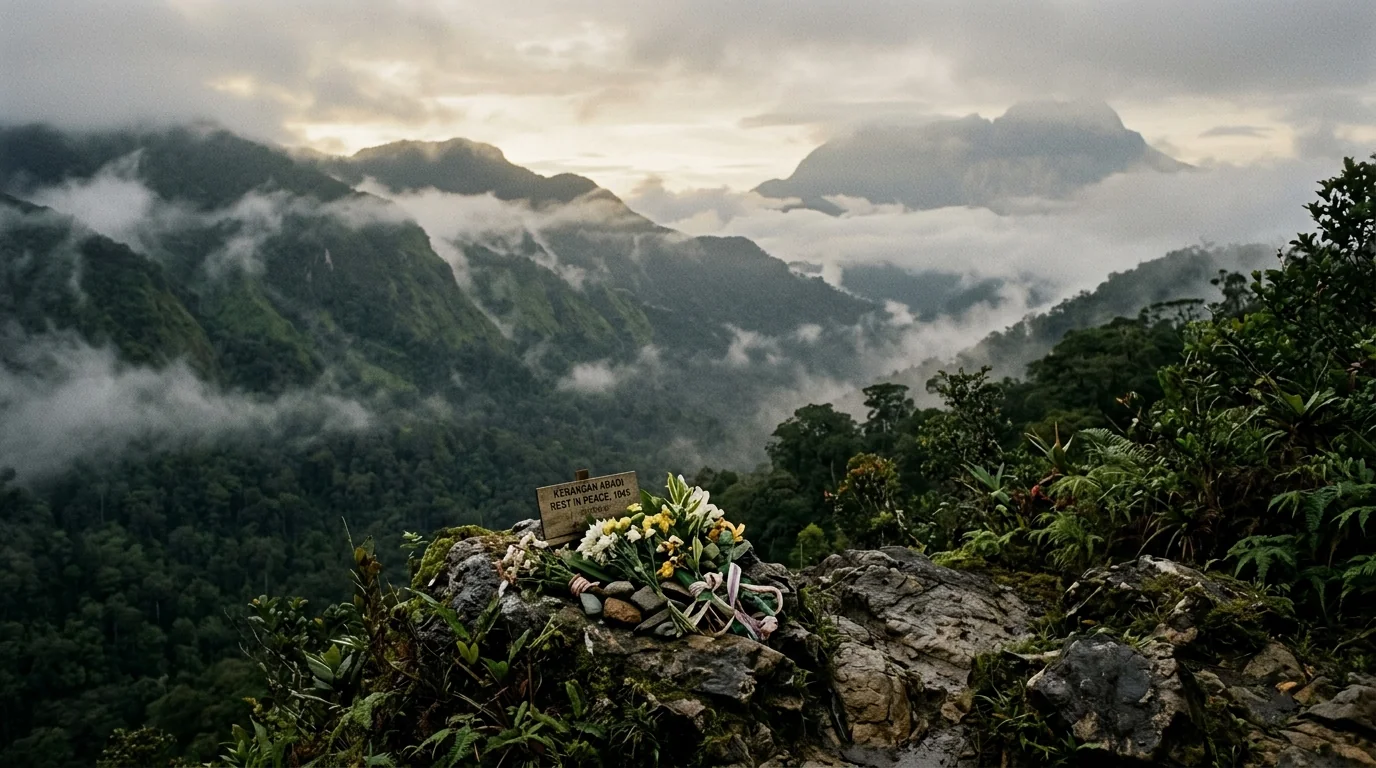
The Double Six Disaster (1976): The Day Sabah Lost Its Leaders
What was the Double Six Disaster?
On 6 June 1976, Malaysian Airline System (MAS) Flight FY 544, a Fokker F27 Friendship turboprop aircraft, crashed shortly after takeoff from Kota Kinabalu Airport. All 10 people aboard perished in the accident. The crash occurred near Sembulan, in the outskirts of Kota Kinabalu, in bad weather conditions with limited visibility.
What made this crash catastrophic was not merely the death toll, but the identities of the victims. The aircraft carried Sabah's Chief Minister, Tun Fuad Stephens, along with five of his eight cabinet ministers, the State Secretary, and several family members. In a single moment, most of Sabah's political leadership was wiped out. The disaster left the state government in crisis, without a chief minister and with most senior leadership dead.
The date—6 June, or 6/6—gave the disaster its name. "Double Six" became a shorthand for one of the most tragic events in Sabah's modern history. The memorial observance of Double Six Day on June 6th has become an annual occasion for Sabahans to reflect on the disaster and remember the leaders who were lost.
The Double Six Disaster stands as Sabah's worst political tragedy. Unlike natural disasters or wars that kill many people, this crash killed the specific individuals who held the state's highest offices, creating an unprecedented leadership vacuum at a critical moment in Sabah's post-independence development.
Who was Tun Fuad Stephens?
Tun Fuad Stephens (born Donald Stephens, later converted to Islam) was Sabah's founding father and the first Chief Minister of Sabah. He was the primary architect of Sabah's entry into Malaysia as a sovereign partner state, not as a colonial territory handed to the Malaysian federation.
Tun Fuad Stephens led the negotiations for the Malaysia Agreement 1963 (MA63), which established the terms under which Sabah, along with Sarawak and the territories of Singapore, joined the Federation of Malaya to form Malaysia. Unlike other regions that were incorporated into Malaysia through colonial arrangements, Sabah negotiated entry as an equal partner state. Tun Fuad insisted on protecting Sabah's rights to control its own education, immigration, and internal security—protections that remain enshrined in Malaysia's constitution and are known as the Sabah safeguards under MA63.
As first Chief Minister (1963–1964), Tun Fuad established Sabah's post-independence government and began the difficult work of building state institutions, developing infrastructure, and establishing Sabah's identity within Malaysia. He then stepped down from leadership for a period but returned to politics, ultimately winning re-election and returning to the office of Chief Minister in 1976—the moment of the Double Six crash.
Tun Fuad Stephens was not merely a political leader; he was a statesman who understood that Sabah's future depended on asserting its dignity and protecting its constitutional rights. His conversion from Christianity (as Donald Stephens) to Islam reflected his commitment to building unity and legitimacy within Malaysia's Muslim-majority political framework. In death, he became even more symbolically important—a martyr whose commitment to Sabah was commemorated and honored across the state and nation.
What happened on 6 June 1976?
The morning of 6 June 1976 was a normal day in Kota Kinabalu, the capital of Sabah. Chief Minister Tun Fuad Stephens was scheduled to fly to Kuala Lumpur (Malaysia's capital) along with several cabinet ministers and state officials. The group included some of the highest-ranking government officials and the families of some officials.
MAS Flight FY 544 boarded at Kota Kinabalu Airport. The aircraft was a Fokker F27 Friendship, a twin-engine turboprop designed for regional routes. Weather conditions in the area that day were poor—visibility was limited, and storms were affecting the region. Despite these conditions, the aircraft received clearance for departure.
The Fokker F27 took off from Kota Kinabalu Airport, but shortly after becoming airborne, the aircraft entered difficult weather. Eyewitness accounts describe the aircraft struggling against wind and rain. The plane lost altitude rapidly and crashed near Sembulan, a village on the outskirts of Kota Kinabalu, just minutes after takeoff. The crash was violent and sudden—there was no emergency landing or controlled descent. All passengers and crew died in the immediate impact.
News of the crash spread quickly through Kota Kinabalu and then throughout Sabah and Malaysia. As the identities of the victims became known—Chief Minister, cabinet ministers, state officials—shock and grief engulfed the state. Sabah's entire political leadership structure had been severed in a single moment. The state was left without a chief minister, without most of its cabinet, and without clear succession plans for this unprecedented crisis.
Who were the victims of the crash?
All 10 people aboard MAS Flight FY 544 perished in the crash. While most were identified as senior government officials and their family members, the complete manifest reflected Sabah's political elite of 1976.
Tun Fuad Stephens was the Chief Minister and primary victim whose death made this a national tragedy rather than a regional air disaster. His death represented the loss of Sabah's founding political father and the architect of MA63.
Five cabinet ministers were among the victims, constituting more than half of Sabah's cabinet. While exact names require verification from official records, the cabinet-level deaths included key ministers responsible for major portfolios including agriculture, development, and administration. The loss of this many senior ministers simultaneously devastated the government's operational capacity.
State Secretary — the top civil servant in Sabah's government—was also killed. The State Secretary serves as the permanent head of the civil service and is essential to government operations. His death disrupted the continuity of institutional memory and administrative function.
Family members and associates made up the remainder of the victims. Some officials' spouses and family members were traveling with them, adding a personal tragedy dimension to the political catastrophe.
| Position | Role in Sabah Government | Significance to State |
|---|---|---|
| Chief Minister | Head of state government, chief executive, supreme political authority | Architect of Sabah's entry into Malaysia under MA63; created the safeguards protecting Sabah's rights |
| Cabinet Ministers (5 total) | Heads of state government departments and policy portfolios | Responsible for implementing state development policies, managing major government functions |
| State Secretary | Permanent head of civil service; chief administrator of government operations | Essential to continuity of government function; keeper of institutional procedures and memory |
| Family members and associates | Accompanying government officials on official travel | Added personal tragedy dimension; widows and family members left grieving |
What caused the Double Six plane crash?
The official investigation into the Double Six Disaster was inconclusive. No single definitive cause was established, despite investigation efforts by Malaysian aviation authorities. This lack of clear answers has been a source of frustration and speculation for nearly 50 years.
Weather factors were significant. Sabah was experiencing poor flying conditions on 6 June 1976, with limited visibility, cloud cover, and storms affecting the region. These conditions made flying hazardous and challenging for pilots. The Fokker F27, while a capable regional aircraft, was vulnerable to severe weather, and the combination of poor visibility and wind conditions may have contributed to the crash.
Possible instrument malfunction was investigated as a potential cause. The aircraft's navigation and instrument systems may have malfunctioned, making it difficult for the pilot to maintain proper altitude and orientation during the difficult weather conditions. However, the investigation could not definitively confirm whether instruments failed before or during the crash sequence.
Pilot error was also considered as a possible contributing factor. The pilot may have made decisions that, combined with weather conditions and possible instrument issues, led to the loss of altitude and subsequent crash. However, without reliable black box data or other definitive evidence, the extent of pilot responsibility could not be determined.
The investigation's inconclusive nature has been controversial. Some observers have questioned whether the investigation was thorough enough or whether answers were deliberately obscured. The lack of clear answers fueled conspiracy theories suggesting sabotage or deliberate action, though no credible evidence of such claims has ever emerged. Most aviation experts and historians attribute the crash to a combination of weather conditions, possible instrument failure, and the inherent risks of flying in severe tropical weather in 1976.
How did the disaster change Sabah's politics?
The Double Six Disaster created an unprecedented succession crisis. For the first time in Sabah's history as an independent state, the chief minister and most senior government officials were suddenly unavailable, forcing an emergency transition of power under the worst possible circumstances.
Immediate succession: Datuk Harris Mohd Salleh, a remaining cabinet minister who had not been on the flight, became acting Chief Minister. Harris faced the daunting task of stabilizing state government, organizing the funeral and memorial services, managing public grief and national mourning, and beginning the process of rebuilding cabinet capacity.
Political realignment: Harris subsequently ran for election as Chief Minister and was elected to a full term. However, the circumstances of his accession—becoming leader not through victory in a contested election but through succession from a tragedy—shaped his political position and legitimacy questions that persisted throughout his tenure.
Lost momentum: Tun Fuad Stephens had just won the 1976 elections and was returning to power with popular support and a clear mandate. His political platform and vision for Sabah's development came to an abrupt halt. Harris Mohd Salleh had a different political style and different policy priorities. The disaster interrupted Tun Fuad's second tenure before he could implement his full agenda, permanently altering the trajectory of Sabah's political development in the 1976–1985 period.
Constitutional succession: The disaster exposed gaps in Sabah's succession planning. Modern governments now maintain more explicit procedures for emergencies involving the death or incapacity of the chief minister and senior officials. While Malaysia's constitution provided legal mechanisms for succession, the practical implementation exposed the vulnerability of having all key leadership concentrated in one aircraft.
Long-term political effects: The trauma of the disaster influenced Sabah's political culture. The memory of losing so much leadership so suddenly created a collective awareness of fragility and the importance of institutional continuity. Harris Mohd Salleh's subsequent tenure as Chief Minister (1976–1985) was shaped by the circumstance of his succession and the challenge of living up to the legacy of Tun Fuad Stephens.
On 6 June 1976, a single aircraft crash wiped out most of Sabah's government in one moment. The chief minister, five cabinet ministers, the state secretary, and their families died together. This concentrated loss of political leadership created a crisis unprecedented in Sabah's modern history. The state's ability to govern was severely disrupted, and the political trajectory for the next decade was fundamentally altered.
How is Double Six Day commemorated?
June 6th is observed annually throughout Sabah as a day of remembrance and reflection. Government buildings lower flags to half-mast. Official ceremonies honor the victims and acknowledge the disaster's impact on Sabah's history. Schools teach students about the Double Six Disaster as a significant historical event in Sabah's timeline.
Double Six Monument: A memorial monument stands at Sembulan, near the crash site in the outskirts of Kota Kinabalu. Managed by local authorities and the Sabah Museum, the monument serves as a physical tribute to the victims and a site for remembrance ceremonies. The monument attracts visitors throughout the year, particularly on June 6th, when special commemorative events are held.
Official recognition: The Malaysian government recognizes Double Six as a significant historical event in the nation's political history. History textbooks in Malaysian schools, particularly in Sabah, cover the disaster and its impact. Tun Fuad Stephens is remembered nationally as Malaysia's founding statesman, and his death in the Double Six Disaster is commemorated alongside his contributions to Malaysia's formation.
Cultural memory: For Sabahans, particularly those old enough to remember 1976, the Double Six Disaster remains a vivid cultural memory. Older generations have personal recollections of where they were when they learned of the crash and their emotional reactions. This collective memory is transmitted to younger generations through storytelling, education, and official commemoration.
Sabah Museum exhibitions: The Sabah Museum maintains exhibits and archives related to the Double Six Disaster and to Tun Fuad Stephens' life and leadership. These exhibitions provide comprehensive documentation of the disaster, its victims, the investigation, and its political consequences. The museum serves as the primary repository for historical information about the event.
Annual observance: Government officials, civil servants, and citizens gather on June 6th each year to honor the victims and reflect on Sabah's history. These observances have become rituals through which Sabahan society collectively processes the loss and maintains the memory alive across generations.
Frequently asked questions
Q Why is the crash called 'Double Six'?
Q How many people were on the plane?
Q Was the crash due to technical failure or pilot error?
Q Did conspiracy theories about the crash ever have evidence?
Q How long did it take for Sabah to recover politically?
Resources and further reading
- Double Six Incident — Wikipedia article covering the crash, victims, and investigation
- Sabah Museum — Exhibitions and archives documenting the Double Six Disaster and Tun Fuad Stephens
- Sabah Tourism Board — Information about Double Six Monument and historical sites in Kota Kinabalu
- Tun Fuad Stephens — Wikipedia biography of Sabah's founding father
- Malaysia Agreement 1963 — The constitutional agreement Tun Fuad negotiated